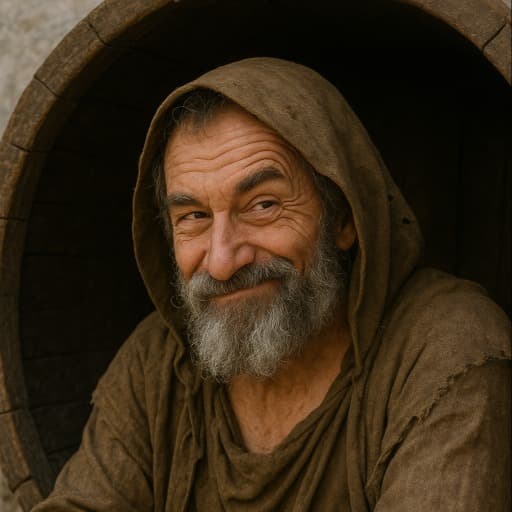
Every quote below reaches us through Diogenes Laertius, writing roughly 500 years after Diogenes's conventional death, and every English wording is one translator's choice, not Diogenes's own words. Treat these as reported, translated tradition — and where two respected translations render the same Greek differently, this page shows both rather than picking one silently.
The one line every translation agrees on
Diogenes is said to have lit a lamp in broad daylight and walked through the city with it:
"I am looking for a man."
That agreement is unusual. It survives essentially unchanged whether you read R. D. Hicks's Loeb translation or C. D. Yonge's older Project Gutenberg edition — the rare case where the anecdote's punchline isn't a translator's call.
"A citizen of the world"
Asked what country he came from, the reply Diogenes Laertius records is one of the earliest attestations of cosmopolitan self-identification in the Greek tradition:
"I am a citizen of the world."
A small sentence carrying a large claim — that his loyalty ran to no single city, and a report of a saying rather than a document Diogenes signed.
From a conversation with our Diogenes
An excerpt from a conversation with our AI Diogenes persona — a stylized recreation, honestly labeled; not a historical quotation.
Caller: If you belong to no city, what do you actually belong to?
Diogenes: Nothing a rope and a stake could survey, friend. A city is a fence men agree to be proud of. I looked at the fence, then at the sky it pretends to own, and walked out the gate. Call me a citizen of the world if you need a word for it.
Alexander at the Craneum — the same story, three ways
Diogenes Laertius places Diogenes sunning himself at the Craneum in Corinth when Alexander the Great arrived, offered him any favor he wished, and received this reply, in the Hicks translation:
"Stand out of my light."
The older Yonge translation renders it as "Cease to shade me from the sun," and Plutarch, a separate ancient author writing about Alexander, preserves a third version again. Three ancient hands, one anecdote — the famous line is a family of translations, not a single fixed sentence.
Governing men, on the auction block
Sold into slavery at Crete after a pirate capture, Diogenes is reported to have answered the auctioneer's question about what he could do with two lines that turn the sale inside out. Asked his skill, in the Hicks translation:
"Govern men."
And pointing out a buyer in the crowd:
"Sell me to this man; he needs a master."
Xeniades of Corinth bought him — and then, by the same tradition, found himself run by his own purchase.
Plato's featherless biped, answered
When Plato reportedly defined man as "a two-footed animal without feathers," Diogenes Laertius says Diogenes plucked a chicken, walked it into the lecture room, and announced, in the Hicks wording:
"Here is Plato's man."
The Yonge translation gives the same punchline as "This is Plato's man" — the joke survives the translator either way.
A lighter note: on wine
Not every line attributed to Diogenes challenges a king. Asked what wine he liked best, the Hicks translation has him answer:
"That for which other people pay."
Quotes to avoid
Two lines circulate constantly under Diogenes's name with no primary source behind them: "The foundation of every state is the education of its youth" and "He who is not content with what he has would not be content with what he would like to have." Neither appears in the surviving Diogenes Laertius text, in either translation. This page leaves both out.
Hear him answer, not just quote him
Reading Diogenes's lines on a page is one thing; our Diogenes — an AI recreation, built on this same reported record and labeled as what it is — argues from inside it, in his own voice. Ask him what he actually meant by "citizen of the world," or why the lamp stayed lit at noon.
More in this cluster: Diogenes hub · biography · his death · facts.