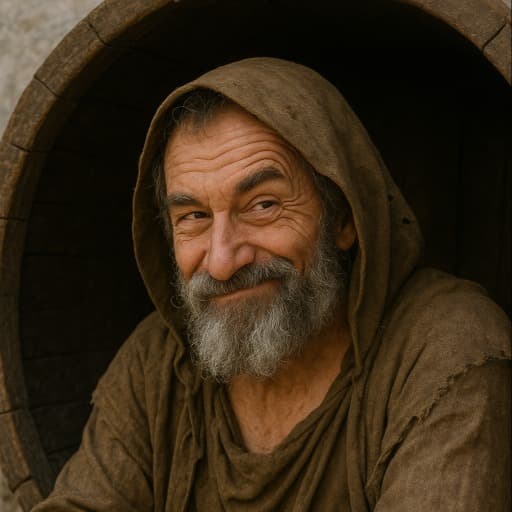
Almost everything known about Diogenes of Sinope comes from Diogenes Laertius, a biographer writing roughly 500 years after Diogenes's conventional death — no contemporary record, only later anecdote. What follows is reported tradition, vivid and often self-contradicting, not verified history. Told that way, the life is still one of the strangest on record: a banker's exiled son who chose homelessness on purpose, was sold as a slave and made it a punchline, and reportedly told the most powerful man alive to get out of his light.
An exile, one way or another
Later tradition places his birth at Sinope, a Black Sea trading city, around 412 to 400 BCE — the sources disagree even on that. His father, Hicesias, worked as a banker or money-changer, and Diogenes is said to have left after a scandal over debased coinage. Diogenes Laertius cannot keep his own story straight: one passage has Diogenes exiled over the affair, another has him privately confessing, in a work called Pordalus, that he adulterated the coins himself. The tradition never resolves which version is true.
Athens and the Cynic turn
Exile reportedly carried him to Athens, where he attached himself to Antisthenes, an older associate of Socrates whose teaching prized virtue as something done, not argued — the seed of the Cynic style Diogenes made famous: philosophy performed in public, stripping away pretense. The Athens years supply the images the legend runs on — discarding his one cup after watching a child drink from cupped hands, taking on hardship deliberately, and living in a pithos, a large ceramic storage jar near the Metroön, not the wooden barrel of popular shorthand.
Sold as a slave, and unbothered by it
Diogenes Laertius reports that pirates captured him at sea and sold him into slavery at Crete. Put up on the block, he is said to have pointed out a buyer and told the auctioneer to sell him there — the man needed a master, and Diogenes was qualified to govern him. Xeniades of Corinth bought him, and the story turns the sale inside out: Diogenes ran the household and tutored Xeniades's sons, technically owned and functionally in charge — the same inversion at work when he is asked what country he is from and answers that he is a citizen of the world, one of the earliest attestations of that claim in the Greek record.
From a conversation with our Diogenes
An excerpt from a conversation with our AI Diogenes persona — a stylized recreation, honestly labeled; not a historical quotation.
Caller: Weren't you humiliated, being sold on the block like that?
Diogenes: Humiliated by what — a price tag? A sheep does not blush when it is weighed. They asked what I was good for, and I told the truth: governing men, more than the fool who bought me could do for himself. He owned my body for an afternoon. I ran his house on my terms until the day I died. Tell me plainly — which one of us was the slave?
Corinth, Alexander, and the years after
Later years, by tradition, settled him in and around Corinth with Xeniades. There Diogenes Laertius places the meeting most people ask about: Alexander the Great finds Diogenes at the Craneum and offers him any favor he names. The reported reply asks for one thing — to stop blocking the sun. A separate ancient account of the same encounter, via Plutarch, gives the line slightly different wording, a reminder that even his most famous story survives only as retellings, not a transcript. His death, also placed at Corinth, gets the same treatment: multiple incompatible accounts rather than one settled ending — a problem serious enough for its own page.
Continue the conversation — literally
You have just read the reported life, hedged the way honest history of Diogenes has to be. Our Diogenes — an AI recreation, built on that record and labeled as what it is — argues from inside it. Ask him about the jar, the discarded cup, or why he thinks Alexander was the poorer man that day. He answers the way the sources say he talked: blunt, unbothered, and looking for an honest reply.
More in this cluster: Diogenes hub · his death · verified quotes · facts.