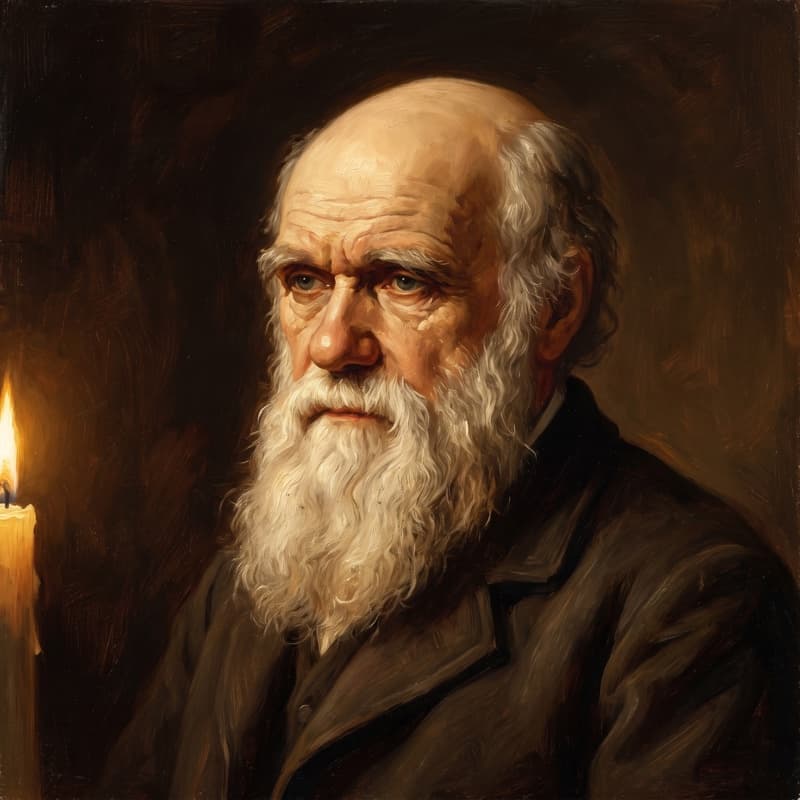
The essential Charles Darwin facts: born February 12, 1809, in Shrewsbury; sailed as naturalist aboard HMS Beagle, December 1831 to October 1836; married his first cousin Emma Wedgwood in January 1839; published On the Origin of Species on November 24, 1859, and The Descent of Man in 1871; died at Down House on April 19, 1882, and was buried in Westminster Abbey near Sir Isaac Newton. This page keeps the facts worth remembering — and flags the popular "facts" that don't survive checking.
The core facts, with why they matter
Born February 12, 1809, in Shrewsbury. Son of the physician Robert Darwin, he began medical studies at Edinburgh in 1825 but couldn't stomach surgery, moving instead to Christ's College, Cambridge, toward a career in the church (BA, 1831) — a path he never walked. He later called himself "a very ordinary boy" in school.
HMS Beagle sailed for nearly five years, December 27, 1831, to October 2, 1836. The voyage supplied the fossils and specimens — Patagonia, the 1835 Concepción earthquake, the Galápagos — Darwin spent his career working through.
Married Emma Wedgwood, his first cousin, on January 29, 1839. They raised ten children, most of them at Down House, their home from 1842 onward (the first two were born in London before the move).
Twenty years passed between the idea and the book. Darwin opened his first notebook on the transmutation of species in 1837. By January 1844, writing to the botanist Joseph Hooker, he was already "almost convinced" species were not fixed — a conclusion he likened to "confessing a murder." On the Origin of Species didn't appear until 1859; roughly eight of those years went to a taxonomic monograph on barnacles before he felt entitled to publish on species at all — patience, not hesitation.
The Wallace hinge, 1858. A letter from Alfred Russel Wallace, sketching an independently derived theory of natural selection, arrived from the Malay Archipelago. Rather than a priority dispute, Lyell and Hooker arranged for papers by both men to be read jointly at the Linnean Society — Origin followed within about a year.
Died April 19, 1882, at Down House, Downe, Kent, and buried in Westminster Abbey's north aisle, near Newton — a national honor his family said he hadn't personally sought; he reportedly preferred a quiet burial at Downe.
From a conversation with our Darwin
An excerpt from our AI Darwin persona — a stylized recreation, honestly labeled; not a historical quotation.
Caller: Once you had the idea, why sit on it for twenty years?
Darwin: Because an idea is cheap, and I distrust cheap things. I spent the better part of a decade on barnacles alone before I trusted myself to say anything larger. What I had, slowly, was evidence — and the stubbornness to keep collecting it after I already believed I was right.
Popular "facts" that need correcting
"Darwin coined 'survival of the fittest.'" He didn't — the phrase belongs to Herbert Spencer. Darwin adopted it only in Origin's fifth edition (1869), always crediting it as Spencer's term.
"Origin sold out on its publication day." Overstated. The 1,250-copy print run was largely taken up by the book trade at a dealers' sale a couple of days before the November 24, 1859, publication date — not sold to the public in a single day.
"Darwin recanted evolution on his deathbed." No contemporary evidence supports it. The story surfaced in print 33 years after his death, denied by the children who were actually present.
"Darwin stole natural selection from Wallace." He'd been drafting the theory since 1842, substantially worked out by January 1844 — years before Wallace's letter arrived. Their papers were presented jointly, by arrangement, not dispute.
The fact pages can't hold him
Facts are the skeleton; the voice is the man. Our Darwin — an AI recreation, built from the sourced record and labeled as what it is — can tell you about the Beagle years, or the barnacles that cost nearly a decade. He's ready when you are.
More in this cluster: Darwin hub · his death · verified quotes · biography.