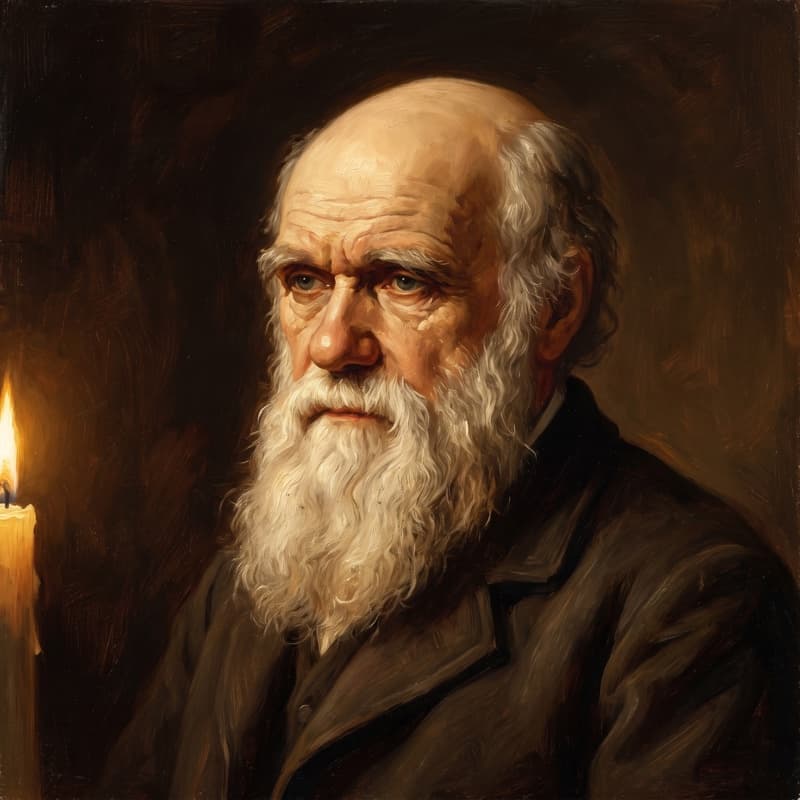
Charles Darwin's most quotable lines were not written for posters. They come from private letters to friends, the closing pages of a book he spent twenty years working up the nerve to publish, and a family memoir he never meant strangers to read. Read together, they show a mind more doubtful and patient than the "confident genius" version of Darwin that circulates online — a version that comes with its own crop of fake quotes, covered below.
1844: Confessing a murder
Fifteen years before On the Origin of Species appeared, Darwin had already worked out the core of his theory — and was frightened enough by it to describe the realization to his closest scientific confidant, the botanist Joseph Hooker, as something close to a crime:
"At last gleams of light have come, & I am almost convinced (quite contrary to opinion I started with) that species are not (it is like confessing a murder) immutable."
That parenthetical explains why Darwin sat on the idea for two more decades before publishing it.
1860: The theological letter to Asa Gray
Writing to the American botanist Asa Gray the year after Origin appeared, Darwin laid out, more openly than almost anywhere else, why he could not reconcile a benevolent, all-powerful design with what he had actually observed in nature:
"There seems to me too much misery in the world."
"I cannot persuade myself that a beneficent & omnipotent God would have designedly created the Ichneumonidæ with the express intention of their feeding within the living bodies of caterpillars, or that a cat should play with mice."
Then, in the same letter, comes his most quoted statement of intellectual humility:
"I feel most deeply that the whole subject is too profound for the human intellect. A dog might as well speculate on the mind of Newton."
He closes the thought without resolving it:
"Let each man hope & believe what he can."
Read together, the four lines refuse both easy faith and easy certainty.
The science, in his own published words
Two lines from On the Origin of Species (1859) carry the actual argument. First, the mechanism of scarcity that sets natural selection in motion:
"Hence, as more individuals are produced than can possibly survive, there must in every case be a struggle for existence."
And Darwin's own definition of the process he named, from the same book:
"This preservation of favourable variations and the rejection of injurious variations, I call Natural Selection."
The book's final paragraph is the closest Darwin came to poetry:
"There is grandeur in this view of life, with its several powers, having been originally breathed into a few forms or into one; and that, whilst this planet has gone cycling on according to the fixed law of gravity, from so simple a beginning endless forms most beautiful and most wonderful have been, and are being, evolved."
On himself: the "very ordinary boy"
Darwin's Autobiography, written in 1876 for his family, shows the same self-deprecation as his letters. Recalling his schooldays at Shrewsbury:
"I believe that I was considered by all my masters and by my father as a very ordinary boy, rather below the common standard in intellect."
The gambler
Not everything Darwin wrote was heavy. In 1863, gripped by a conviction that orchid seeds might live as parasites on mosses and lichens in their earliest growth — he had planted some on sphagnum and was begging Hooker to have tropical mosses scraped off the hothouse trees at Kew and sent to him — he added:
"I am like a gambler, & love a wild experiment."
A line he probably said — but didn't write
One more line is worth including, clearly labeled: the zoologist E. Ray Lankester recalled Darwin telling him, "I love fools' experiments. I am always making them." It is not from a letter or manuscript in Darwin's own hand, so treat it as a secondhand recollection, not a documented quotation on the same footing as the lines above.
Quotes Darwin never said
- "It is not the strongest of the species that survives, nor the most intelligent, but the one most responsive to change." Not Darwin. Quote Investigator traces this to Leon C. Megginson, a business professor paraphrasing Darwin's ideas in his own words in a 1963 speech; over subsequent decades the paraphrase drifted into a direct Darwin attribution.
- "Survival of the fittest" as Darwin's own coinage. The phrase belongs to Herbert Spencer. Darwin did not use it himself until the fifth edition of Origin (1869), where it appears in a chapter heading as a synonym for natural selection — not as his original term.
Notice the pattern: the fakes are tidy maxims. The real Darwin, above, is almost always mid-doubt — testing an idea, or admitting he can't fully resolve it.
From a conversation with our Darwin
An excerpt from our AI Darwin persona — a stylized recreation, clearly labeled; not a historical quotation.
Caller: Weren't you afraid people would laugh at you?
Darwin: Laughter I could have borne, friend — I was afraid I was right. There is a particular dread in watching a fact arrange itself in front of you when you did not ask it to. Twenty years I kept my confession in a drawer, adding evidence the way another man might add locks to a door. In the end the drawer got the better of me. Facts generally do.
Hear him work through it himself
Our Darwin — an AI recreation of the man, honestly labeled — argues the way the letters above suggest he actually did: cautiously, self-doubtingly, more interested in the next piece of evidence than in sounding certain. Ask him about the Ichneumonidae letter, why he waited twenty years to publish, or what "survival of the fittest" actually meant to him.
More in this cluster: Darwin hub · his death · biography · facts.