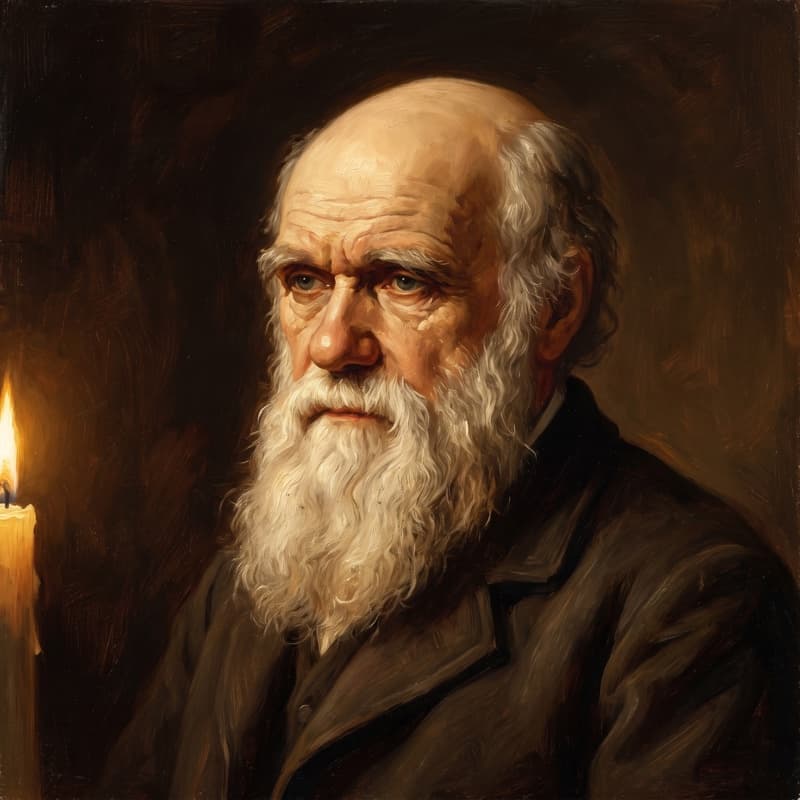
Charles Darwin died on April 19, 1882, at Down House, his home in Downe, Kent (Westminster Abbey; Darwin Correspondence Project). He had been unwell for decades — recurrent vomiting, heart palpitations, exhaustion no doctor ever managed to name or agree on. There was no single dramatic crisis; the record shows a chronically fragile man whose body finally gave out at home. That's the plain answer. What came before it, and a myth that grew up after it, are worth a few minutes.
A harder loss, thirty years earlier
If you are looking for the death that actually reshaped Darwin's life, it isn't his own. In 1851, his ten-year-old daughter Anne Elizabeth — "Annie" — died at midday on April 23, at Malvern, during a course of hydrotherapy treatment her parents had hoped would help her (Darwin Correspondence Project). Annie's death is widely discussed as a turning point in Darwin's relationship to orthodox religious belief; the pain of it is visible even indirectly, in a letter nine years later to the botanist Asa Gray about how a benevolent, all-powerful God could allow the suffering he saw in nature: "There seems to me too much misery in the world" (Darwin Correspondence Project). His own death in 1882 was quiet by comparison. Annie's was the one that left a mark on the record.
The burial he didn't ask for
Darwin's own preference, by the account preserved at Westminster Abbey, was a quiet churchyard burial near Downe. Colleagues and friends petitioned instead for a national funeral, and the request was granted (Darwin Correspondence Project). He was buried on April 26, 1882, in the north aisle of Westminster Abbey's nave, near Sir John Herschel and a few feet from Sir Isaac Newton (Westminster Abbey) — a scale of public honor set against the guarded, decades-long private phase in which he'd first worked the theory out, confiding to a friend in 1844 that admitting he doubted species were fixed felt "like confessing a murder" (Darwin Correspondence Project).
The deathbed story that isn't true
No, Darwin did not recant evolution or convert to Christianity on his deathbed. That claim comes from Elizabeth "Lady Hope" Cotton, who published an account decades after his death describing a visit and a recantation. His children — present in his final days — denied it outright, and Lady Hope's own timeline doesn't hold up: any visit she made to Down House came months before Darwin was bedridden, not during his final illness (Darwin Correspondence Project).
On the illness itself, resist a tidy modern diagnosis. Various retrospective explanations for Darwin's decades of symptoms have been proposed, but the contemporary record — what his doctors observed and tried, not a modern label — is what actually survives, and it doesn't settle the question on its own.
From a conversation with our Darwin
An excerpt from a conversation with our AI Darwin persona — a stylized recreation, honestly labeled, not a historical quotation.
Caller: Were you afraid of what would happen to your ideas after you were gone?
Darwin: Anxious, perhaps, the way a man is anxious about a hypothesis he can no longer test himself. I spent so many years gathering evidence before I dared publish a word of it that I trusted the method more than I trusted myself. If the facts hold, they will go on holding without my supervision. If they don't, no amount of worrying from the churchyard will save them. I'd rather have left more specimens than opinions about my own importance.
Related pages
Darwin hub · verified quotes and misattributions · biography · fact file.