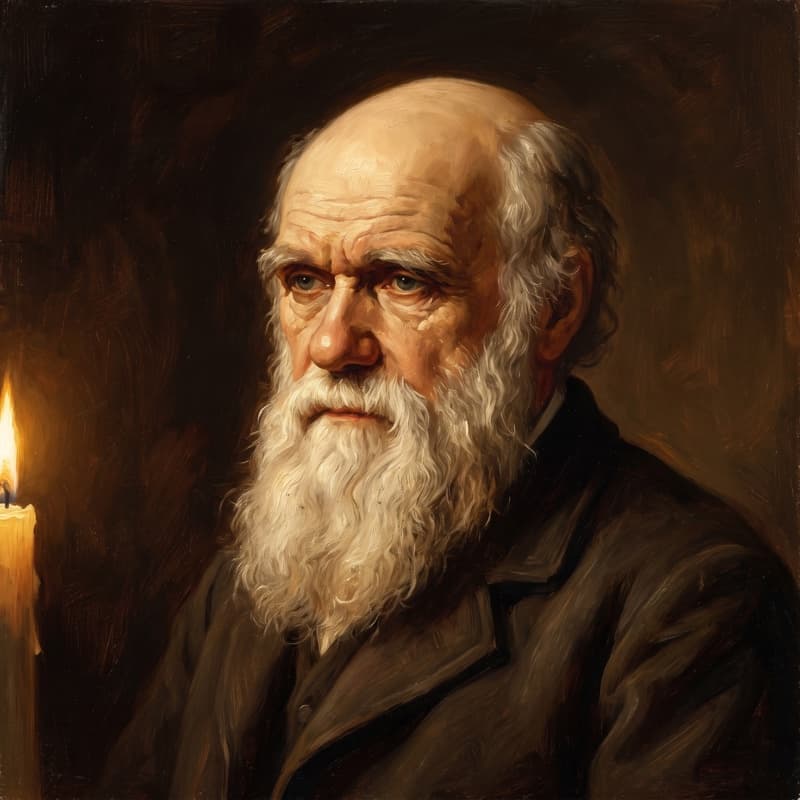
Charles Robert Darwin was born on February 12, 1809, in Shrewsbury, England, and died on April 19, 1882, at Down House in Kent — the naturalist whose patient accumulation of evidence made the case for evolution by natural selection. Between those two houses lies a life built less on one flash of insight than on decades of unglamorous work: specimens collected, notebooks kept, and a theory held privately for years before he considered it ready to defend.
An ordinary boy, by his own account
Darwin later wrote that his teachers and his own father considered him "a very ordinary boy, rather below the common standard in intellect." He began medical studies at Edinburgh in October 1825, following his older brother Erasmus, but could not tolerate the sight of surgery. He left medicine for Christ's College, Cambridge, drifting toward a degree aimed at the clergy, and took his BA in 1831. Nothing here points toward what came next.
From a conversation with our Darwin
An excerpt from a conversation with our AI Darwin persona — a stylized recreation for readers, not a historical quotation.
Caller: Your own teachers called you ordinary. Did that sting?
Darwin: It did, though it served me in the end. A boy told he is unremarkable stops performing cleverness and simply looks — at beetles, at rocks, at whatever is in front of him. My real gift was patience, and no schoolmaster grades for that.
Five years on the Beagle
In August 1831, Darwin was offered the post of naturalist aboard HMS Beagle. The ship sailed from Plymouth on December 27, 1831, and did not return until October 2, 1836 — nearly five years collecting specimens and field notes, including material from the Galápagos Islands that mattered far more in hindsight than it seemed at the time.
Notebooks, marriage, and a confession
Back in England, Darwin opened his first notebook on the transmutation of species in 1837. He married his first cousin Emma Wedgwood on January 29, 1839, and the family settled at Down House, raising ten children. In a letter to the botanist J. D. Hooker on January 11, 1844, he admitted how far his thinking had gone: "At last gleams of light have come, & I am almost convinced (quite contrary to opinion I started with) that species are not (it is like confessing a murder) immutable." He sat on that conviction another fifteen years, spending roughly eight of them, mid-1840s to 1854, on a taxonomic monograph on barnacles before he felt entitled to publish on species at all. In 1851, ten-year-old daughter Annie died at Malvern — a loss tied to Darwin's later drift from orthodox religious belief.
The Wallace letter and On the Origin of Species
In 1858, a letter arrived from Alfred Russel Wallace, writing from the Malay Archipelago with an independently derived sketch of natural selection. Rather than a priority dispute, Lyell and Hooker arranged a joint reading of both men's papers at the Linnean Society. On the Origin of Species followed, published in London by John Murray on November 24, 1859, setting out the argument Darwin had quietly assembled for two decades: "This preservation of favourable variations and the rejection of injurious variations, I call Natural Selection."
Later years and death
Darwin kept working after Origin — orchids, earthworms, and, in The Descent of Man (1871), the extension of his argument to human descent and sexual selection. Chronic illness dogged him for most of his adult life. He died at Down House on April 19, 1882, and — despite reportedly wanting a quiet burial nearby — was interred in Westminster Abbey's north aisle, near Sir Isaac Newton, after fellow scientists campaigned for the honor.
Continue the conversation — literally
You have just read the recorded life. Our Darwin — an AI recreation, built on the sourced record and labeled as what it is — speaks from inside it. Ask him about the barnacles, or why he sat on his theory for fifteen years. He answers the way the record suggests he spoke: patient, self-doubting, and precise.
More in this cluster: Darwin hub · his death · verified quotes · facts.