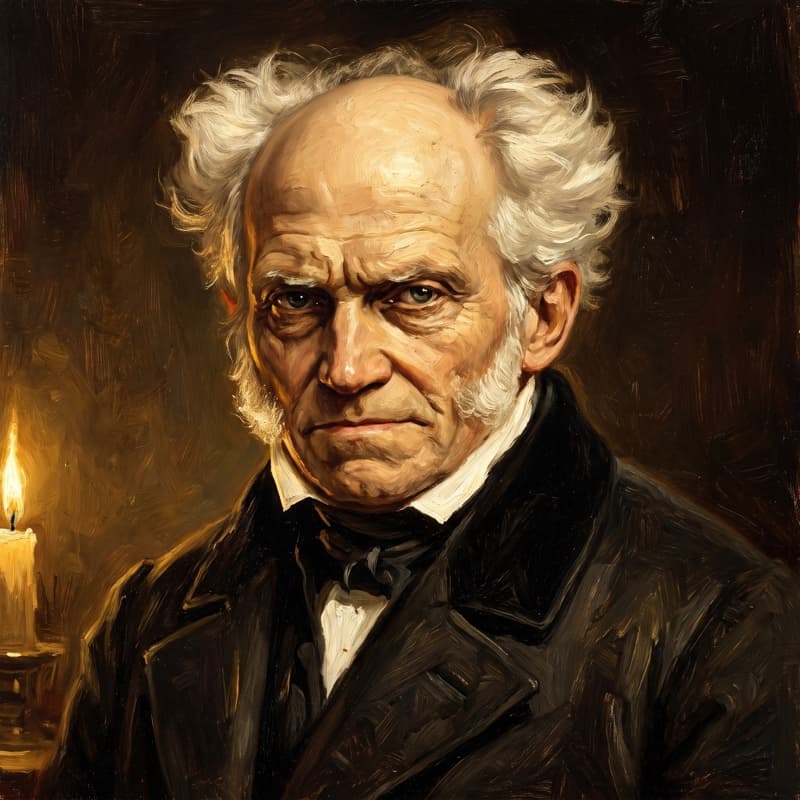
Arthur Schopenhauer was born on February 22, 1788, in Danzig, and died on September 21, 1860, in Frankfurt am Main, at seventy-two. Between those two cities sits a life that spent its first half being groomed for a countinghouse and its second half writing philosophy almost nobody read until the very end. "The world is my idea" — the opening line of his life's work — was also, in a sense, his revenge on the career he was supposed to have instead.
A merchant's son, a novelist's son
Schopenhauer's father, Heinrich Floris Schopenhauer, was a Danzig merchant and shipowner; his mother, Johanna Henriette Schopenhauer, went on to become a celebrated novelist and salon hostess. In 1793, when Danzig fell under Prussian annexation, the family relocated to Hamburg, and a decade later, as a teenager on a family tour of Europe, young Arthur spent time at an Anglican boarding school in Wimbledon. He was being prepared, deliberately, for trade.
That plan ended on April 20, 1805, when his father died in Hamburg, possibly by suicide. Arthur was seventeen. The death was a private catastrophe and, in the long run, a professional liberation: freed from the mercantile path, he turned toward the university instead.
Göttingen, Berlin, and a doctorate no one attended
In 1809 he entered the University of Göttingen, beginning in medicine before turning to philosophy. From 1811 to 1813 he studied at the University of Berlin, sitting in on lectures by Fichte and Schleiermacher, and in 1813 he received his doctorate in absentia from the University of Jena for The Fourfold Root of the Principle of Sufficient Reason. Five years later the real work arrived: The World as Will and Representation was published in December 1818, carrying an 1819 title page. It laid out the whole architecture that would occupy him for the rest of his life — the world as it appears to a knowing subject, and the will that drives beneath it. Almost nobody read it.
In 1820, still hoping for an academic audience, he tried lecturing at the University of Berlin — and scheduled his course at the same hour as Hegel's. The benches were nearly empty. It is one of philosophy's better-known professional humiliations, and Schopenhauer never really got another shot at a university chair.
The long Frankfurt exile
The following years brought a Berlin lawsuit — a 1821 altercation with a seamstress named Caroline Luise Marquet dragged through the courts until 1827, when he was ordered to pay her a pension for the rest of her life — and, in June 1833, a permanent move to Frankfurt am Main. He lived there, eventually settling at Schöne Aussicht 17 from 1843 to 1859, for the rest of his days, keeping a succession of poodles all named Atman.
Recognition, when it came, arrived slowly. In 1839 his essay On the Freedom of the Will won a prize from the Royal Norwegian Society of Sciences; in 1841 it was published alongside The Basis of Morality as The Two Fundamental Problems of Ethics. The real turn came in 1851, with the publication of Parerga and Paralipomena, and then in 1853, when John Oxenford's favorable notice in the Westminster Review introduced him to a much wider public. Fame reached him in his sixties, decades after the book that deserved it.
He died in Frankfurt on September 21, 1860, and was buried at the Frankfurt Hauptfriedhof, leaving much of his estate to a Prussian fund for soldiers disabled — and the families of soldiers killed — suppressing the revolutions of 1848: an oddly institutional final gesture from the philosopher who had spent his life arguing that compassion, not doctrine, was the true basis of morality.
Continue the conversation
Ask our Schopenhauer persona about the father he lost at seventeen, the empty lecture hall in Berlin, or what it meant to become famous only after four decades of being ignored.
More in this cluster: Schopenhauer hub · verified quotes · facts.