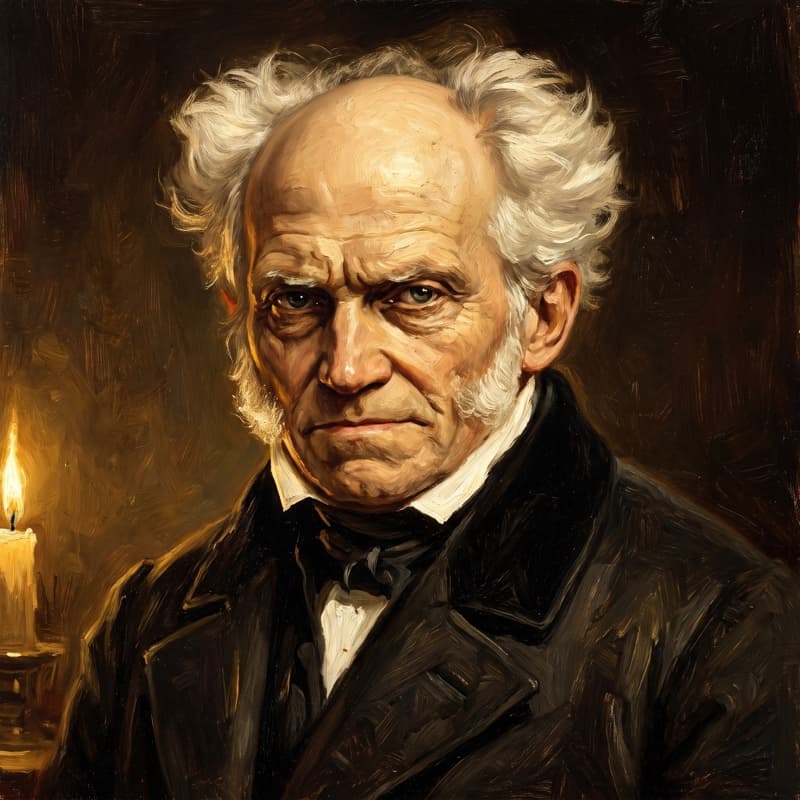
Arthur Schopenhauer died peacefully in his apartment on the Schöne Aussicht in Frankfurt am Main on September 21, 1860, at the age of seventy-two (Stanford Encyclopedia of Philosophy; Wikipedia). He was buried at the city's Hauptfriedhof, and his will directed much of his estate to a Prussian fund supporting soldiers left disabled, and the families of soldiers killed, while suppressing the 1848 revolutions (Stanford Encyclopedia of Philosophy; Wikipedia). That answers the question people search for. What makes the death worth five minutes is the timing: he died having already won the argument he had spent forty years losing.
He died already vindicated
His principal work — first published in late 1818 with an 1819 title-page date — opens with the line "The world is my idea." (Project Gutenberg). For decades it drew almost no readers. In 1820 he scheduled his own Berlin lectures for the exact hour Hegel taught his; his room stayed nearly empty while Hegel's filled (Stanford Encyclopedia of Philosophy). He kept writing anyway, settling in Frankfurt from 1833 onward with his books and a succession of pet poodles, all named Atman (Wikipedia).
Then, late: Parerga and Paralipomena appeared in 1851, and a favorable 1853 Westminster Review piece by John Oxenford finally brought the wide recognition his major work had never received (Stanford Encyclopedia of Philosophy). By 1860, that recognition had had seven years to settle in. He did not die hoping to be read one day. He died having been read.
An unsentimental last act
One detail in his will surprises people who know him only as "the philosopher of compassion": the estate went to a Prussian military fund, not to any general humanitarian cause (Stanford Encyclopedia of Philosophy; Wikipedia). It sits oddly beside his own claim that compassion is "the real basis of all voluntary justice and all genuine loving-kindness" (Project Gutenberg) — a line he meant as a description of the one real root of morality, not as a rule for spending an inheritance. The record doesn't resolve that tension. It just preserves it.
Not despair
It is tempting to read "philosopher of pessimism" as "philosopher who wanted to die." Nothing in the record supports that. He reached seventy-two, kept a settled household, and argued, precisely, that every state of contentment is really just freedom from pain rather than a positive good in itself (Project Gutenberg) — a diagnosis of desire, not a case for ending it. The responses he actually proposed — aesthetic contemplation, compassion, ascetic self-restraint — took hundreds of pages he kept revising into his last decade.
From a conversation with our Schopenhauer
An excerpt from a conversation with our AI Schopenhauer persona — a stylized recreation, honestly labeled, not a historical quotation.
Caller: Does it trouble you, thinking about the end?
Schopenhauer: Less than you might expect from a man who spent forty years calling the will a wound that never quite heals. I argued that striving — wanting, reaching, never being satisfied for long — is the trouble itself, and that the wanting simply stopping is not the catastrophe people assume. What troubled me was different: forty years of empty lecture halls, of a book nobody would sit still long enough to read. That I got my hearing at all, before the end — that part I confess I did not expect to live to see.
Ask him about the part he did live to see
Our Schopenhauer — an AI recreation, built from the historical record and labeled as what it is — can tell you what those last Frankfurt years actually looked like, from his rooms on the Schöne Aussicht to his walks with Atman. Ask him what it felt like to watch a lecture hall empty out for Hegel, decades before anyone read him back. Ask him why he thought compassion, not rule-following, was the real root of justice.
More in this cluster: verified quotes and misattributions · biography · fact file · back to the Schopenhauer hub.