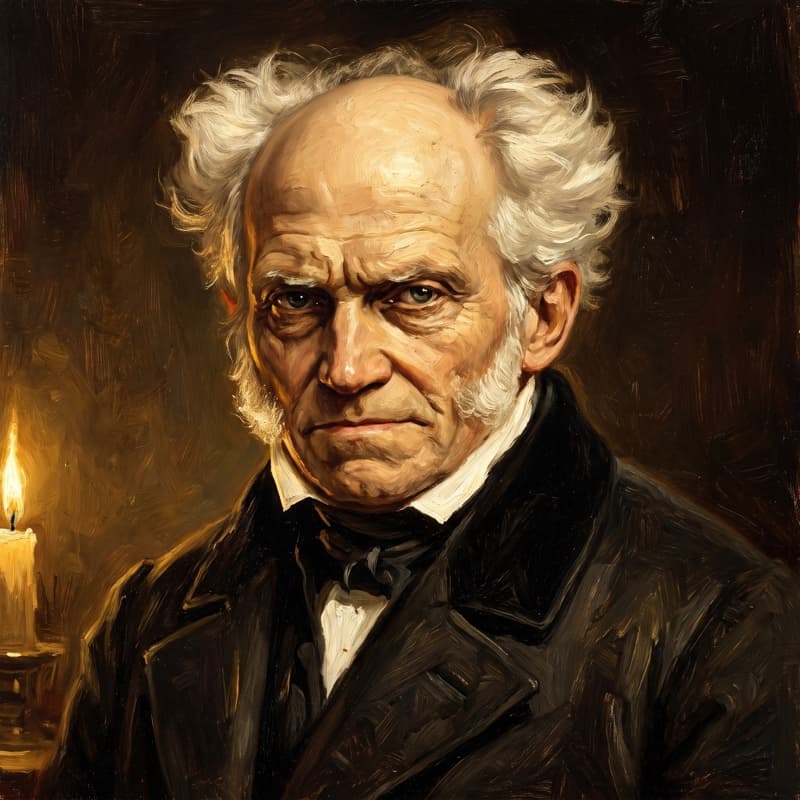
Arthur Schopenhauer's most quoted line is also his shortest: "The world is my idea." Everything else he wrote argues what that sentence costs you. Below: his verified words, sourced to the original translations — plus the famous line he never wrote.
The opening claim
"The world is my idea."
Everything anyone experiences, he argues, comes to them as representation first; the rest of his philosophy asks what lies beneath it, and what living costs once you've seen that.
The World as Will and Idea, Vol. 1, trans. R. B. Haldane and J. Kemp, §1 (Project Gutenberg)
The diagnosis: pleasure is the absence of pain
"Every state of welfare, every feeling of satisfaction, is negative in its character; that is to say, it consists in freedom from pain, which is the positive element of existence."
("On the Sufferings of the World," in Studies in Pessimism, trans. T. Bailey Saunders, Project Gutenberg)
The response: compassion, not indifference
Readers who stop here miss the system's answer. Schopenhauer names compassion, not resignation, as the one truly moral motive:
"It is this Compassion alone which is the real basis of all voluntary justice and all genuine loving-kindness."
"Boundless compassion for all living beings is the surest and most certain guarantee of pure moral conduct, and needs no casuistry."
(The Basis of Morality, trans. Arthur Brodrick Bullock, Chapters V and VIII, Project Gutenberg — "all living beings," not just people)
Practical wisdom: health, inner wealth, solitude
From The Wisdom of Life, Chapter II, trans. T. Bailey Saunders (Project Gutenberg):
"Health outweighs all other blessings so much that one may really say that a healthy beggar is happier than an ailing king."
"The more a man has in himself, the less he will want from other people,—the less, indeed, other people can be to him."
The noise essay
His essay "On Noise" opens with this:
"Kant has written a treatise on The Vital Powers; but I should like to write a dirge on them, since their lavish use in the form of knocking, hammering, and tumbling things about has made the whole of my life a daily torment."
Then states the underlying claim directly:
"This is why the most eminent intellects have always been strongly averse to any kind of disturbance, interruption and distraction, and above everything to that violent interruption which is caused by noise."
("On Noise," in Essays of Schopenhauer, trans. Mrs. Rudolf Dircks, Project Gutenberg)
A quote he never wrote
Credited to Schopenhauer constantly: "All truth passes through three stages: first, it is ridiculed; second, it is violently opposed; third, it is accepted as self-evident." It isn't in his published work. Researchers who checked with Schopenhauer scholars found no trace of it, tracing the popular wording to a 1981 newspaper interview — decades after his death — with the same template also wrongly pinned on Shaw, Huxley, William James, and Arthur C. Clarke (documented here).
A related case: "the amount of noise which anyone can bear undisturbed stands in inverse proportion to his mental capacity" is not found verbatim in "On Noise." His actual sentence is the one above, about eminent intellects and disturbance — close in spirit, not in wording.
From a conversation with our Schopenhauer
An excerpt from our AI Schopenhauer persona — a stylized recreation, clearly labeled; not a historical quotation.
Caller: People quote you saying truth always wins in the end. Did you believe that?
Schopenhauer: I never wrote the line they hang on me — go and look, it isn't there. What I did write is harder to embroider on a cushion: satisfaction is only the brief absence of pain, and compassion, not optimism, is the one honest motive left to us. Go be kind to something anyway. That much I meant.
Read him carefully, then hear him argue
Quote cards flatten Schopenhauer into doom or a dog-loving eccentric. The primary texts show a system: the diagnosis of desire, the argument for compassion, and practical wisdom sitting beside the pessimism. Ask our Schopenhauer why compassion survives it — he argues sentence by sentence, not slogan by slogan.
More in this cluster: Schopenhauer hub · his biography · facts.