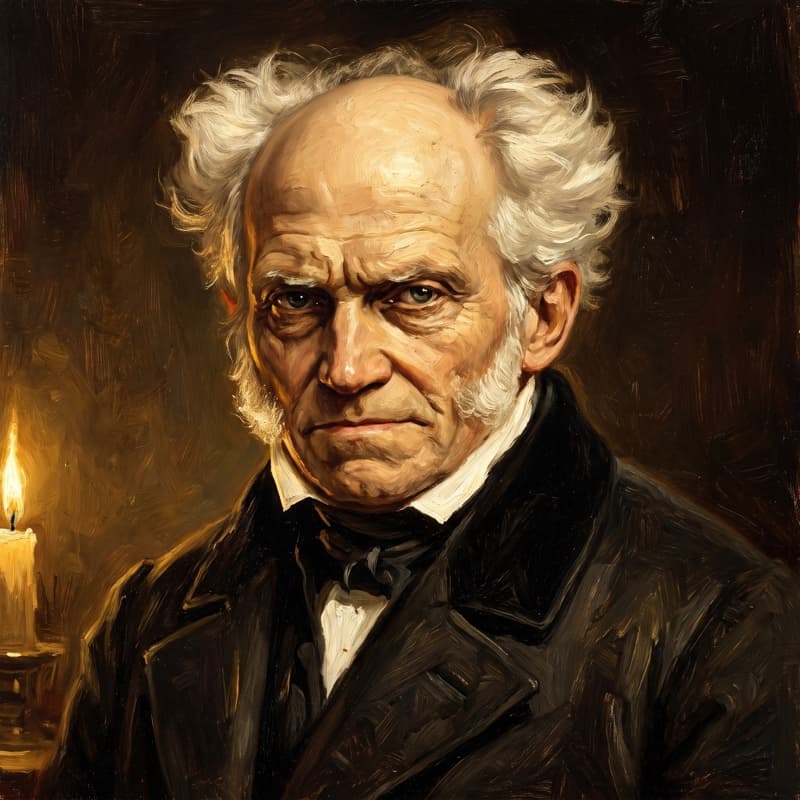
Every fact here is checked against a primary text, the Stanford Encyclopedia of Philosophy, or Wikipedia, with the citation shown inline. Short version: born February 22, 1788, in Danzig; died September 21, 1860, in Frankfurt, at 72; studied at Göttingen and Berlin before taking a Jena doctorate in absentia; published The World as Will and Representation in 1818; spent decades in relative obscurity before Parerga and Paralipomena (1851) brought late fame. Details below, followed by corrections to claims that circulate as his but aren't.
Verified facts
- Born February 22, 1788, in Danzig; died September 21, 1860, in Frankfurt, at 72 (Stanford Encyclopedia of Philosophy).
- His father, Heinrich Floris Schopenhauer, died in a Hamburg canal in 1805, in what the family believed was suicide, freeing 17-year-old Arthur from an intended career in the family trading business (Wikipedia).
- He entered the University of Göttingen in 1809 (medicine, then philosophy), then studied at Berlin from 1811 to 1813 under Fichte and Schleiermacher (Stanford Encyclopedia of Philosophy; Wikipedia).
- He received his doctorate from the University of Jena in 1813, in absentia, for The Fourfold Root of the Principle of Sufficient Reason (Stanford Encyclopedia of Philosophy).
- In 1820 he scheduled his Berlin lectures at the same hour as Hegel's. Hegel, already established, drew the crowds; Schopenhauer's course drew almost no students (Stanford Encyclopedia of Philosophy).
- In August 1821 Berlin seamstress Caroline Luise Marquet sued him over an altercation at his apartment entrance; the case dragged on until 1827, when a court found him liable and ordered a pension paid to her until her 1842 death (Wikipedia).
- He settled permanently in Frankfurt in June 1833, remaining there for the rest of his life, sharing his rooms with a succession of pet poodles named Atman (one also recorded as Butz) (Stanford Encyclopedia of Philosophy; Wikipedia).
- His prize essay On the Freedom of the Will won the Royal Norwegian Society of Sciences competition in 1839; he published it in 1841 with The Basis of Morality as The Two Fundamental Problems of Ethics (Stanford Encyclopedia of Philosophy).
- Real fame arrived only after Parerga and Paralipomena (1851), helped by a favorable 1853 Westminster Review piece by John Oxenford; he later willed part of his estate to a Prussian fund for soldiers disabled suppressing the 1848 revolutions (Stanford Encyclopedia of Philosophy).
Claims that circulate, corrected
"All truth passes through three stages: first ridiculed, second violently opposed, third accepted as self-evident." Not Schopenhauer's. A documented source inquiry — including consultation with Schopenhauer scholars — could not locate this wording anywhere in his writings; the popular form traces to a 1981 New York Times interview and The Harper Book of Quotations, and near-identical "stages of truth" lines are misattributed to Shaw, Huxley, William James, and Arthur C. Clarke as well (source inquiry).
"His pessimism means indifference to other people." The opposite of his stated position: he calls compassion "the real basis of all voluntary justice and all genuine loving-kindness," extending it to "all living beings," not just people (The Basis of Morality, trans. Bullock).
"His pessimism is just a recommendation of suicide." A flattening. The World as Will and Representation opens from the claim that "the world is my idea" and builds toward aesthetic contemplation and compassion as responses to suffering, not a single prescriptive act (The World as Will and Idea, trans. Haldane & Kemp).
Two more, quickly answered
Did Schopenhauer own a dog? Yes — a succession of poodles, all named Atman, one also recorded as "Butz" (Wikipedia).
When did fame actually arrive? Not with his 1818 masterwork — with Parerga and Paralipomena in 1851 and Oxenford's 1853 review (Stanford Encyclopedia of Philosophy).
Related pages
Schopenhauer hub · his death · verified quotes · biography.
For what a fact list can't settle — how a Danzig merchant's son talked himself into philosophy, and why the man who called existence a pendulum between pain and boredom still kept a flute and a well-fed poodle — this site hosts a conversational AI recreation of Schopenhauer, grounded in the sources above and labeled plainly as an AI persona.