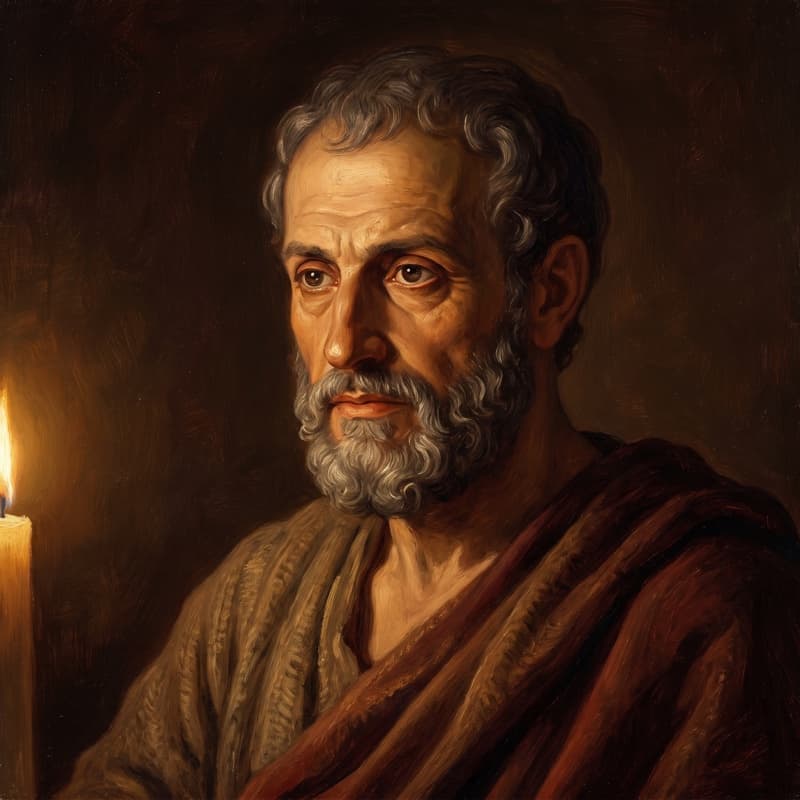
Aristotle (384 BC – 322 BC) was born at Stagira in the Macedonian region of northeastern Greece, the son of Nicomachus, court physician to King Amyntas III of Macedon (Stanford Encyclopedia of Philosophy; Wikipedia). He spent roughly twenty years at Plato's Academy, three years tutoring the future Alexander the Great, and his last twelve working years running his own school, the Lyceum. This biography states only what the record supports, cited throughout.
Stagira to the Academy
Aristotle's household was medical, not philosophical — his father belonged to the Asclepiadae, a guild of physicians, and served the Macedonian court directly (Wikipedia). At about seventeen, he left for Athens and joined Plato's Academy, remaining roughly twenty years, until Plato's death in 347 BC (SEP). Two decades was long enough to absorb Plato's system, and to start diverging from it.
Assos, Lesbos, and a first marriage
When Plato died, Aristotle left Athens for Assos in Asia Minor, then moved to Lesbos, working alongside his colleague Theophrastus on biological and marine research in the lagoon at Pyrrha (SEP). During this period he married Pythias, ward of Hermias of Atarneus; they had a daughter, also named Pythias (Wikipedia).
Tutor to a king's son
In 343 BC, Philip II of Macedon summoned Aristotle from Lesbos to Pella to tutor his thirteen-year-old son, Alexander, later Alexander the Great (SEP). The arrangement lasted only two or three years, ending when Alexander, around sixteen, was made regent of Macedon (SEP).
The Lyceum
Aristotle returned to Athens in 335 BC and founded his own school in a public precinct dedicated to Apollo Lykeios — the Lyceum, whose name gave his followers the label Peripatetics (SEP). Of an estimated two hundred treatises, only about thirty-one survive, mostly as lecture and research notes rather than polished works (SEP; Wikipedia), spanning logic, natural philosophy, biology, ethics, politics, rhetoric, and poetics — still readable in full at the MIT Internet Classics Archive. The Metaphysics states his premise plainly: "ALL men by nature desire to know" (Metaphysics I.1, MIT Classics).
What this biography does not soften
Politics Book I argues that some people are "slaves by nature," contending that those suited by nature to labor with the body should serve as slaves under a master (Politics I.4-5, MIT Classics). That argument sits in the same text as Aristotle's famous claim that "man is by nature a political animal" (Politics I.2, MIT Classics) — a responsible account names both.
Departure and death
Alexander died in 323 BC, and anti-Macedonian feeling surged in Athens. Aristotle, a Macedonian-connected metic — a resident foreigner without citizenship — chose to leave the city rather than risk the fate Socrates had met a generation earlier (SEP). He withdrew to Chalcis on Euboea, his mother's family home, and died there in 322 BC, reportedly of a stomach ailment, at about sixty-two (SEP). No trial, no execution — a self-imposed exile followed by a natural death.
Related pages
Aristotle hub · his death · verified quotes · fact file.
Where the documents stop, a conversation can still start — this site hosts an AI recreation of Aristotle, built on the record above and labeled as exactly that. Fair questions for him directly: what Lesbos taught him that the Academy hadn't, what it was like tutoring a boy who would outgrow every teacher, and how he'd defend — or wouldn't — the argument in Politics I.