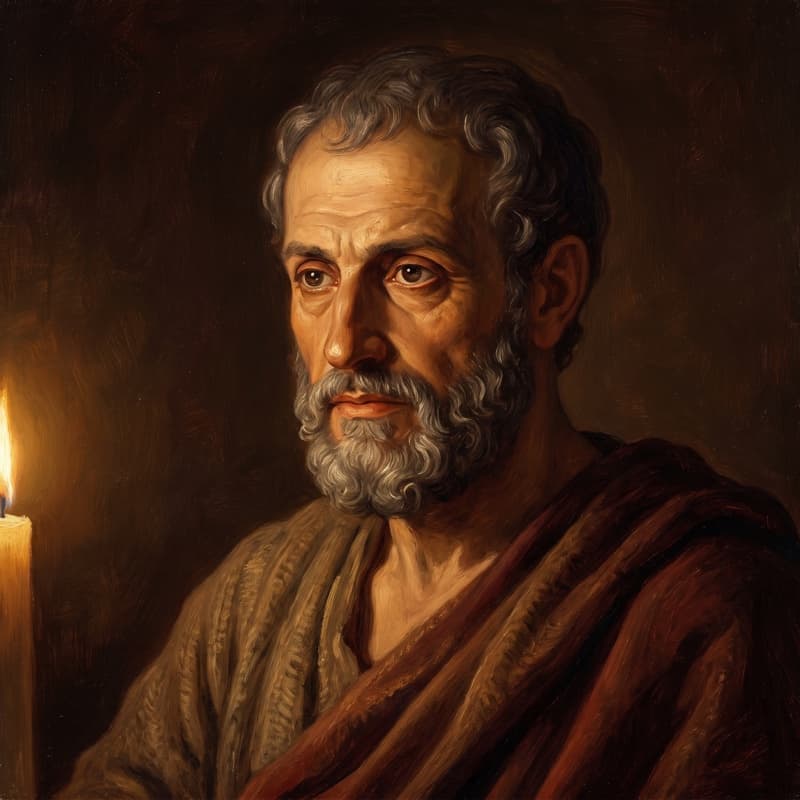
Aristotle's most quoted line is also his shortest: "ALL men by nature desire to know," the opening sentence of the Metaphysics. Everything else attributed to him should be checked against a work, a Bekker number, and a named translator — a striking number of the internet's favorite "Aristotle quotes" are not in his surviving corpus at all. This page gives both lists: the real sentences, and the three fakes that keep getting mistaken for them.
The opening line
Metaphysics I.1, 980a21 (W. D. Ross translation):
"ALL men by nature desire to know."
It is the first sentence of the whole treatise, and it sets the terms for everything Aristotle built afterward: ethics, politics, biology, and rhetoric are all, in his framing, forms of that same desire aimed at different objects.
The ethics cluster: aiming at the good
The Nicomachean Ethics opens by naming the target before it names the virtues:
"Every art and every inquiry, and similarly every action and pursuit, is thought to aim at some good."
A few chapters later, he defines the end of that aiming:
"Happiness, then, is something final and self-sufficient, and is the end of action."
Then comes the mechanism — how a person actually becomes good, which is not by understanding virtue but by doing it:
"Moral virtue comes about as a result of habit."
"For the things we have to learn before we can do them, we learn by doing them, e.g. men become builders by building and lyreplayers by playing the lyre; so too we become just by doing just acts, temperate by doing temperate acts, brave by doing brave acts."
And the definition that follows from that practice, the doctrine now shorthanded as the "golden mean":
"Virtue, then, is a state of character concerned with choice, lying in a mean, i.e. the mean relative to us, this being determined by a rational principle, and by that principle by which the man of practical wisdom would determine it."
(Nicomachean Ethics I.1 1094a1, I.7 1097b20, II.1 1103a17, II.1 1103a32, and II.6 1106b36 — all W. D. Ross's translation, all read in full at the MIT Internet Classics Archive.)
Politics: "a political animal"
From the opening book of the Politics (I.2, 1253a2, Benjamin Jowett's translation), the line that gave English the phrase "political animal":
"Hence it is evident that the state is a creation of nature, and that man is by nature a political animal."
Beyond ethics: poetry, persuasion, and wonder in the kitchen
Aristotle's range shows up outside the ethics and politics texts too. On why poetry is, in his view, more serious than history (Poetics IX, 1451b5):
"Poetry, therefore, is a more philosophical and a higher thing than history: for poetry tends to express the universal, history the particular."
On the discipline he more or less founded (Rhetoric I.2, 1355b25, W. Rhys Roberts's translation):
"Rhetoric may be defined as the faculty of observing in any given case the available means of persuasion."
And from Parts of Animals (I.5, 645a17, William Ogle's translation), the anecdote that best captures Aristotle the working biologist — visitors hesitating outside Heraclitus's kitchen, unimpressed by so humble a setting for a philosopher:
"Heraclitus, when the strangers who came to visit him found him warming himself at the furnace in the kitchen and hesitated to go in, reported to have bidden them not to be afraid to enter, as even in that kitchen divinities were present."
Aristotle tells the story to make a point about his own dissections: nothing observed carefully is beneath philosophy, because "Every realm of nature is marvellous."
From a conversation with our Aristotle
An excerpt from our AI Aristotle persona — a stylized recreation, clearly labeled; not a historical quotation.
Caller: People love quoting you on habit. What did you actually mean?
Aristotle: Not a slogan, friend — a method. I never said virtue was a habit and left it there; I said we become builders by building, and just by doing just acts. You do not reason your way into courage at a desk. You do it badly at first, the way a boy plays the lyre badly, and the doing itself trains the doer. That is not inspiration. That is craft, applied to a life.
Quotes Aristotle never wrote
Three lines circulate constantly under his name. None of them is in his surviving works.
- "We are what we repeatedly do. Excellence, then, is not an act, but a habit." This is Will Durant's own compression of Aristotelian ethics, from his 1926 book The Story of Philosophy — not a sentence Aristotle wrote. The genuine line behind it is "Moral virtue comes about as a result of habit," above (Internet Archive).
- "The whole is greater than the sum of its parts." No such sentence appears in Aristotle's text. Metaphysics VIII.3 argues that a whole is "not, as it were, a mere heap," and is "something beside the parts" — a related idea, but not this slogan, which should never carry his name in quotation marks (MIT Internet Classics Archive).
- "It is the mark of an educated mind to be able to entertain a thought without accepting it." Its earliest known print appearance is Lowell L. Bennion's 1989 book Religion and the Pursuit of Truth — over two thousand years after Aristotle. It likely reworks his real line at Nicomachean Ethics I.3, 1094b24 — "it is the mark of an educated man to look for precision in each class of things just so far as the nature of the subject admits" — which is about calibrating precision, not entertaining opinions (Sententiae Antiquae).
Reading Aristotle instead of harvesting him
Notice what every genuine quote above has in common: a work, a book and chapter, a Bekker number, and a named translator. That is not academic throat-clearing — it is the only way to tell a real sentence from a slogan wearing his name. If a quote floats free of all four, treat it the way Aristotle treated an unexamined claim: worth checking before it is worth repeating.
More in this cluster: Aristotle hub · his death · biography · facts.