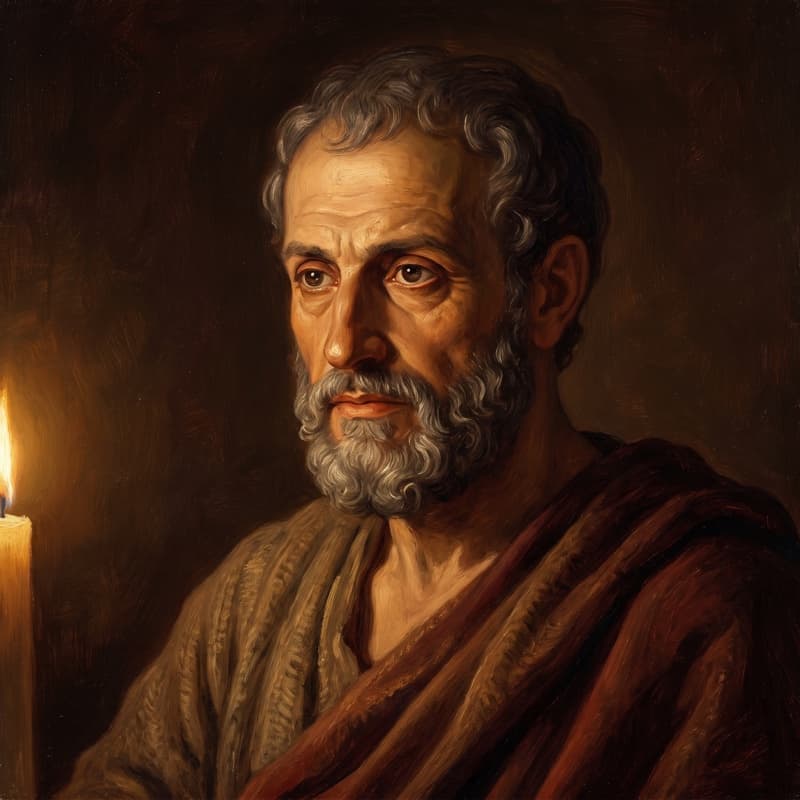
Aristotle died in 322 BC at Chalcis, on the island of Euboea, reportedly of a stomach or digestive ailment. He was about sixty-two. He was not tried, and he was not executed. The year before, Alexander the Great — his former student — had died, and anti-Macedonian feeling surged through Athens. Aristotle, a Macedonian-connected metic (a resident foreigner with no property rights in the city), faced a charge of impiety and chose to leave rather than stand trial. He withdrew to Chalcis, his mother's family home, and died there the following year.
That answers the search. The comparison people reach for is Socrates, and it's worth walking through — because Aristotle's ending was a deliberate rewrite of that precedent, not a repeat of it.
Why Athens turned on him
Aristotle had spent twelve years back in Athens running the Lyceum, the school he founded in 335 BC after twenty years at Plato's Academy and a stint tutoring the young Alexander at Mieza. None of that made him a citizen. As a metic, his standing in Athens depended on the political weather, and his biography was unusually tangled with Macedon: his father had served as court physician to a Macedonian king, and he had personally taught the man who then conquered most of the known world. When Alexander died in 323 BC, Athenian resentment of Macedonian dominance had nowhere else to land.
The charge, and the line tradition attaches to it
The accusation was impiety — the same category of charge Athens had used against Socrates a generation earlier. Later tradition holds that Aristotle explained his decision to leave by saying he would not let Athens "sin twice against philosophy," recalling the city's execution of Socrates. Treat that line as attributed legend rather than a documented quotation: no surviving Aristotelian text records him saying it, and it should never be cited as a sourced quote the way his lines from the Ethics or Politics can be. What is well established is the underlying situation — a foreign-born philosopher, an impiety charge shaped exactly like the one that killed Socrates, and a choice not to test an Athenian jury a second time.
Chalcis, not a cup of hemlock
Where Socrates stayed in Athens, argued his defense, and drank the executioner's hemlock after conviction, Aristotle left the city. He crossed to Chalcis, the same island region where his mother's family had roots, and settled there rather than face a verdict. He died in 322 BC, reportedly of a digestive ailment — a natural death, at home among family land, with no trial and no sentence ever carried out. Ancient biographical tradition also credits his will with freeing several household slaves and providing for his dependents, and credits Theophrastus — his colleague since the Assos and Lesbos years — with inheriting leadership of the Lyceum and access to his library.
From a conversation with our Aristotle
An excerpt from a conversation with our AI Aristotle persona — a stylized recreation, honestly labeled, not a historical quotation.
Caller: Weren't you afraid, leaving Athens behind for Chalcis?
Aristotle: Fear is a passion, friend, and passions are meant to be governed by reason, not obeyed blindly. I had watched what an Athenian jury did to a man who stayed and argued his case on principle. There is no virtue in repeating an experiment once its result is known. Courage is a mean between recklessness and cowardice — and leaving a courtroom that had already decided its verdict in spirit, if not yet on paper, is not cowardice. It is simply arithmetic.
Aristotle's death, in the end, is a story about the limits of citizenship as much as the limits of the body. Ask our Aristotle how he weighed that decision, what he thought the Lyceum owed the city that expelled him, or how a man who spent a lifetime cataloguing virtues judged his own choice to walk away.
More in this cluster: Aristotle's verified quotes · his biography · fact file · back to the Aristotle hub.