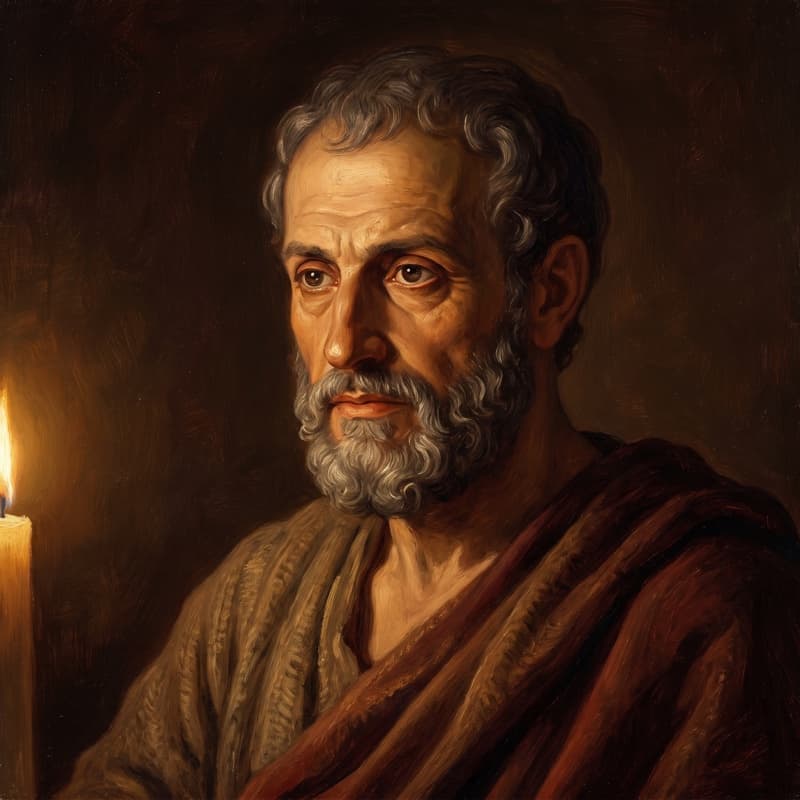
Every Aristotle fact on this page is checked against the Stanford Encyclopedia of Philosophy, Wikipedia, and the surviving texts themselves at the MIT Internet Classics Archive, with each citation shown inline. The short version: born 384 BC at Stagira; roughly twenty years inside Plato's Academy; tutor to the young Alexander the Great; founder of his own school, the Lyceum; author of a corpus of which only about a third survives; died at Chalcis in 322 BC, not by execution. Details and sources below, followed by two claims that circulate as settled fact but need correcting — one about his science, one about his sentences.
Ten verified facts
- Born in 384 BC at Stagira, a small city in the Chalcidice region of northeastern Greece, in Macedon's sphere (Stanford Encyclopedia of Philosophy).
- His father, Nicomachus, was court physician to King Amyntas III of Macedon, part of the Asclepiadae medical guild (Wikipedia).
- At about seventeen he joined Plato's Academy in Athens and stayed roughly twenty years, until Plato's death in 347 BC (Stanford Encyclopedia of Philosophy).
- After Plato died, Aristotle left Athens for Assos and then Lesbos, doing biological and marine research alongside Theophrastus; he married Pythias during these years (Stanford Encyclopedia of Philosophy).
- In 343 BC, Philip II of Macedon summoned him to tutor his thirteen-year-old son at Mieza — the boy who became Alexander the Great. The tutorship lasted roughly two to three years (Stanford Encyclopedia of Philosophy).
- In 335 BC he returned to Athens and founded the Lyceum, a school in a precinct sacred to Apollo Lykeios; his followers were later called Peripatetics (Stanford Encyclopedia of Philosophy).
- Of an estimated 200 treatises, about 31 survive today, most of them lecture and research notes rather than works polished for publication (Stanford Encyclopedia of Philosophy).
- The surviving corpus spans logic, biology, ethics, politics, rhetoric, and poetics — full texts, including the Nicomachean Ethics and Politics, are hosted at the MIT Internet Classics Archive (Politics I).
- In 323 BC, after Alexander's death, anti-Macedonian feeling surged in Athens. Aristotle, a Macedonian-connected resident foreigner, left the city rather than risk trial (Stanford Encyclopedia of Philosophy).
- He withdrew to Chalcis on Euboea and died there in 322 BC, reportedly of a stomach or digestive ailment, at about 62 (Stanford Encyclopedia of Philosophy).
Two claims, corrected
"Aristotle's physics was simply wrong." Not within its own terms. His account of falling bodies describes motion through a resistive medium — air or water — and is "correct within its domain of validity," a distinction popular retellings of the Galileo story usually drop (Wikipedia).
"We are what we repeatedly do. Excellence, then, is not an act, but a habit." This line is not in Aristotle's surviving works. It is Will Durant's twentieth-century compression of Aristotelian ethics from The Story of Philosophy (1926) (Internet Archive). What Aristotle actually wrote, in the Nicomachean Ethics, is that moral virtue comes about as a result of habit — a related but distinct claim, cited with its Bekker reference on the quotes page.
One more fact worth stating plainly rather than passing over: Politics I.4–7 argues that some people are "slaves by nature." It is a historically significant and ethically indefensible part of the text, and a responsible overview names it rather than editing it out (Politics I).
Frequently asked, quickly answered
Was Aristotle a student of Plato? Yes — for roughly twenty years at the Academy, until Plato's death in 347 BC, after which their views on the theory of Forms had already begun to diverge (Stanford Encyclopedia of Philosophy).
Who did Aristotle teach? Alexander the Great, starting in 343 BC at age thirteen, plus generations of students at his own Lyceum from 335 BC onward (Stanford Encyclopedia of Philosophy).
How did Aristotle die — was he executed like Socrates? No. He left Athens voluntarily in 323 BC amid anti-Macedonian sentiment and died of natural causes at Chalcis the following year (Stanford Encyclopedia of Philosophy).
Related pages
Aristotle hub · his death · verified quotes · biography.
For what a fact list can't hold — how twenty years next to Plato shaped a rival system, what dissection at Lesbos actually looked like, how a tutor talks to a student who will outgrow him — this site hosts a conversational AI recreation of Aristotle, grounded in the sources cited above and labeled plainly as an AI persona.