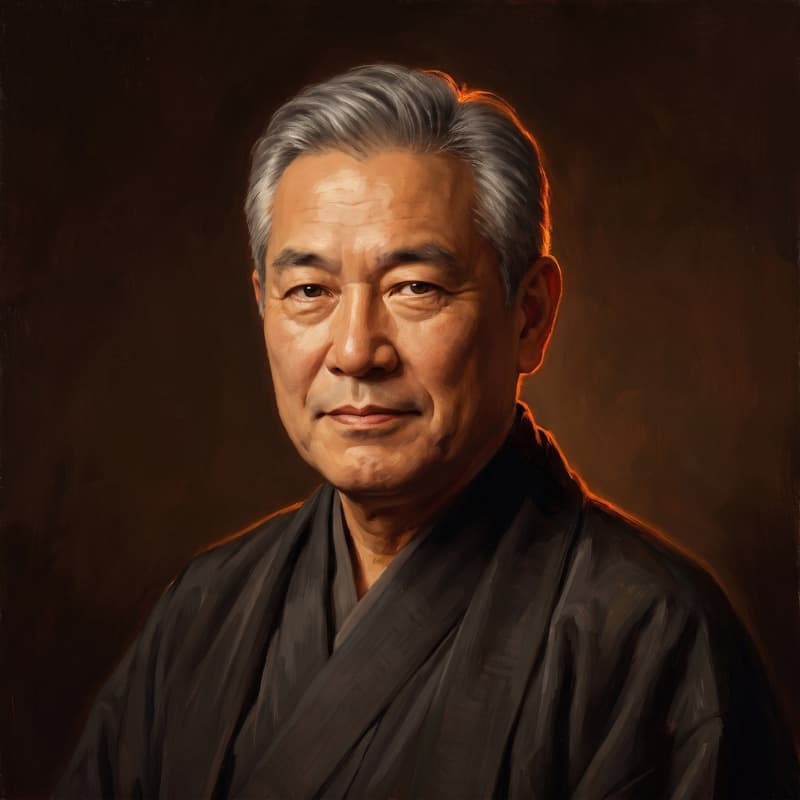
Yukichi Fukuzawa (born January 10, 1835, in Osaka — died February 3, 1901, in Tokyo) was a Meiji-era educator, writer, and public intellectual who taught himself Dutch and then English, crossed the Pacific on Japan's first official mission to the United States, and turned what he saw abroad into a lifelong argument for education and independence at home (Keio University; Wikipedia). He founded the school that became Keio University, wrote the best-selling An Encouragement of Learning, and refused every government post offered to him. Every claim on this page carries a citation; where a popular version of the story oversimplifies him, we say so.
The documented life
Fukuzawa was born the second son of a low-ranking Nakatsu-domain treasury official; his father died in 1836, while Yukichi was still an infant, and the family struggled financially afterward (Keio University; Wikipedia). By his own account, that unrealized promise — a learned father whose rank kept him from mattering — became the engine of Fukuzawa's life: in his autobiography he wrote that "the feudal system is my father's mortal enemy which I am honor-bound to destroy" (Autobiography of Fukuzawa Yukichi, tr. Eiichi Kiyooka).
Keio's own biography notes he did not begin formal schooling until age 14, roughly a decade later than his peers. He caught up fast: studying Dutch at Ogata Kōan's Tekijuku academy in Osaka through the mid-to-late 1850s, he rose to head student (Keio University). In 1858, on orders from his domain, he opened a school for Dutch studies in Edo — the direct origin of what later became Keio (Keio University). Then, in 1859, after Japan opened its ports to Western trade, he discovered his hard-won Dutch was useless with the foreign merchants at Yokohama, who spoke English — and began teaching himself a new language from scratch (Keio University).
The documented career
- 1860 — Crossing to San Francisco. At age 25, Fukuzawa sailed aboard the Kanrin Maru as part of Japan's first official mission to the United States (Keio University; Wikipedia).
- 1861 — Marriage. He married Toki Okin; the couple had nine children (Wikipedia).
- 1862 — Europe. He traveled through England, France, Germany, the Netherlands, Portugal, and Russia as an official translator for a shogunate mission (Keio University).
- 1866–1870 — Seiyō Jijō. His book explaining "Conditions in the West" was published in installments and sold roughly 250,000 copies (Wikipedia).
- 1867 — Second U.S. trip. He returned to the United States, visiting Washington, Philadelphia, and New York while acquiring textbooks (Keio University).
- 1868 — Keio Gijuku. He moved his school to Shiba/Mita in Edo and renamed it Keio Gijuku, after the Keio era name (Keio University; Wikipedia).
- 1872–1880 — Gakumon no Susume. An Encouragement of Learning was issued as 17 separate essays from February 1872 through November 1876, then compiled into one volume in July 1880; the compiled edition sold roughly 700,000 copies (Keio Times). Its opening line argues, "It is said that heaven does not create one man above or below another man" — immediately followed by the sentence that gives the line its actual meaning: "Any existing distinction between the wise and the stupid, between the rich and the poor, comes down to a matter of education" (Keio University).
- 1882 or 1883 — Jiji Shinpō. Fukuzawa founded this newspaper to circulate his political and social views independent of party factions. Wikipedia dates the founding to 1882; Keio's own biography dates it to 1883 — the two institutional sources disagree, and we note that rather than silently picking one (Wikipedia; Keio University).
- 1890 and 1920 — Keio grows up. Keio added Departments of Economics, Law, and Letters in 1890, and was formally authorized as a university in 1920 — nearly two decades after Fukuzawa's death (Wikipedia).
- 1898–1901 — Decline and death. Fukuzawa suffered a first stroke in 1898 and relearned to write; a second stroke around January 25, 1901, preceded his death on February 3, 1901, in Tokyo at age 66 (Wikipedia).
Underlying all of it was a doctrine he called dokuritsu jison — independence and self-respect. Keio's own philosophy page still quotes his formal statement of it: "Whosoever perfectly realizes the principle of Independence, both of Mind and Body, and, paying due respect to his own person, preserves his dignity unblemished — him we call a man of independence and self-respect" (Keio University).
Corrections to the popular record
"Heaven does not create inequality." Incomplete, and misleading in exactly the way that matters. The famous opening line of Gakumon no Susume is routinely quoted alone, as if Fukuzawa believed social distinctions don't exist. He said the opposite in the very next sentence: differences between the wise and the foolish, the rich and the poor, come from education — not from birth. Quoting the first sentence without the second turns an argument for universal schooling into a vague slogan about equality (Keio University).
"Fukuzawa founded Keio as a government university." False. His school began in 1858 as a small private academy for Dutch studies in Edo, was renamed Keio Gijuku in 1868, and did not receive formal university status until 1920 — nineteen years after he died (Wikipedia).
"An Encouragement of Learning was a single essay." Incomplete. It was a run of 17 separate essays published between 1872 and 1876, later compiled into one volume in 1880 (Keio Times).
"Fukuzawa is still on the 10,000 yen note." No longer. His portrait appeared on the note from November 1, 2004, until a July 3, 2024 redesign replaced him with Shibusawa Eiichi (Bank of Japan).
Why he still matters
Fukuzawa spent a public life that spanned the fall of the shogunate and the whole Meiji era without ever taking a government post — a deliberate choice, not an accident of circumstance. He built a school, ran a newspaper, and wrote for an audience he wanted educated rather than ruled, arguing that a nation's independence rests on the independent character of its individual citizens. His own account of the engine behind it all is blunt: a father whose rank and poverty wasted his learning, and a son who decided the system that did that was worth destroying (Autobiography of Fukuzawa Yukichi).
Go deeper
Sourced spoke pages: his full biography · verified quotes and misattributions · fact file · his final years and death.
This site also hosts a conversational AI recreation of Fukuzawa, built from the same documented record cited above. If you want to put a question to him directly — why he abandoned years of Dutch study overnight, what he actually meant by "heaven creates no one above another," or why he refused every government post he was ever offered — you can start a conversation now. It is a labeled AI persona, not the man; the citations on this page are the man.