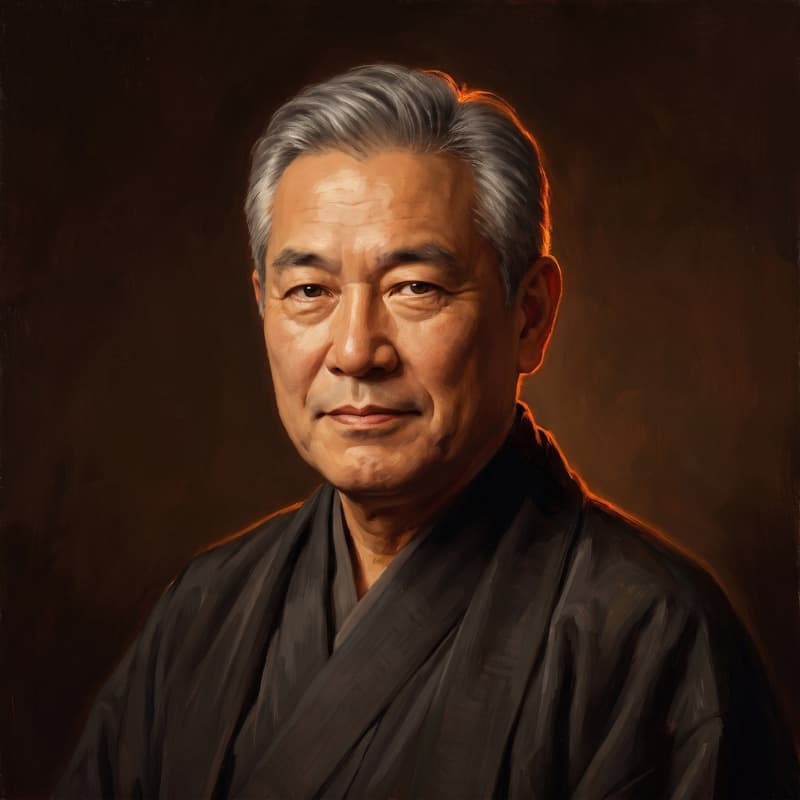
Yukichi Fukuzawa (January 10, 1835 – February 3, 1901) was a Meiji-era educator, writer, and public intellectual who founded the school that became Keio University (Keio University). Born in Osaka, the second son of a low-ranking Nakatsu-domain treasury official, he built a career entirely outside government while Japan dismantled its feudal order and remade itself as a modern state (Wikipedia). This biography states only what the cited record supports.
A poor son of a minor clan
Fukuzawa's father died in 1836, when Yukichi was an infant, and the family fell into poverty (Wikipedia). He did not begin formal schooling until age 14, roughly a decade later than his peers, by Keio's own account (Keio University). Late in life he wrote plainly about what that childhood cost him: "The thing that made me most unhappy in Nakatsu was the restriction of rank and position," and of the system that had constrained his father's whole life, "To me, indeed, the feudal system is my father's mortal enemy which I am honor-bound to destroy" (Autobiography, tr. Kiyooka).
Tekijuku, and a language rendered useless overnight
Around 1855–1858 he studied Dutch at Ogata Kōan's Tekijuku academy in Osaka, rising to head student (Wikipedia). In 1858, on orders from his domain, he opened a school for Dutch studies in Edo — the origin of what became Keio (Keio University). In 1859 Japan opened its ports to Western trade, and Fukuzawa found his years of Dutch useless with the foreign merchants at Yokohama; he began teaching himself English from scratch (Keio University).
Two oceans, twice
In spring 1860, at age 25, he sailed aboard the Kanrin Maru to San Francisco as part of Japan's first official mission to the United States (Keio University). He married Toki Okin in 1861 (Wikipedia), then in 1862 crossed to Europe as an official translator on a shogunate mission, and returned to the United States again in 1867, visiting Washington, Philadelphia, and New York while acquiring textbooks (Keio University). Of his own temperament across these years he later wrote, "I was always unconcerned with the way of society, and it was my inborn nature to act always in my own way" (Autobiography, tr. Kiyooka).
A school renamed, a doctrine written down
In 1868 he moved his school to Shiba, Edo, and renamed it Keio Gijuku (Keio University); it would not become a legal university until 1920, nineteen years after his death (Wikipedia). He also published prolifically: Seiyō Jijō ("Conditions in the West") became a bestseller and sold roughly 250,000 copies (Wikipedia), and Gakumon no Susume ("An Encouragement of Learning") ran as 17 essays from 1872 to 1876 before being compiled in 1880, selling roughly 700,000 copies (Keio Times). Its opening line is his best known: "It is said that heaven does not create one man above or below another man" — followed by the sentence that gives it meaning, "Any existing distinction between the wise and the stupid, between the rich and the poor, comes down to a matter of education" (Keio University). He stated the same conviction about independence more formally elsewhere: "Whosoever perfectly realizes the principle of Independence, both of Mind and Body, and, paying due respect to his own person, preserves his dignity unblemished—him we call a man of independence and self-respect" (Keio University). In the early 1880s he founded the newspaper Jiji Shinpō to circulate his views independent of party factions; the founding year is unsettled between the two institutional sources — Wikipedia gives 1882, Keio's own biography 1883 — so we note both rather than pick one (Wikipedia; Keio University).
What this biography deliberately does not claim
That the "heaven" line means Fukuzawa saw people as socially equal. Quoted alone, it drops the next sentence, which locates social difference in unequal access to education, not in birth (Keio University).
That Keio was founded as a government university. It began as a private Dutch-studies school in Edo in 1858 and only gained university status in 1920 (Keio University; Wikipedia).
Across a public life spanning the fall of the shogunate and the whole Meiji era, Fukuzawa never held government office — a refusal, not an accident.
Related pages
Fukuzawa hub · his death · verified quotes · fact file.
Where the documents stop, the questions start — and this site hosts a conversational AI recreation of Fukuzawa, built on the record cited above and labeled as exactly that. Ask him what the Yokohama shock felt like, why he kept refusing office, or what he actually meant by the line about heaven.