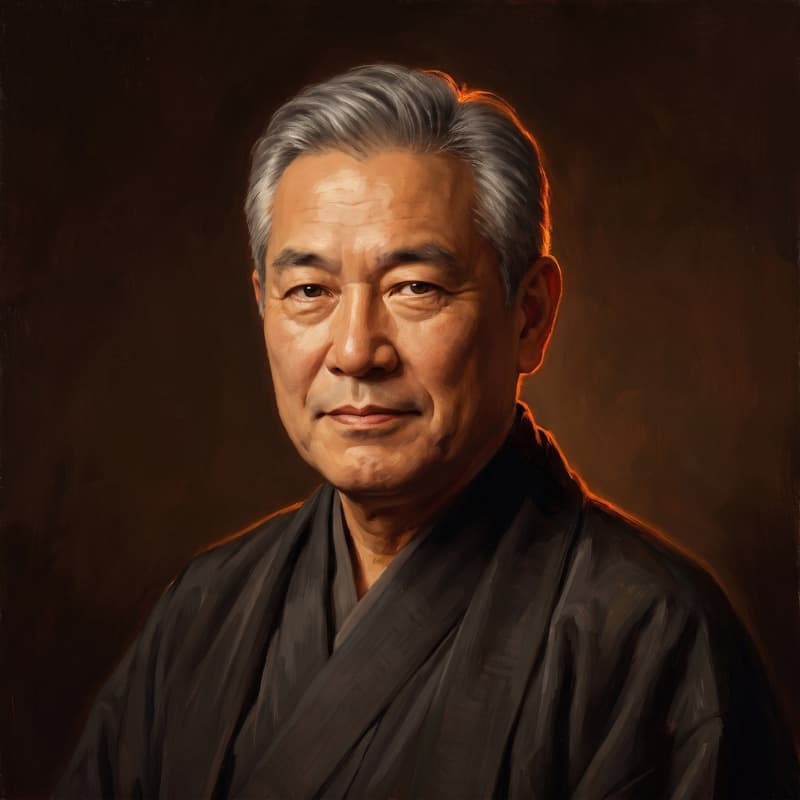
Yukichi Fukuzawa's most quoted line — "heaven does not create one man above or below another" — is also his most misused, because almost nobody quotes the sentence that follows it. Below are his verified lines, in his own words, checked against the institutional and archival sources that carry them, followed by the one line worth handling with care.
The line everyone half-quotes
The opening of Gakumon no Susume ("An Encouragement of Learning," 1872) reads:
"It is said that heaven does not create one man above or below another man."
Fukuzawa's very next sentence is the actual argument, and it is almost never quoted alongside the first:
"Any existing distinction between the wise and the stupid, between the rich and the poor, comes down to a matter of education."
Read together, this is not a claim that Japanese society had no hierarchy. It is an argument that whatever hierarchy exists comes from unequal schooling, not from birth — which is why he spent a career building a school rather than a manifesto (Keio University).
On independence and self-respect
Fukuzawa's fullest formal statement of dokuritsu jison — independence and self-respect, the doctrine still cited as Keio's founding philosophy — reads:
"Whosoever perfectly realizes the principle of Independence, both of Mind and Body, and, paying due respect to his own person, preserves his dignity unblemished — him we call a man of independence and self-respect."
From the autobiography
Fukuzawa dictated his autobiography late in life, and its lines are blunter than his published essays. On the origin of his lifelong project:
"To me, indeed, the feudal system is my father's mortal enemy which I am honor-bound to destroy."
On the childhood that produced that conviction:
"The thing that made me most unhappy in Nakatsu was the restriction of rank and position."
On his own temperament:
"I was always unconcerned with the way of society, and it was my inborn nature to act always in my own way."
(All three: Autobiography of Fukuzawa Yukichi, tr. Eiichi Kiyooka)
On his lifelong refusal of government office, he described wanting to demonstrate the principle of independence through his own life and career rather than by taking a post under the new government — the standing explanation, in his own account, for why he turned down every office he was offered (Autobiography of Fukuzawa Yukichi, tr. Eiichi Kiyooka).
A quote to handle with care
"Heaven does not create inequality." This compressed paraphrase circulates as if it were the whole of Fukuzawa's argument. It is the first half of a sentence whose second half — the line about education above — reverses the plain reading of the first. Quote the opening line alone and you have manufactured a Fukuzawa who believed something close to the opposite of what he wrote (Keio University).
Hear him make the argument himself
Reading Fukuzawa's lines on the page is one thing; his AI recreation on this site — a labeled, honest re-creation, not the historical man — will walk you through what "heaven creates no one above another" actually meant to him, or explain in his own voice why he turned down every post the new government offered him.
More in this cluster: Fukuzawa hub · biography · his death.