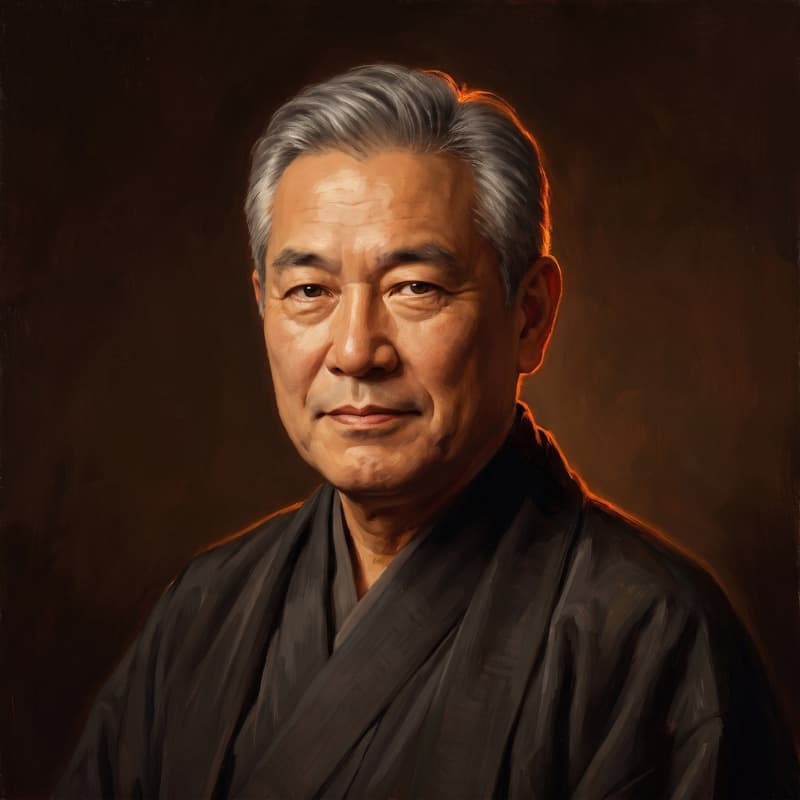
Every Fukuzawa fact on this page is verified against an institutional source — Keio University's own historical record, Wikipedia, and the Bank of Japan — with each citation shown inline. The short version: born January 10, 1835, in Osaka; no formal schooling until age 14; sailed to San Francisco in 1860 with Japan's first government mission to the United States; founded the Dutch-studies school in Edo that became Keio; published An Encouragement of Learning to roughly 700,000 copies; never held government office; and died February 3, 1901. Details and sources below, followed by three claims that circulate as fact but don't hold up.
Ten verified facts
- Born January 10, 1835, in Osaka, the second son of a low-ranking Nakatsu-domain treasury official (Wikipedia).
- No formal schooling until age 14 — roughly a decade later than his peers, by Keio's own account of his life (Keio University).
- Opened a school for Dutch studies in Edo in 1858 on orders from his domain — the direct origin of what became Keio (Keio University).
- Sailed to San Francisco in spring 1860, at age 25, as part of Japan's first official government mission to the United States (Keio University).
- Traveled abroad three times in seven years: San Francisco in 1860, a shogunate mission through Europe in 1862, and a second U.S. trip in 1867 (Keio University).
- Renamed his school Keio Gijuku in 1868, after moving it to Shiba, Edo — but Keio was not legally authorized as a university until 1920, nineteen years after his death (Keio University; Wikipedia).
- An Encouragement of Learning appeared as 17 essays between February 1872 and November 1876, then was compiled into one volume in July 1880, reaching roughly 700,000 copies (Keio Times).
- Founded the newspaper Jiji Shinpō to circulate his political and social views independent of party factions — the founding year is disputed between the institutional sources: Wikipedia gives 1882, Keio's own biography 1883 (Wikipedia; Keio University).
- Never held government office, across a public life spanning the fall of the shogunate and the entire Meiji era — a deliberate refusal, not an accident (Keio University).
- Died February 3, 1901, in Tokyo, at age 66, after a first stroke in 1898 and a second stroke roughly a week before his death (Wikipedia).
One more, for the currency-trivia file: his portrait appeared on Japan's 10,000 yen note from November 1, 2004, until a July 3, 2024 redesign replaced him with Shibusawa Eiichi (Bank of Japan).
Three circulating claims, corrected
"Heaven does not create inequality." An over-shortened paraphrase. Fukuzawa's actual opening line is immediately followed by a sentence locating social difference in unequal education, not in birth — quoting the first half alone reverses the point (Keio University).
"Fukuzawa founded Keio as a government university." False. His school began as a private academy for Dutch studies in Edo in 1858 and did not gain university status until 1920 (Keio University; Wikipedia).
"An Encouragement of Learning was a single essay, published once, in 1872." Incomplete. It was a 17-essay series issued between 1872 and 1876, only compiled into a single volume in 1880 (Keio Times).
Frequently asked, quickly answered
Is Fukuzawa on Japanese money? He was — the 10,000 yen note from 2004 to 2024 — before a redesign replaced him with Shibusawa Eiichi (Bank of Japan).
Did Fukuzawa found Keio University? He founded the school, not the university. It opened as a private Dutch-studies academy in 1858, was renamed Keio in 1868, and only became a legally authorized university in 1920 (Keio University; Wikipedia).
How many times did Fukuzawa travel abroad? Three times: San Francisco in 1860, Europe in 1862, and the United States again in 1867 (Keio University).
Was Fukuzawa ever a government official? No — by choice, across a public career that ran from the last years of the shogunate through the whole of the Meiji era (Keio University).
Related pages
Fukuzawa hub · his death · verified quotes · biography.
For what a fact list can't settle — what the Yokohama shock actually felt like, why he kept refusing office, what a decade of poverty in Nakatsu was like from the inside — this site hosts a conversational AI recreation of Fukuzawa, built on the record cited above and labeled plainly as an AI persona.