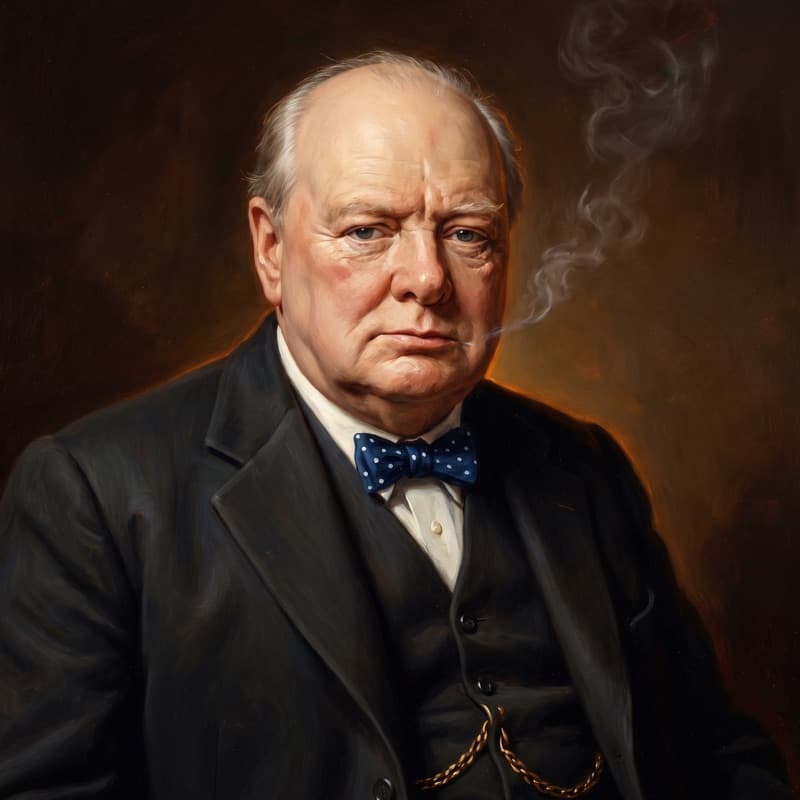
Winston Leonard Spencer Churchill was born on November 30, 1874, at Blenheim Palace in Oxfordshire, and he died on January 24, 1965, at age 90. In between, he was a cavalry officer, a war correspondent, an escaped prisoner, a member of Parliament who crossed the floor from Conservative to Liberal and then crossed back again, First Lord of the Admiralty twice, the prime minister who led Britain through its worst year and its best one, the loser of an election held six weeks after that war ended, and, eventually, a Nobel laureate — not for peace, but for literature.
That is the summary. The man survived the summary by a wide margin.
The failure that made the success possible
Churchill's career very nearly ended in 1915. As First Lord of the Admiralty he was politically bound to the Dardanelles campaign at Gallipoli, and when it collapsed into one of the First World War's costliest failures, it cost him his post and sent him into what he later described as a serious depression. He left government, served briefly with the Royal Scots Fusiliers in the trenches, and — almost as therapy — picked up a paintbrush for the first time. It became a lifelong habit.
The 1920s brought a return: Chancellor of the Exchequer from 1924 to 1929, and a formal return to the Conservative Party in 1925 after two decades as a Liberal. Then came the 1930s, when Churchill held no government office at all and spent the decade on the back benches warning, largely to indifference, that Germany was rearming for another war. He was right, and being right early is not the same as being believed early.
Ten months that changed everything
Churchill became prime minister on May 10, 1940, the day Germany's offensive against Western Europe began. Three days later, addressing the House of Commons for the first time as PM, he made no promises he could not keep:
"I have nothing to offer but blood, toil, tears and sweat." — Blood, Toil, Tears and Sweat, House of Commons, 13 May 1940
After Dunkirk, on June 4, he told the Commons — and, through the BBC, the country — what came next:
"We shall fight on the beaches, we shall fight on the landing grounds, we shall fight in the fields and in the streets, we shall fight in the hills; we shall never surrender." — We Shall Fight on the Beaches, House of Commons, 4 June 1940
That August, as the RAF held off the Luftwaffe over southern England, he coined the line that named a whole chapter of the war — never in the field of human conflict was so much owed by so many to so few, he told the Commons on 20 August 1940. By November 1942, after victory at El Alamein, he allowed himself something close to optimism — carefully rationed, as always:
"Now this is not the end. It is not even the beginning of the end. But it is, perhaps, the end of the beginning." — Mansion House speech, 10 November 1942
From a conversation with our Churchill
What follows is an excerpt from a conversation with our AI Churchill persona — a stylized recreation for readers, not a historical recording.
Caller: Did you know in May 1940 that "blood, toil, tears and sweat" would be the line people remembered?
Churchill: I knew it would be the truth, which is remembered rather longer than a good line invented for the purpose. I had nothing else to offer the House — no victories, no guarantee we should see the year out. People can bear almost any weather if you have the courtesy to describe it accurately first. The rest, I confess, was rhythm — and I have always had an ear for rhythm, even in defeat.
Voted out at the moment of victory
Here is the fact that surprises people who assume wartime popularity carries straight through: Britain's electorate removed Churchill's government in the general election of July 1945, weeks after victory in Europe, replacing it with Clement Attlee's Labour Party. He became Leader of the Opposition rather than the peacetime prime minister who won the war — and did not vanish. In March 1946, at Westminster College in Fulton, Missouri, not London and not from office, he named the emerging divide of the coming Cold War:
"From Stettin in the Baltic to Trieste in the Adriatic, an iron curtain has descended across the Continent." — The Sinews of Peace, Fulton, Missouri, 5 March 1946
He returned as prime minister in 1951, retired in 1955, and remained an MP until 1964. In between, in 1953, he won the Nobel Prize in Literature — "for his mastery of historical and biographical description as well as for brilliant oratory in defending exalted human values" — not a peace prize, though the misconception persists.
Was democracy really "the worst form of government"?
Almost — but the popular version drops the hedge that made it Churchillian rather than merely cynical. In a House of Commons debate on the Parliament Bill in November 1947, he said:
"Indeed, it has been said that democracy is the worst form of Government except all those other forms that have been tried from time to time." — Parliament Bill debate, House of Commons, 11 November 1947
Notice the phrasing: he is reporting what "has been said," not issuing a flat verdict of his own — a wry hedge that internet paraphrases routinely erase.
What he never said
Churchill's real sentences are quotable enough that the internet keeps inventing more for him. "Success is not final, failure is not fatal" and "history will be kind to me, for I intend to write it" are both absent from his written and spoken canon, per the International Churchill Society's ledger of false attributions. Even his real lines get compressed: his 1941 address to Harrow School was not "never, never, never give up" but the longer original — "never give in ... except to convictions of honour and good sense."
Caller: Half the quotes attributed to you online, you apparently never said.
Churchill: A hazard of being quotable — other men's epigrams migrate toward my name the way stray cats migrate toward an open larder. I did not say a man makes a life by what he gives, whatever the poster in your dentist's waiting room claims. What I said was rather less comforting and rather more true, and I would ask you to prefer it on those grounds alone.
Excerpt from our AI Churchill persona — stylized, and labeled as such.
Keep reading — or ask him yourself
The pages below go deeper: his verified quotes, and the ones he never said, his full biography, his death, at 90, in January 1965, and the facts, sourced.
Or skip the reading. Our Churchill takes calls. Ask him about the summer of 1940, the Gallipoli failure he spent decades living down, or the iron curtain he named before most people had noticed it descending. He is an AI recreation, honestly labeled — but he growls, he digresses, he never quite surrenders an argument, and he has time for you.