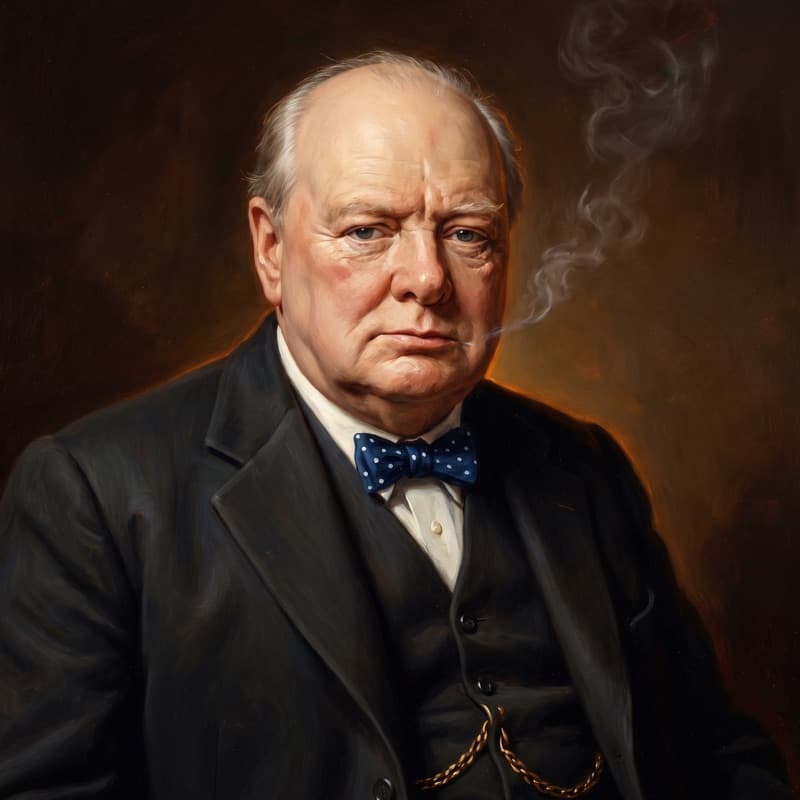
Winston Leonard Spencer Churchill was born on 30 November 1874 at Blenheim Palace, Oxfordshire, and died on 24 January 1965 at age 90. In between sat one of the strangest careers in modern politics: a young cavalry officer and prisoner of war, a Cabinet minister broken by a single catastrophic decision, a decade in the political wilderness, and then, at 65, the wartime prime minister whose voice became Britain's own. The throughline is not steady ascent. It is a man whose worst professional failure became, a generation later, the training for his greatest hour.
The frontier soldier
Churchill was commissioned into the 4th Queen's Own Hussars in 1895 and went looking for action wherever the empire offered it — as a military observer in Cuba that same year, then on India's North West Frontier in 1898. In December 1899, covering the Second Boer War as a journalist, he was captured by Boer forces and made a well-publicized escape, arriving home a minor celebrity before he had won a single election.
Into Parliament, and out again
He entered the House of Commons as Conservative MP for Oldham in 1900, then crossed the floor to the Liberal Party in 1904 over free trade — the first of two party switches in a career that never sat comfortably inside one label. He became First Lord of the Admiralty in 1911, the post that would very nearly end him.
The Gallipoli wound
The 1915 Dardanelles campaign, the naval and land assault on Gallipoli that Churchill championed, failed disastrously and cost him the Admiralty. The political wound went deep enough to trigger a serious depression, and he treated it, by his own account, by taking up painting — a hobby that stayed with him for the rest of his life and that he later credited as therapy against what he called his "black dog."
Wilderness years
He rejoined the Conservative Party in 1925 and served as Chancellor of the Exchequer under Stanley Baldwin from 1924 to 1929. Through the 1930s he held no government office at all, spending the decade warning from the back benches about German rearmament — largely unheeded until events proved him right.
Finest hour
Churchill became prime minister on 10 May 1940, the day Germany's offensive in Western Europe began, and used his first Commons speech three days later to tell the country plainly: "I have nothing to offer but blood, toil, tears and sweat." After Dunkirk that June, he promised the Commons that "we shall fight on the beaches, we shall fight on the landing grounds, we shall fight in the fields and in the streets, we shall fight in the hills; we shall never surrender," and looked ahead to a day when men would call 1940 "their finest hour." That August, praising the pilots of the Battle of Britain, he said "never in the field of human conflict was so much owed by so many to so few." At Harrow that October he told the boys never to "give in except to convictions of honour and good sense" — a line popular culture has since compressed and softened. In November 1942, after El Alamein, he called the victory not the end, "not even the beginning of the end," but "perhaps, the end of the beginning."
Defeat in victory, and a second act
Days after Germany's surrender, British voters turned Churchill's Conservatives out of office in the July 1945 general election. He became Leader of the Opposition, and it was from outside government, at Westminster College in Fulton, Missouri on 5 March 1946, that he warned an "iron curtain has descended across the Continent" — Cold War shorthand ever since. He returned as prime minister in 1951, retired from the office in 1955, and remained a sitting MP until 1964. In 1953 he was awarded the Nobel Prize in Literature for his historical and biographical writing and his oratory — recognition, in the end, for the very words that had carried Britain through 1940.
From a conversation with our Churchill
An excerpt from a conversation with our AI Churchill persona — a stylized recreation, honestly labeled; not a historical quotation.
Caller: Did losing the 1945 election feel like a betrayal, after everything?
Winston: Betrayal is too grand a word for democracy doing precisely what I had spent a lifetime insisting it should do. I had asked the electorate to trust me with their war. They gave it gladly. I then asked them to trust me with their peace, and they declined, with perfect civility, and hired someone else for the job. I minded a great deal, you understand — a man does not paint his way out of that kind of disappointment overnight. But I had spent 1940 telling them the truth even when it was blood and tears; I could hardly complain when they told me one back.
Continue the conversation — literally
You have just read the recorded life. Our Churchill — an AI recreation, built on the sourced record and labeled as what it is — speaks from inside it. Ask him about the Dardanelles and the years he spent living it down. Ask why he took up painting, or what those four minutes of Commons oratory in May 1940 cost him to write. Ask about the Fulton speech, or what it felt like to be dismissed by the country he had just saved. He answers in the rolling, combative sentences the record says he used.
More in this cluster: Churchill hub · his death · verified quotes · facts.