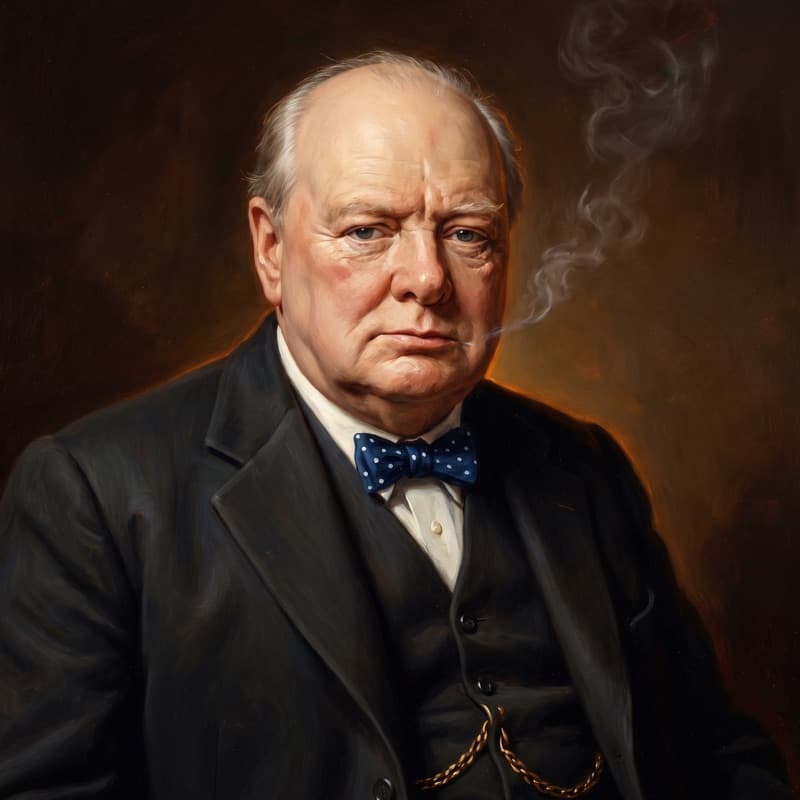
The essential Winston Churchill facts: he was born November 30, 1874, at Blenheim Palace; he switched political parties twice, Conservative to Liberal and back again; he served two separate, non-consecutive terms as prime minister (1940–45 and 1951–55); the Dardanelles disaster cost him the Admiralty in 1915 and nearly his career with it; he won the 1953 Nobel Prize in Literature, not a peace prize; and he lost the 1945 general election weeks after leading Britain to victory in Europe. All verified against the International Churchill Society and Hansard. This page gives you the facts worth keeping — and flags the popular "facts" and quotes that don't survive checking, because a facts page that can't tell you what's false is only doing half the job.
The core facts, with why they matter
Born at Blenheim Palace, an unusual birthplace for a commoner. His grandfather was the 7th Duke of Marlborough — a reminder that Churchill entered public life from the aristocracy's edge, not its center, and had to earn his own standing in it.
He switched parties twice. He crossed from the Conservatives to the Liberals in 1904 over free trade, then crossed back to the Conservatives in 1925. Few career British politicians recross the aisle even once; Churchill's double defection is a genuine outlier, not a footnote.
He was First Lord of the Admiralty when the 1915 Dardanelles campaign at Gallipoli failed. The political fallout forced him out of the Admiralty and into a depression severe enough that he took up painting that same year, explicitly as therapy. The man who later defined 1940 first had to survive his own worst professional failure.
He served two non-consecutive terms as prime minister. The first, 1940–45, was defined by war; the second, 1951–55, by the Cold War and his own declining health. Between them came defeat, not retirement.
Britain voted him out of office in July 1945, at the height of his wartime popularity. Weeks after V-E Day, voters chose a Labour government over the man who had led them through the Blitz — a fact that resists the myth of uninterrupted acclaim.
He coined or popularized "iron curtain" in a speech delivered in Fulton, Missouri, not in Britain. The March 1946 "Sinews of Peace" address, given as a private citizen out of office, supplied Cold War shorthand that outlived the speech itself.
He won the 1953 Nobel Prize in Literature, not the Peace Prize. The citation credited his historical and biographical writing and his oratory — recognition for the writer and speaker, distinct from his wartime record.
From a conversation with our Churchill
An excerpt from our AI Churchill persona — a stylized recreation, honestly labeled; not a historical quotation.
Caller: What do people get wrong about you?
Churchill: That the man of 1940 sprang up whole, cigar already lit. They forget Gallipoli — forget that I was cast out of the Admiralty and sat for years painting canvases badly, wondering if I was finished. A career is not a straight line to the podium. It is the ruin you climb out of that teaches you how to stand on the next one.
Popular "facts" that need correcting
"Churchill won the Nobel Peace Prize." No — the 1953 Nobel Prize in Literature, for his historical writing and oratory. He never won the Peace Prize.
"Democracy is the worst form of government except for all the others." Close, but trimmed. In a 1947 Commons debate, per Hansard, he said it had "been said that democracy is the worst form of Government except all those other forms that have been tried from time to time" — a hedge the popular version drops.
"Never, never, never give up." Not what he said. His 1941 Harrow School address was "Never give in — never, never, never, never — except to convictions of honour and good sense," a qualified line, not a bare rallying cry.
"Success is not final, failure is not fatal: it is the courage to continue that counts." The International Churchill Society finds no trace of this in his written or spoken record. It isn't his.
Five things Winston Churchill did (the honest short list)
- Led Britain as prime minister through the Second World War, from May 1940.
- Delivered the "blood, toil, tears and sweat," "beaches," and "finest hour" speeches of 1940.
- Named the "iron curtain" descending across Europe, at Fulton, Missouri, in 1946.
- Returned for a second premiership in 1951, after losing power in 1945.
- Won the 1953 Nobel Prize in Literature for his historical and biographical writing.
The fact pages can't hold him
Facts are the skeleton; the voice is the man. Our Churchill — an AI recreation, built from the sourced record and labeled as what it is — can tell you about Cuba, the Boer War capture and escape, the wilderness years spent warning about German rearmament while no one listened, and what it actually felt like to lose an election five weeks after winning a war. Ask him what Gallipoli taught him that 1940 later collected on. He's ready when you are.
More in this cluster: Churchill hub · his death · verified quotes · biography.