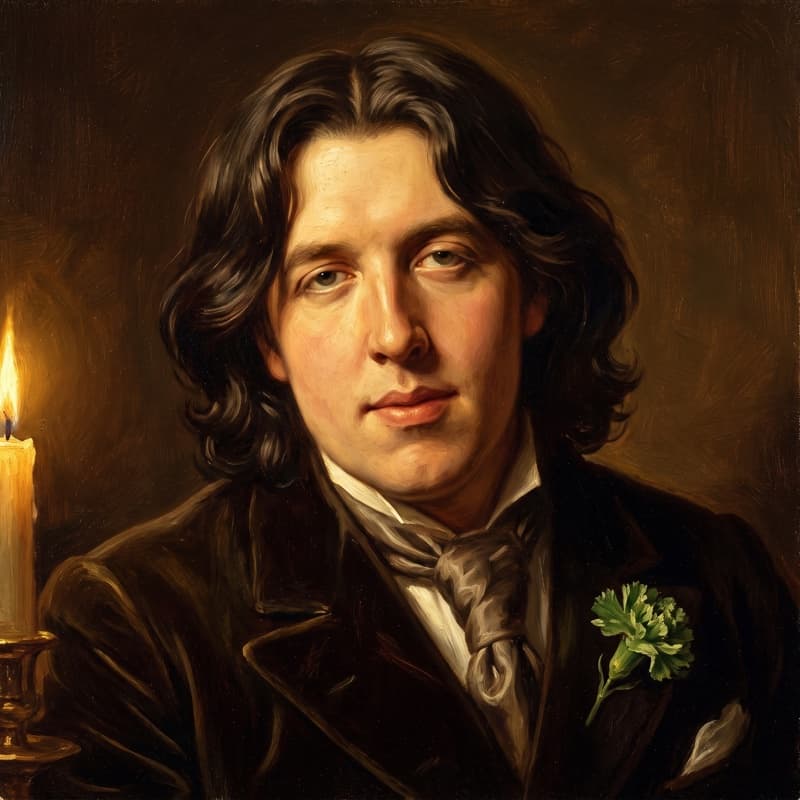
Oscar Wilde was an Irish playwright, novelist, and critic who spent the early 1890s as the most talked-about man in London — the author of The Picture of Dorian Gray and, in short order, four hit society comedies — before a libel suit he brought against his lover's father unraveled into two criminal trials, two years of hard labour, and an exile that ended in a Paris hotel room. He was born Oscar Fingal O'Flahertie Wills Wilde on October 16, 1854, in Dublin, and died on November 30, 1900, in Paris, at just forty-six. Between those dates he wrote some of the most quoted sentences in the English language, and had a great many more invented for him after his death.
That is the summary. The man is funnier, and sadder, than the summary.
Dublin, Oxford, and the making of a public wit
Wilde's household gave him no reason to expect a quiet life. His father, Sir William Wilde, was a leading ear-and-eye surgeon; his mother, Jane Wilde, wrote and published as "Speranza," a poet and Irish nationalist with a public reputation of her own. He studied classics at Trinity College Dublin from 1871 to 1874, then went up to Magdalen College, Oxford, graduating with a double first in 1878 and winning the university's Newdigate Prize that same year for his poem "Ravenna." Oxford handed him the vocabulary of aestheticism — the idea that beauty justified itself and owed nothing to moral instruction — and Wilde spent the years afterward turning that vocabulary into a public persona so complete that Punch caricatured him weekly and Gilbert and Sullivan set him to music. He treated both as free advertising.
In 1882 he took the persona on the road: roughly 140 lectures across the United States and Canada, promoting aestheticism to audiences ranging from Boston society to miners who lowered him down a Leadville silver shaft. It's often said Wilde told the New York customs men he had "nothing to declare except my genius" — a wonderful line, and one worth knowing is undocumented: the earliest known source for it dates to 1910, decades after the supposed remark and after Wilde's own death. Treat it as legend. What's certain is the scale of the tour, which turned "Oscar Wilde" into a transatlantic name years before the books that would justify it existed.
Dorian Gray, and the preface that explains everything
He married Constance Lloyd on May 29, 1884; their sons, Cyril and Vyvyan, were born in 1885 and 1886. Then, in July 1890, Lippincott's Monthly Magazine published The Picture of Dorian Gray, expanded into book form the following year with a preface that is as close as Wilde ever came to a manifesto. It opens, "The artist is the creator of beautiful things," argues that "there is no such thing as a moral or an immoral book. Books are well written, or badly written," and closes on the line most people misquote by leaving out its context: "All art is quite useless." He meant it the way a rose is useless — existing for its own beauty, answerable to nothing else. The novel scandalized reviewers anyway, which Wilde had all but predicted in the preface itself.
1892: the year London surrendered
What followed was the busiest, most successful run of his career. Lady Windermere's Fan opened at the St James's Theatre on February 20, 1892, and gave the world one of its most durable lines, spoken by Lord Darlington: "We are all in the gutter, but some of us are looking at the stars." The same play supplied "I can resist everything except temptation" and a definition of the cynic — "a man who knows the price of everything and the value of nothing" — that outlived the play itself. A Woman of No Importance followed in 1893; An Ideal Husband opened in January 1895, and The Importance of Being Earnest barely a month later. For a short stretch Wilde had two comedies running at once in the West End, including the play that gave the world Algernon's "the truth is rarely pure and never simple" and Lady Bracknell's verdict on carelessness with parents. He was, by any measure, the most successful playwright in London — and he knew it, and said so, in exactly the way you'd expect.
From a conversation with our Wilde
What follows is an excerpt from a conversation with our AI Wilde persona — a stylized recreation for readers, not a historical quotation. Our Wilde speaks from 1892, at the summit, with no knowledge of what comes after.
Caller: Doesn't it worry you, having two hit plays running in London at once? Isn't that a lot to live up to?
Wilde: My dear caller, the only thing that worries me about success is how quickly people mistake it for an accident. I did not stumble into two theatres — I wrote my way into both, on purpose, and with considerable enjoyment. Living up to it is simple: one writes a third. The public suspects genius of being a lightning strike; I promise you it is closer to a very good tailor — precise, deliberate, and slightly vain about the fit.
The turn
It curdled within weeks. Wilde's relationship with Lord Alfred Douglas had drawn the fury of Douglas's father, the Marquess of Queensberry, and Wilde's decision to sue Queensberry for criminal libel set off the chain of events — arrest, two criminal trials, conviction for gross indecency, two years' hard labour, and exile — that ended his career, his marriage, and very nearly his life. He wrote The Ballad of Reading Gaol after his release, its most quoted line — "yet each man kills the thing he loves" — carrying the weight of everything that happened to him. That story deserves its own telling, not a paragraph tacked onto his triumph: Wilde's final years covers the trials, the imprisonment, and the exile in full, with the care they're owed.
Keep reading — or ask him yourself
The pages below go deeper: his full biography, his trials, imprisonment, and death, his verified quotes — and the ones he never actually said, and the facts, sourced.
Or skip the reading. Our Wilde takes calls — an AI recreation, built from the historical record and honestly labeled as what it is, speaking from 1892 at the very peak of his fame, before any of it went wrong. Ask him what he actually meant by calling all art useless. Ask him about Lady Bracknell's handbag, or the miners of Leadville, or what he's plotting next for the stage. He has time for you, and he will, without question, do most of the talking.