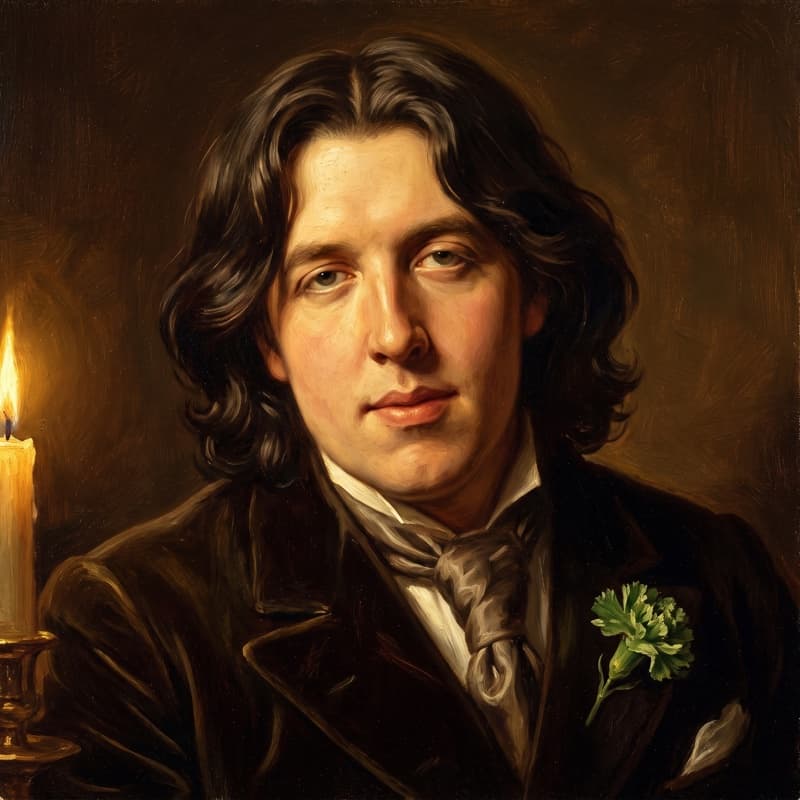
Oscar Fingal O'Flahertie Wills Wilde was born on October 16, 1854, in Dublin, and by his early forties had written the most quoted comedy in the English language, been convicted of a crime for how he loved, and died in a Paris hotel room, exiled and broke, on November 30, 1900. Between those two facts sits a career built almost entirely on talk — on the idea that wit, dress, and a well-turned sentence were themselves a kind of argument.
A house built on words
Wilde's parents gave him no reason to expect an ordinary life. His father, Sir William Wilde, was a leading ear and eye surgeon; his mother, Jane Wilde, wrote and published as "Speranza," a poet and Irish nationalist with her own public reputation. Growing up in that household meant growing up around performance, argument, and cause — Wilde's later gift for turning a room simply by speaking in it did not come from nowhere.
He studied classics at Trinity College Dublin from 1871 to 1874, winning the Berkeley Gold Medal in Greek, then went up to Magdalen College, Oxford, where he graduated with a double first in 1878 and won the university's Newdigate Prize for his poem "Ravenna" the same year. Oxford gave him the vocabulary of aestheticism — art pursued for its own sake, beauty as its own justification — and he spent the years after turning that vocabulary into a public persona: the velvet coats, the lilies, the epigrams, the willingness to be caricatured in Punch and to enjoy it. In 1882 he took the persona on tour, lecturing extensively across the United States and Canada, a genuinely enormous undertaking that made "Oscar Wilde" a transatlantic name before he had written the books it would rest on.
Marriage, magazine work, and Dorian Gray
He married Constance Lloyd on May 29, 1884; their sons, Cyril and Vyvyan, were born in 1885 and 1886. Wilde spent part of the later 1880s editing The Woman's World, steady work that sits oddly against his reputation as a pure aesthete — he could also run a magazine. Then, in July 1890, Lippincott's Monthly Magazine published The Picture of Dorian Gray, expanded into book form the following year. The preface Wilde attached to the 1891 edition is as close as he came to a manifesto: "The artist is the creator of beautiful things," it opens, and it closes, after arguing that "there is no such thing as a moral or an immoral book," with the flattest line he ever wrote — "All art is quite useless." The novel scandalized reviewers anyway; Wilde had more or less predicted that it would and said so in the preface itself.
The society comedies, and the summit of his fame
What followed was the busiest and most successful stretch of his career. Lady Windermere's Fan opened at London's St James's Theatre on February 20, 1892; A Woman of No Importance followed in 1893; An Ideal Husband opened in January 1895, and The Importance of Being Earnest just weeks later, in February 1895. For a short run, Wilde had two hit comedies playing in London's West End at once — the summit of a fame built entirely on being the wittiest man anyone had heard talk.
It curdled within weeks. Wilde's relationship with Lord Alfred Douglas had drawn the attention of Douglas's father, the Marquess of Queensberry, and Wilde's decision to sue Queensberry for criminal libel set in motion the trials that ended his career, his marriage, and very nearly his life. That story — arrest, conviction, Reading Gaol, exile, and the poem prison gave him — belongs to Oscar Wilde's final years.
Talk to him
Our Oscar Wilde — an AI recreation built on the sourced record and labeled as what it is — talks the way the record says he talked: fast, funny, and rarely in a hurry to be sincere.
Caller: Weren't you worried, putting so much of yourself into Dorian Gray?
Wilde: My dear caller, every artist puts himself into his work — the alternative is putting nothing into it, which is worse and, I promise you, far less interesting. I gave the book my aestheticism, my epigrams, and a great many opinions I hold at dinner parties. What I did not expect was for London to read it as a confession rather than a preface. One ought to be careful what one writes; one cannot, alas, be careful how it is read.
More in this cluster: Oscar Wilde hub · his final years · verified quotes · facts.