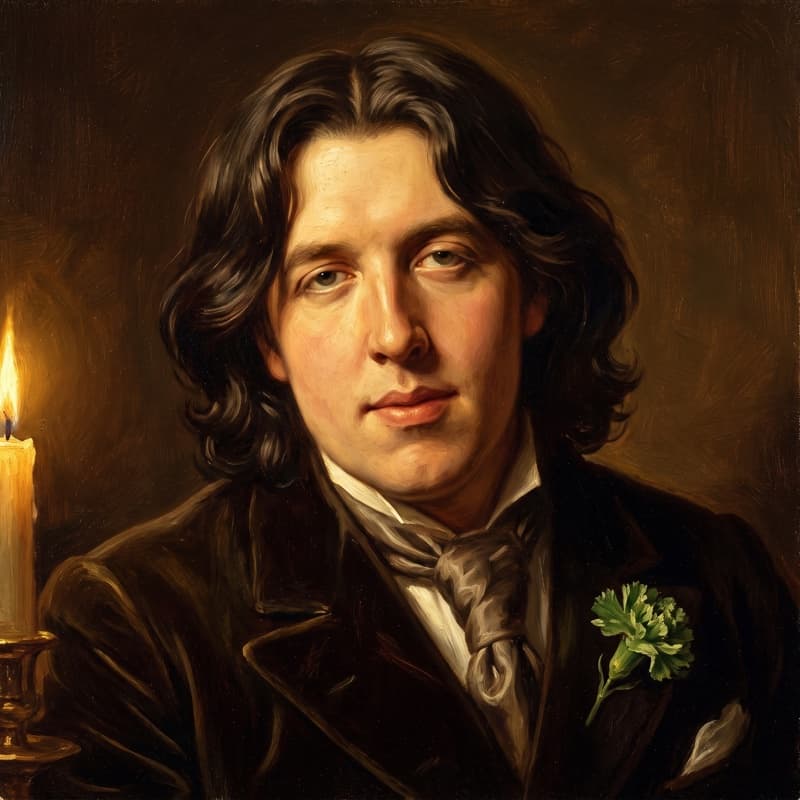
Oscar Wilde's most quoted lines come from four places people routinely mix up: the preface to The Picture of Dorian Gray, the stage dialogue of The Importance of Being Earnest, an earlier and less-remembered comedy called Lady Windermere's Fan, and a political essay most quote pages skip entirely. Below, each line is sourced to the play or book it actually comes from — and the closing section flags the "Wilde quotes" that Wilde never wrote at all.
The Dorian Gray preface: three lines, one argument
Wilde's preface to The Picture of Dorian Gray (1891) is the closest thing he wrote to a manifesto, and it opens and closes with its two most famous sentences:
"The artist is the creator of beautiful things."
"There is no such thing as a moral or an immoral book. Books are well written, or badly written."
"All art is quite useless."
Read in order, they are one argument, not three slogans: art exists to be beautiful, judgment of it is a craft question, and its value is not measured by any use it serves.
The Importance of Being Earnest: the stage epigrams
Wilde's 1895 comedy supplies the lines most people mean when they say "very Oscar Wilde." Algernon, defending nonsense as a way of speaking truth, tells Jack:
"The truth is rarely pure and never simple."
And Lady Bracknell, interrogating Jack about his origins as a foundling, delivers the play's most quoted put-down:
"To lose one parent, Mr. Worthing, may be regarded as a misfortune; to lose both looks like carelessness."
Lady Windermere's Fan: often credited to the wrong play
Four of Wilde's best-known lines actually come from Lady Windermere's Fan (1892), three years before Earnest, and are frequently misattributed to it. All four belong to Lord Darlington and Dumby:
"We are all in the gutter, but some of us are looking at the stars." — Lord Darlington
"I can resist everything except temptation." — Lord Darlington
"A cynic is a man who knows the price of everything and the value of nothing." — Lord Darlington
"Experience is the name every one gives to their mistakes." — Dumby
Beyond the stage: politics and prison
Wilde's political essay The Soul of Man under Socialism (1891) carries a line worth setting beside the plays:
"A map of the world that does not include Utopia is not worth even glancing at."
And after his release from Reading Gaol in 1897, exiled and writing under a different name, he produced The Ballad of Reading Gaol — its most quoted stanza turns his own downfall into a general law:
"Yet each man kills the thing he loves."
From a conversation with our Wilde
An excerpt from our AI Wilde persona — a stylized recreation, honestly labeled; not a historical quotation.
Caller: People quote you constantly. Does it ever sound right to you?
Wilde: Half the time, dear caller, they are quoting Darlington, and crediting Algernon, and thanking neither of us. I forgive it — a good line should travel further than its owner. What I mind is the lines I never wrote at all, dressed up in my waistcoat and sent out to work. A forger, at least, studies the hand he's copying.
Lines Wilde never actually said
"I have nothing to declare except my genius." Told as his 1882 quip to a New York customs officer, but the earliest known source is 1910 — twenty-eight years later and a decade after his death, with no contemporary record.
"Work is the curse of the drinking classes." A version of this line was already circulating anonymously in the British press by 1875, before Wilde was famous; the attribution to him comes only from a 1916 biography.
"Be yourself; everyone else is already taken." No Wilde source exists. The exact wording traces to an anonymous 1999 internet posting.
"Always forgive your enemies; nothing annoys them so much." Traced to writer Percy Colson in 1949, misattributed to Wilde by Reader's Digest five years later.
More in this cluster: Wilde hub · biography · his final years · facts.