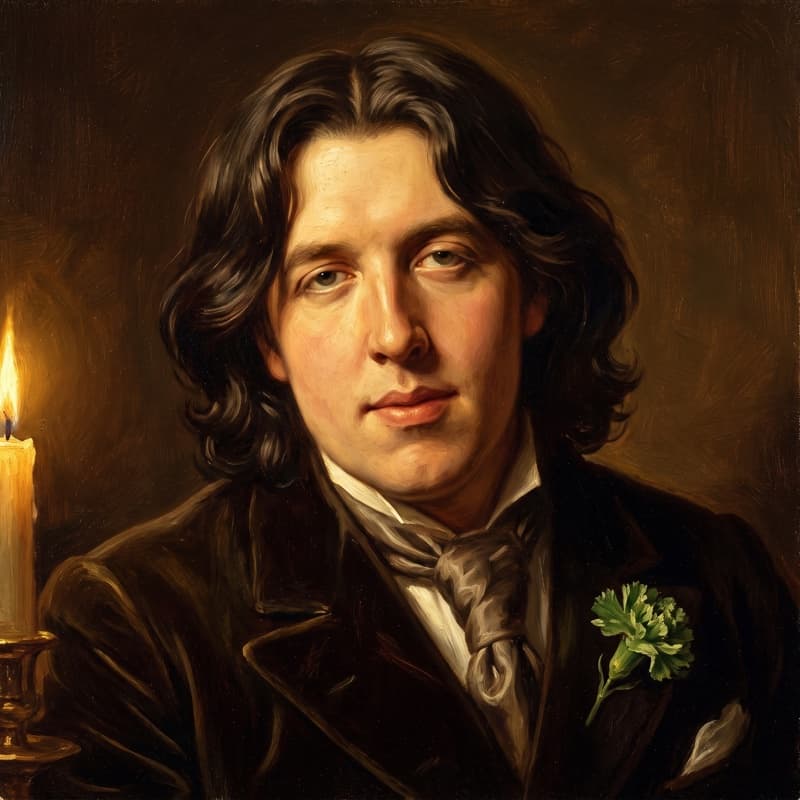
Oscar Wilde died on November 30, 1900, in Paris, at the Hôtel d'Alsace, three and a half years after walking out of an English prison. The collapse that led there started five years earlier and moved fast: a libel suit he brought against the Marquess of Queensberry in April 1895 opened, then fell apart within days when Queensberry's lawyers produced evidence Wilde could not answer. He withdrew the case. Within a week he was under arrest.
That answers the question people search for. The fuller sequence — two criminal trials, two years of hard labour, and a final act of exile and poverty — is worth the five minutes it takes to read properly.
From libel suit to the dock
Wilde sued Queensberry, the father of his companion Lord Alfred Douglas, for calling him a sodomite. The libel trial opened April 3, 1895, and collapsed almost immediately once the defense turned the proceedings toward Wilde's own conduct. He was arrested at the Cadogan Hotel on April 6. A first criminal trial for gross indecency opened April 26 and ended in a hung jury. The state tried again: a second trial convicted him on May 25, 1895, and the judge sentenced him to two years' hard labour — the maximum the law allowed. He served the sentence at Pentonville, then Wandsworth, then, from November 1895, Reading Gaol.
From a conversation with our Wilde
An excerpt from a conversation with our AI Wilde persona — a stylized recreation, honestly labeled, not a historical quotation. Our Wilde's knowledge ends before the trials.
Caller: Everyone remembers you for your wit. Were you ever afraid of anything?
Wilde: Afraid of being ordinary, mostly — of writing a sentence any dull man might have written. I have arranged my whole life around avoiding that particular humiliation. Real fear, the kind that keeps a man awake, seems to me a private matter one oughtn't perform for an audience, so I've never much practiced describing it. I suspect it announces itself clearly enough when it finally arrives, and asks no permission to be believed.
Reading Gaol and what came after
Wilde was released in May 1897 and went into exile in France, living under the assumed name Sebastian Melmoth and in genuine financial hardship. The major literary product of the ordeal was The Ballad of Reading Gaol, published in 1898, which turns his own conviction into a meditation on cruelty and guilt shared by every prisoner, guard, and judge: "Yet each man kills the thing he loves." He never returned to England. He died in Paris on November 30, 1900, and is buried at Père Lachaise Cemetery.
It is worth naming plainly what the conviction was actually for: consensual sexual acts between men, criminalized under Victorian law. The trials are sometimes flattened into pure scandal or pure spectacle; they were a prosecution under a specific, punitive statute, and the sentence — hard labour at three different prisons across more than two years — was a severe one even by the standards the judge himself was bound by.
Ask him about the part he did see
Our Wilde — an AI recreation, built from the historical record and labeled as what it is — can't tell you about the dock, the cell, or the hotel room in Paris; his knowledge ends before all of it. But he can tell you about the plays, the epigrams, and the argument he spent a career making about art answering to nothing but itself. Ask him what he meant by calling all art useless. Ask him about Dorian Gray's preface, or about Lady Bracknell's handbag. Start the conversation whenever you're ready; he has time.
More in this cluster: Wilde's verified quotes · his biography · fact file · back to the Wilde hub.