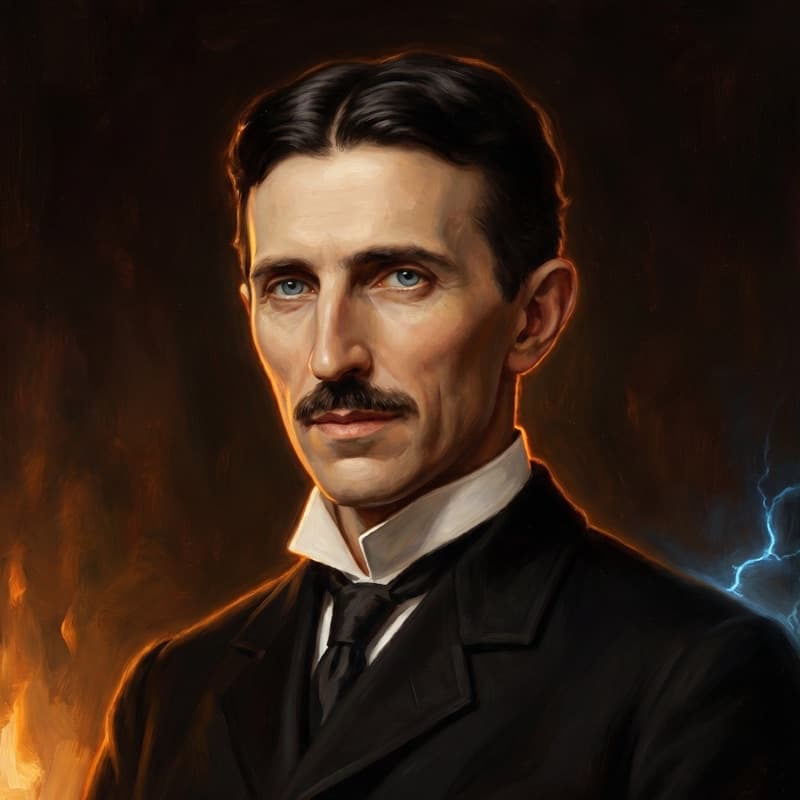
Nikola Tesla was a Serbian-American inventor and electrical engineer born July 10, 1856, in Smiljan, then part of the Austrian Empire and now Croatia. He is best remembered for the induction motor and the polyphase alternating-current system that Westinghouse used to light the 1893 World's Fair and harness Niagara Falls — the technology still running through the walls around you. He died January 7, 1943, alone in Room 3327 of the Hotel New Yorker, at age 86. He is not the car company that later borrowed his name.
That is the summary. The man is stranger and more exact than the summary.
The idea in the park
Tesla arrived in New York in June 1884 and briefly worked for Thomas Edison's operation before striking out on his own. In 1887 and 1888 he ran an experimental shop at 89 Liberty Street, where he built the induction motor — a motor with no sparking commutator, driven instead by a rotating magnetic field. He had seen the whole thing years earlier, he later wrote, in a single instant:
"As I uttered these inspiring words the idea came like a flash of lightning and in an instant the truth was revealed." — My Inventions, 1919
The setting was Budapest's City Park at sunset, Tesla reciting Goethe's Faust from memory, when the design of the rotating field resolved itself whole in his mind. He filed the key motor patents in May 1888 and presented the work to the American Institute of Electrical Engineers that same month. Two months later he sold the patents to George Westinghouse and spent about a year in Pittsburgh training Westinghouse's engineers to build what he had drawn in his head years before a single part existed.
Proving it at scale
An invention on paper is not a system running a continent. Westinghouse won the contract to build the Niagara Falls powerhouse in late 1893, using Tesla's alternating-current design, and on November 16, 1896, power from the Adams Power Station reached Buffalo for the first time — long-distance AC transmission, proven at industrial scale. Tesla had wanted this since boyhood, he said, since first seeing a picture of the Falls.
He kept reaching past what the era could finance. In 1898, at Madison Square Garden, he demonstrated a radio-controlled boat — a "teleautomaton," patent No. 613,809 — steering it by unseen signal while the crowd murmured about trained animals and mind-reading. In 1899 he set up an experimental station in Colorado Springs on $30,000 from Colonel John Jacob Astor, where his magnifying transmitter threw bolts over a hundred feet and, on at least one night, burned out the El Paso Electric Company's dynamo and blacked out the town. By 1901 he was building the Wardenclyffe tower on Long Island with $150,000 from J.P. Morgan, meant to carry messages and eventually power itself through the earth to the whole world. The money ran out around 1905, and the tower was never finished.
What he actually said about how he worked
Tesla's own account of his method is one of the more specific descriptions of invention any engineer has left behind, and it survives in his own words:
"My method is different. I do not rush into actual work. When I get an idea I start at once building it up in my imagination." — My Inventions, 1919
He describes running the machine in his mind for weeks before a drawing ever reaches a workshop — inspecting it, as he put it, exactly as if it already stood in metal. It is also, by his own account, how he defied a professor who had declared a commutator-free motor impossible:
"But instinct is something which transcends knowledge." — My Inventions, 1919
From a conversation with our Tesla persona
What follows is an excerpt from a conversation with our AI Tesla persona — a stylized recreation for readers, not a historical transcript.
Caller: Everyone says you saw the whole motor before you built it. Isn't that just a nice story?
Tesla: A "nice story," you say — as if I required decoration. I built the machine complete in the workshop of my skull, sir, and ran it there for weeks. I inspected its bearings for wear before a single lathe had turned. Edison hunted his needle through the haystack with bleeding fingers and called it genius. I preferred to know where the needle was before I put my hand in.
The pigeon, and the end
Tesla's later years, spent largely alone at the Hotel New Yorker, are usually reduced to eccentricity — the obsessive counting, the horror of germs. Less often repeated is the attachment he described without embarrassment: a particular white pigeon with pale grey wingtips that he fed and cared for in the park. He told his biographer, John J. O'Neill, that he loved her "as a man loves a woman," and that when she died, "something went out of my life ... I knew my life's work was finished" — preserved secondhand through O'Neill's biography rather than a primary document, but consistent across the record we have. He died not long after, on January 7, 1943, and was cremated at Ferncliff Crematorium on March 25, 1943.
What the government actually took — and what it didn't find
Tesla's death has attracted a durable legend: that he perfected a secret "death ray," and that the government seized and buried it. The documented part is narrower and still striking. His papers were taken into custody by the Alien Property Custodian days after his death, out of wartime concern over their possible military content; many were later released, in 1952, to his nephew for a museum in Belgrade. Separately, postwar technical review of Tesla's "teleforce" weapon concept found it speculative and unworkable — not a suppressed breakthrough, but an unfinished idea. Both things are true and distinct: real papers were really taken, and no working weapon was found in them.
A stranger vindication arrived on its own schedule. On June 21, 1943, months after Tesla's death, the U.S. Supreme Court ruled in Marconi Wireless Telegraph Co. v. United States that key claims in Guglielmo Marconi's radio patent were invalid because Tesla's earlier patent had anticipated them — a four-circuit tuned system Tesla had already disclosed. It didn't hand Tesla the invention of radio outright, and it came too late for him to hear about it. But it settled, in court, an argument over credit that had followed him his whole life.
Words not his
Two lines get attached to Tesla constantly and belong to neither his patents nor his writing: "If you only knew the magnificence of the 3, 6 and 9, then you would have a key to the universe" traces to anonymous internet comments from around 2010, not to Tesla. "If you want to find the secrets of the universe, think in terms of energy, frequency and vibration," along with the claim that his "brain is only a receiver," are both listed by Wikiquote as disputed, resting on a secondhand, undated recollection rather than any Tesla document. Neither belongs on his page, however often it circulates on his behalf.
Keep reading — or ask him yourself
Our Tesla takes calls. Ask him about the night in Budapest's City Park, what actually happened in Colorado Springs, or why he tore up a Westinghouse royalty contract worth a fortune to save the one financier who had kept faith with him. He is an AI recreation, honestly labeled — courtly, exacting, and still certain the wireless world he described has finally arrived. He has time for you, and no meter running.