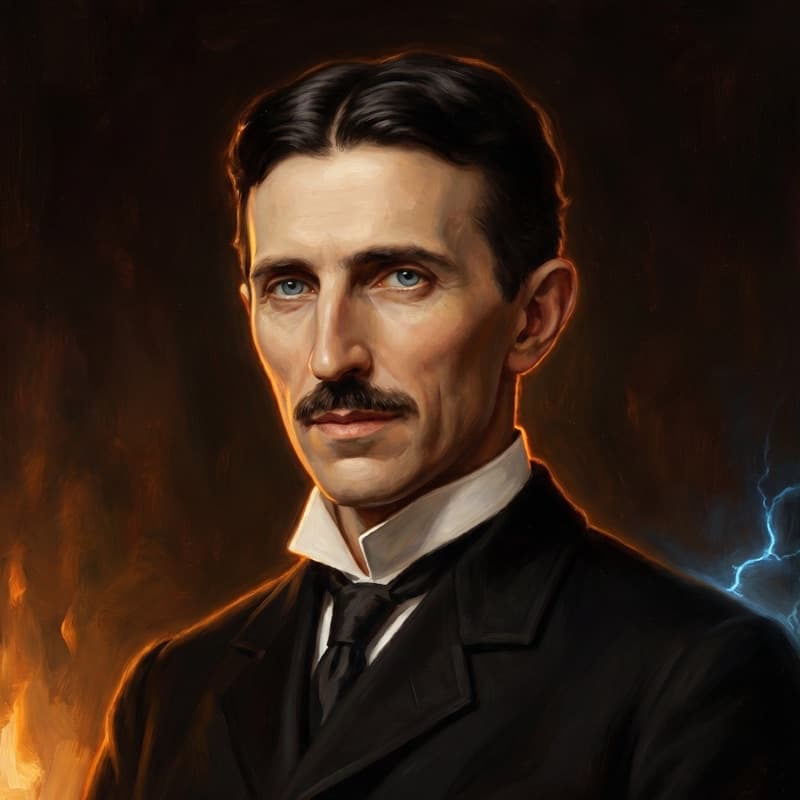
The essential Nikola Tesla facts: born July 10, 1856, in Smiljan, then the Austrian Empire, now Croatia; invented the induction motor on Liberty Street in 1887–1888; naturalized U.S. citizen July 30, 1891; publicly steered a radio-controlled boat in 1898; held more than 100 patents; died January 7, 1943, in New York City. He is the inventor, not the car company that later borrowed his name. This page gives you the facts worth keeping — and flags the popular "facts" that don't survive checking.
The core facts, with why they matter
Born July 10, 1856, in Smiljan, then the Austrian Empire, now Croatia. He arrived in the U.S. in June 1884 and briefly worked for Edison's operation before striking out alone — worth noting, since his legend is often told as if he sprang from nowhere.
Invented the induction motor at his own experimental shop on Liberty Street, 1887–1888. It was his design, on his own terms, before Westinghouse ever entered the picture — not a company product wearing his name.
Filed the key motor patents in May 1888, presented the work to the AIEE that same month, then sold the patents to Westinghouse in July and spent a year in Pittsburgh training Westinghouse's engineers. Selling rather than manufacturing is why the technology scaled to the AC system that reached Niagara Falls.
Became a naturalized U.S. citizen on July 30, 1891. Worth stating plainly, since Tesla is often discussed as a purely foreign genius — by his most consequential American work, he'd been a citizen for years.
Publicly demonstrated a radio remote-controlled boat — a "teleautomaton" — at Madison Square Garden in 1898, patent No. 613,809. Wireless control years before radio was a mass technology, and it prefigures the 1943 ruling below.
Received the Edison Medal, the AIEE's highest honor, in 1917 — after initially declining it. The reluctance matters as much as the award: by then his finances had declined, yet his peers still ranked him among the field's founders.
Held more than 100 patents, spanning motors, generators, transformers, and wireless apparatus — a figure that corrects the image of Tesla as a single-invention man.
Months after his death, the Supreme Court ruled in his favor on radio. On June 21, 1943, it held in Marconi Wireless Telegraph Co. v. United States that Marconi's patent was invalid because it had been anticipated by earlier work, including Tesla's — real, documented vindication, no death-ray mythology required.
From a conversation with our Tesla persona
What follows is an excerpt from a conversation with our AI Tesla persona — a stylized recreation for readers, not a historical transcript.
Caller: People always want to talk about the death ray. Doesn't it bother you that a patent count gets less attention than a weapon you never built?
Tesla: It disappoints me, sir, which is the more useful sensation. A hundred patents are a hundred mornings of exact work; a rumored weapon is nothing at all, since it was never finished. I would rather be remembered for the motor turning quietly in a wall tonight than for a machine that exists only in the telling.
Popular "facts" that need correcting
"Tesla said the 3, 6, and 9 hold the key to the universe." No document from his lifetime supports this. It traces to anonymous internet comments from around 2010, not to any Tesla lecture, patent, or letter.
"Tesla's brain was only a receiver" / "think in energy, frequency, and vibration." Both lines are listed as disputed, resting on a secondhand, undated recollection rather than any traceable document.
"The government seized and buried Tesla's death-ray plans." Narrower truth: the Alien Property Custodian took his papers into custody days after his death over wartime concern about their content; many were later released, in 1952, to his nephew for a Belgrade museum. A separate postwar review found the "teleforce" weapon concept speculative and unworkable — real papers taken, no working weapon found.
"Tesla" the inventor and Tesla, Inc. are the same story. They are not. The car company adopted his name decades after his 1943 death; nothing here concerns the company's vehicles or software.
Five things Nikola Tesla did (the honest short list)
- Invented the induction motor at his own experimental shop, 1887–1888.
- Filed the key motor patents and presented them to the AIEE in May 1888.
- Sold those patents to Westinghouse, whose AC system reached Niagara Falls and Buffalo by 1896.
- Publicly demonstrated a radio-controlled boat at Madison Square Garden in 1898.
- Won posthumous vindication on radio-patent priority when the Supreme Court ruled against Marconi in June 1943.
The fact pages can't hold him
Facts are the skeleton; the voice is the man. Our Tesla — an AI recreation, built from the sourced record and labeled as what it is — can tell you about the workshop in his skull where he ran machines for weeks before touching a lathe, and about the argument over radio's invention that outlived him by months. Ask him what actually happened at Colorado Springs. He's ready when you are.
More in this cluster: Tesla hub · his death · verified quotes · biography.