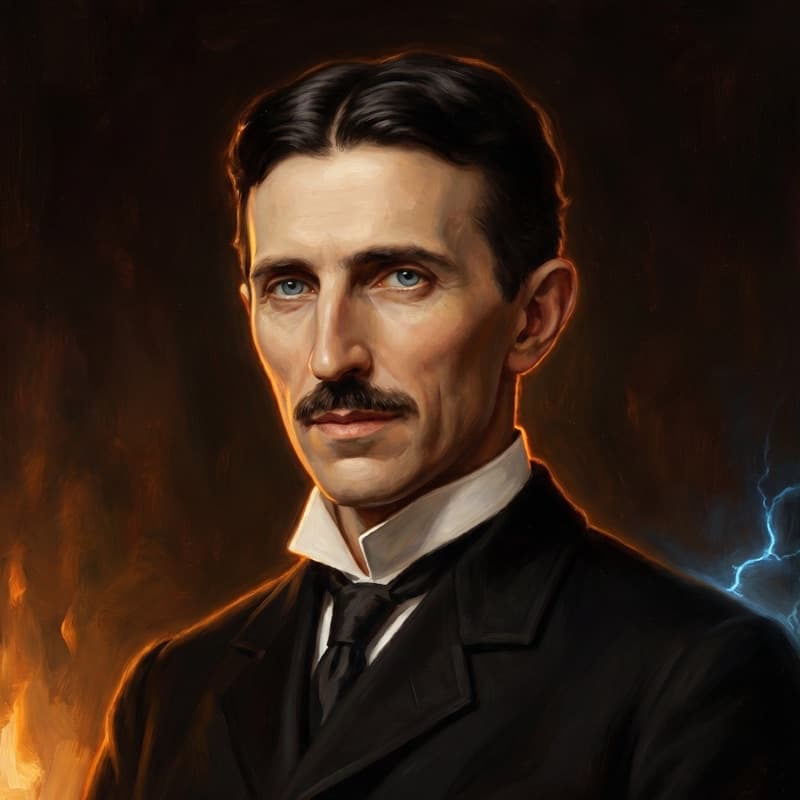
Nikola Tesla was born July 10, 1856, in Smiljan, then part of the Austrian Empire and now in Croatia, and died January 7, 1943, alone in Room 3327 of the Hotel New Yorker — the electrical engineer whose alternating-current work made long-distance power practical, not the car company that later borrowed his name. Between those rooms sits a life of exacting engineering interrupted by grand ambition.
Edison's shop, briefly
Tesla reached New York on June 6, 1884, and went to work for Edison Machine Works as a dynamo designer. It was a short, uneasy arrangement — within a couple of years he was working for himself, the first of several breaks that define his career.
Independent, at 89 Liberty Street
In 1887 and 1888, Tesla ran an experimental shop at 89 Liberty Street in Manhattan and there built the induction motor — a way of running an AC motor without the sparking commutators direct-current machines needed. He filed the key motor patents in May 1888 and presented the work to the American Institute of Electrical Engineers that same month, then sold the patents to George Westinghouse in July and spent about a year in Pittsburgh instructing Westinghouse's engineers. Of his method, Tesla later wrote: "My method is different. I do not rush into actual work." He built machines in his imagination first, down to the last part, before he touched a lathe.
Proving the system at Niagara
The idea had to work at industrial scale, and Westinghouse gave it the chance: in late 1893 the company won the contract to build the Niagara Falls power station on Tesla's alternating-current system. On November 16, 1896, power generated there reached Buffalo — proof that long-distance AC transmission was an industry, not a curiosity.
Chasing bigger visions
Success bought Tesla room to dream larger, and harder to finance. In 1898, at Madison Square Garden, he demonstrated a radio-controlled boat he called a "teleautomaton," patented as No. 613,809. From May 1899 he ran an experimental station at Colorado Springs for about nine months, funded with $30,000 from Colonel John Jacob Astor, where his tests once burned out the El Paso Electric Company's dynamo and blacked out the town. By 1901 he had the Wardenclyffe tower underway on Long Island, backed by $150,000 from J.P. Morgan, meant to prove wireless transmission of power and signals across the Atlantic. The money ran out before the idea could; Wardenclyffe was abandoned by 1905.
From a conversation with our Tesla persona
An excerpt from a conversation with our AI Tesla persona — a stylized recreation, honestly labeled; not a historical quotation.
Caller: Wardenclyffe never finished. Does that sit with you as failure?
Tesla: Failure is a word for men counting coins, not currents. I saw the tower complete in my mind long before Mr. Morgan's money ran short of my ambition.
Recognition, then isolation
In 1917 the AIEE gave Tesla its highest honor, the Edison Medal, which he initially refused before accepting. He held more than 100 patents by the end of his life, but the later years narrowed considerably: increasingly isolated, he was living at the Hotel New Yorker when his money and his grand projects had run out.
A death, and a delayed vindication
Tesla died on January 7, 1943, in that hotel room, at 86, and was cremated at Ferncliff Crematorium in Hartsdale, New York, on March 25, 1943. Months later, on June 21, 1943, the U.S. Supreme Court ruled in Marconi Wireless Telegraph Co. v. United States that Marconi's foundational radio patent was invalid, anticipated by earlier work — including Tesla's own patent No. 645,576. The argument over credit that ran through his career was still being settled after he was gone.
Continue the conversation — literally
You have just read the recorded life. Our Tesla — an AI recreation, built on the sourced record and labeled as what it is — speaks from inside it. Ask him about the 89 Liberty Street motor, or why he sold it to Westinghouse rather than build an empire on it himself.
More in this cluster: Tesla hub · his death · verified quotes · facts.