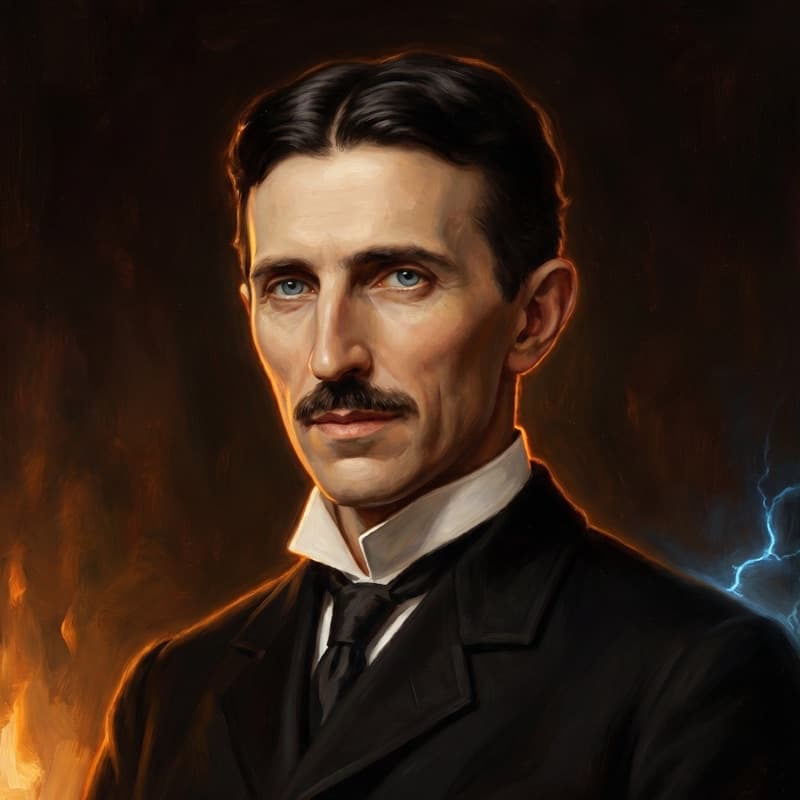
Nikola Tesla died on January 7, 1943, alone in Room 3327 of the Hotel New Yorker, at age 86. He had been living in increasing poverty and isolation for years by then, a long way from the AIEE lectures and Niagara contracts of his prime. His death certificate was issued by the New York City Health Department four days later, on January 11, 1943.
That answers the search. The rest of the story is about what happened to him after, and why so much of what people think they know about it is wrong.
What happened to his papers
Tesla's nephew, Sava Kosanović, went to the hotel room after his uncle's death. By some accounts, a few technical papers and a notebook had already gone missing before government agents arrived. Within days, the U.S. Office of Alien Property Custodian took custody of the rest of Tesla's effects — a wartime move, driven by concern over what an aging, foreign-born inventor with a public reputation for advanced weapons ideas might have been sitting on, not evidence that he had built one. Years later, in 1952, a substantial share of the seized papers were released to Kosanović, who arranged for them to go to a museum in Belgrade.
This is where the story usually curdles into legend: a secret death-ray, suppressed by the government, the inventor silenced. Set that aside. The documented version is plainer and, honestly, sadder — an old man's papers taken by wartime bureaucrats worried about loose ends, most of them eventually returned to his family, none of them a working weapon. A postwar technical review of Tesla's "teleforce" concept — the closest thing to a death-ray idea in his own writing — found it speculative and never reduced to a workable design. Losing that romantic version costs you nothing you actually had.
From a conversation with our Tesla
An excerpt from a conversation with our AI Tesla persona — a stylized recreation, honestly labeled, not a historical recording. Our Tesla's knowledge ends before that January night.
Caller: People are going to say all kinds of things happened to your notes after you're gone. What do you actually want kept?
Tesla: Kept? Friend, an idea that is truly sound does not need me to guard it — it needs someone patient enough to build it properly, which is not always the same thing as someone who understands it. I have spent a great deal of this life imagining a machine perfectly before I ever touched a tool, and I tell you the imagining is the part that survives. Papers can be misplaced or seized by frightened men in wartime; I would rather be remembered for the motor that already turns in a thousand factories than for whatever they think I was hiding in a drawer.
A quieter vindication than the myths
The real posthumous twist came that June. On June 21, 1943 — five months after Tesla's death — the U.S. Supreme Court ruled in Marconi Wireless Telegraph Co. v. United States that Marconi's foundational radio patent was invalid, because it had been anticipated by earlier work, including Tesla's own radio patent. It's a genuine vindication on priority, decided by a court, months late and no comfort to the man himself — a sturdier thing to hold onto than any death-ray story, because it's a matter of public record rather than rumor.
Tesla was cremated on March 25, 1943, at Ferncliff Crematorium in Hartsdale, New York. He had told his biographer, John O'Neill, about a white pigeon with light-grey wingtips that he said he'd loved as a man loves a woman — and that when she died, something went out of his own life with her, so that he knew his work was finished. Whatever that meant to him privately, the public record closes on a Supreme Court opinion crediting him for radio, arriving just months too late to read.
More in this cluster: Tesla's verified quotes · his biography · fact file · back to the Tesla hub.