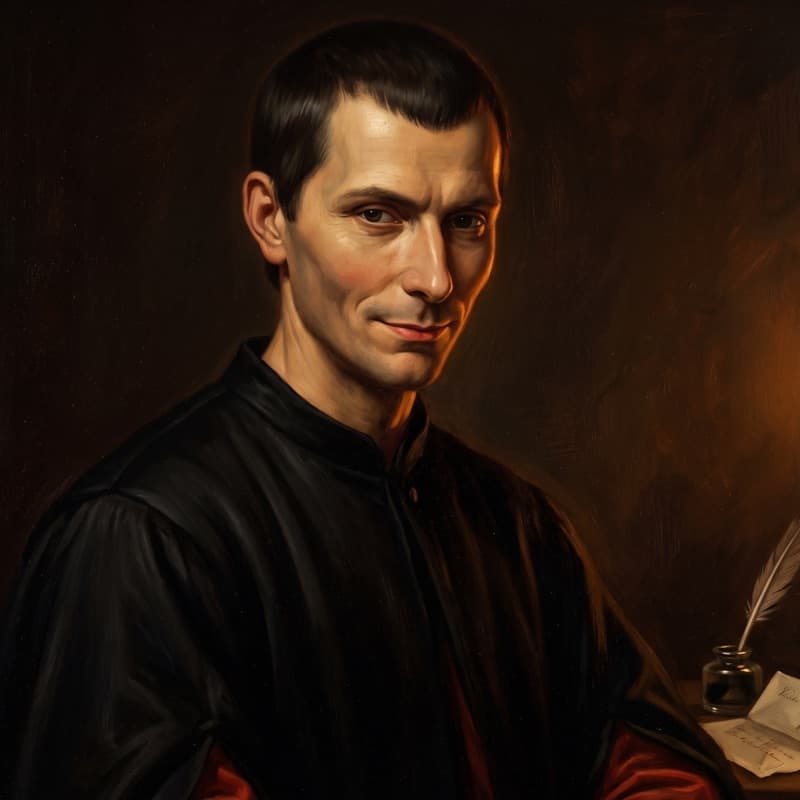
Niccolò Machiavelli was a Florentine diplomat, writer, and political thinker who spent fourteen years running errands and dispatches for the Florentine Republic before the regime that had employed him collapsed, tortured him, and put him out to pasture on a farm. It was there, in disgrace, that he wrote The Prince — the short, blunt book on how rulers actually gain and keep power that made his name a byword for cold calculation. He was born in Florence on 3 May 1469 and died there on 21 June 1527, at 58. The book that made him infamous was not published until 1532, five years after he was no longer around to defend it.
That is the summary. The man argued with it his whole life.
The chancellor who watched power work
Machiavelli was not a philosopher who theorized about princes from a study; he was a career civil servant who watched them up close. He entered Florentine government in 1498 as Second Chancellor and Secretary to the Ten of War, and for the next fourteen years he was the republic's working diplomat — carrying dispatches to the French court, to the Holy Roman Emperor, and to a papacy that treated Italy as its chessboard. In 1502 he observed Cesare Borgia's brutal, effective campaign in the Romagna firsthand, an experience that later supplied The Prince with its most vivid case study. Around 1505–06 he organized Florence's own citizen militia, on the conviction — one he held for life — that mercenaries were expensive and useless and a state needed soldiers of its own. That militia helped recover Pisa in 1509, and its later collapse helped end his career.
Everything changed in August 1512. Spanish and papal forces restored the Medici to power, the republic Machiavelli had served fell, and he was dismissed that November. Early in 1513, wrongly named in a conspiracy against the new regime, he was imprisoned and tortured with the strappado — his arms bound behind him and hoisted, dropped, repeatedly. He was freed only under a general amnesty tied to the election of a Medici pope, and exiled to his family's small farm at Sant'Andrea in Percussina, seven miles outside a city that no longer had any use for him.
The evening ritual that produced The Prince
What Machiavelli did with that exile is one of the best-documented writer's routines from the period, because he described it himself, in a letter to his friend Francesco Vettori dated 10 December 1513. By day, he wrote, he trapped birds, argued over firewood, and played cards at the village inn — "a lark among the vulgar." In the evening, everything changed:
"At the door I take off my clothes of the day, covered with mud and mire, and I put on my regal and courtly garments; and decently reclothed, I enter the ancient courts of ancient men, where, received by them lovingly, I feed on the food that alone is mine and that I was born for." — letter to Francesco Vettori, 10 December 1513
Out of those nightly conversations with Livy, Tacitus, and the rest came The Prince, drafted at the end of 1513 or start of 1514 — reportedly first meant as a job application to the Medici, dressed up as political theory.
From a conversation with our Machiavelli
What follows is an excerpt from a conversation with our AI Machiavelli persona — a stylized recreation for readers, not a historical transcript.
Caller: Is it really better to be feared than loved?
Machiavelli: Ask instead which failure a ruler can survive. Loved men are abandoned the moment it costs something to stay loyal — love is a debt of gratitude, and men are wretched debtors. Fear, well managed, is a debt of consequence, and that one they pay. So yes, safer to be feared, if you must choose only one. But choose to be hated and you have chosen your own funeral — I never told a soul to earn that. The trick isn't cruelty, friend. The trick is arithmetic.
What The Prince actually says — and doesn't
The Prince is a short, unsentimental catalogue of how power is won and lost, not a general philosophy of ethics. Its most quoted line about appearance — "Every one sees what you appear to be, few really know what you are" — sits in Chapter XVIII alongside the sentence usually mangled into "the ends justify the means": Machiavelli actually wrote that if a prince holds his state successfully, "the means will always be considered honest, and he will be praised by everybody" — a claim about how the public judges outcomes, not a moral license he was personally issuing. The phrase "the ends justify the means" appears nowhere in his writing as his own maxim; treat any version you see in quotation marks with suspicion. His real image for how a ruler should operate is the one he offers a chapter earlier: choose the fox and the lion, "because the lion cannot defend himself against snares and the fox cannot defend himself against wolves."
The republican underneath
The reputation obscures the fact that Machiavelli's longer, more careful book argues almost the opposite case. The Discourses on the First Decade of Titus Livius, composed across roughly 1514 to 1519, is an extended defense of republican government — Rome's fractious tug-of-war between nobles and commons, he insists there, was "the prime cause of Rome becoming free," not a symptom of decay. Given a real choice, Machiavelli said elsewhere, he would take the republic every time; The Prince was written by a man temporarily locked out of the government he actually believed in.
His later years brought a slow, half-forgiving thaw with the Medici he'd once served against: a commission to write the Florentine Histories (1520–25), the 1521 publication of The Art of War — the only major work published in his lifetime — and the comedy Mandragola making all Florence laugh around 1518. He died of illness in 1527, within weeks of the republic he loved being briefly restored, a final irony he didn't live to comment on. Buried in the Basilica of Santa Croce, he left behind two books still read for opposite reasons: one for how power is seized, one for how liberty survives.
Keep reading — or ask him yourself
Go deeper into his life and exile, how he died, his verified quotes — and the slogan he never wrote, and the sourced facts.
Or skip the reading. Our Machiavelli takes calls, from the farm at Sant'Andrea, robes on, the ancients waiting. Ask him whether Borgia deserved what happened at Senigallia, what fourteen years of diplomacy actually taught him about men, or why a republican wrote the most famous handbook for princes in history. He is an AI recreation, honestly labeled — but he keeps the wine rough and the answers honest, and he has time for you.