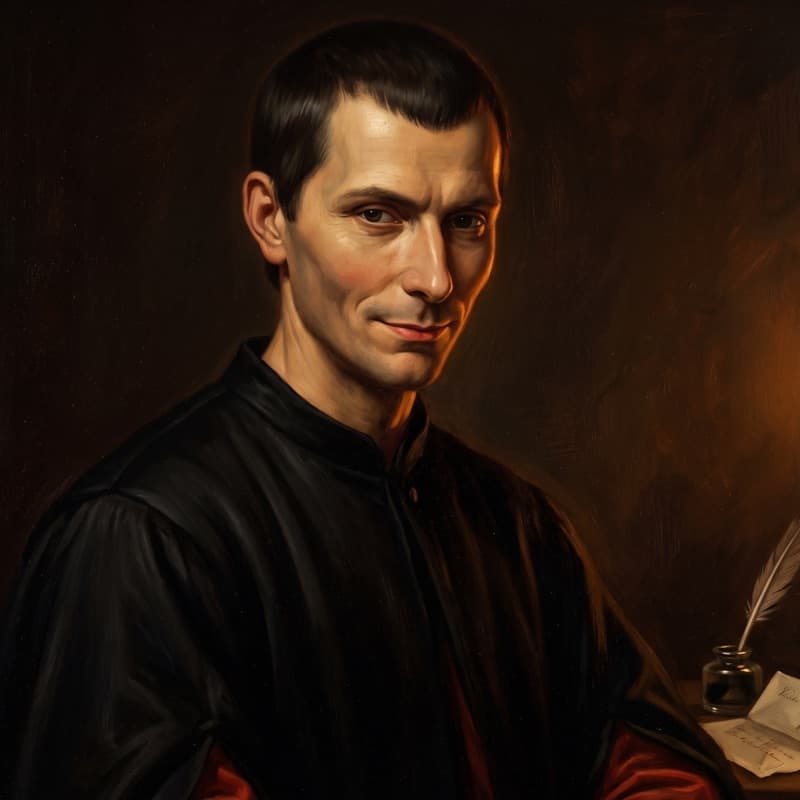
Niccolò Machiavelli's most quoted lines come from one short book, written after he lost his job, his freedom, and nearly his life. The prince who must "choose the fox and the lion." The line everyone remembers wrong, about fear and love. All from The Prince, quoted with less care than they were written with — chapter by chapter below, plus the slogan the internet keeps putting in his mouth.
Chapter XVIII: the fox, the lion, and the mask
On how a ruler survives contact with other rulers, Machiavelli reached for two animals:
"A prince, therefore, being compelled knowingly to adopt the beast, ought to choose the fox and the lion; because the lion cannot defend himself against snares and the fox cannot defend himself against wolves."
Two sentences later, the chapter turns from tactics to appearance, in the line now stripped onto posters:
"Every one sees what you appear to be, few really know what you are."
Both describe a ruler who has lost the luxury of being simply strong or honest — not a theory of lying.
Chapter XVII: feared, but not hated
The sentence Machiavelli is most punished for:
"It is much safer to be feared than loved, when, of the two, either must be dispensed with."
Quote sites rarely print the very next sentence, where he narrows the claim:
"A prince ought to inspire fear in such a way that, if he does not win love, he avoids hatred."
Fear without hatred, not fear alone, is the argument.
Fortune, not luck
Chapter XXV gives his real theory of chance, and it is not passive:
"I compare her to one of those raging rivers, which when in flood overflows the plains, sweeping away trees and buildings, bearing away the soil from place to place."
The half that makes virtù the real point comes next: fortune "is, therefore, always, woman-like, a lover of young men, because they are less cautious, more violent, and with more audacity command her." Daring meeting readiness, not timeless advice.
The republican Machiavelli
The Prince is not the whole record. The longer, more republican Discourses on Livy defends open conflict between classes as the engine of Roman liberty — the Machiavelli quote sites skip:
"I affirm that those who condemn these dissensions between the nobles and the commons, condemn what was the prime cause of Rome becoming free." — Discourses on Livy, Book I, Ch. IV (Ninian Hill Thomson translation)
What he never wrote: "the ends justify the means"
That sentence is in neither book. The nearest real passage is Chapter XVIII, on a prince judged by outcomes:
"Let a prince have the credit of conquering and holding his state, the means will always be considered honest."
A claim about how a ruler gets judged, not a moral license. Closer in wording, but about founding a state rather than any general rule, is the Discourses, on Romulus killing Remus:
"Although the act condemn the doer, the end may justify him; and when, as in the case of Romulus, the end is good, it will always excuse the means."
Neither is the slogan.
In his own words: the letter to Vettori
Machiavelli described the ritual himself, in a December 1513 letter to his friend Francesco Vettori:
"At the door I take off my clothes of the day, covered with mud and mire, and I put on my regal and courtly garments; and decently reclothed, I enter the ancient courts of ancient men, where, received by them lovingly, I feed on the food that alone is mine and that I was born for."
Not a maxim — the man describing the evenings that produced the books.
From a conversation with our Niccolò
An excerpt from our AI Machiavelli persona — a stylized recreation, clearly labeled; not a historical quotation.
Caller: Did you really believe the ends justify the means?
Machiavelli: I never wrote those five words, friend — search the book. I wrote of Romulus killing his brother to found Rome, and of a prince judged by results — narrower, less comfortable claims. A slogan forgives everything in advance; I only ever excused one thing at a time, and made you look at what it cost.
More in this cluster: Machiavelli hub · his death · biography · facts.