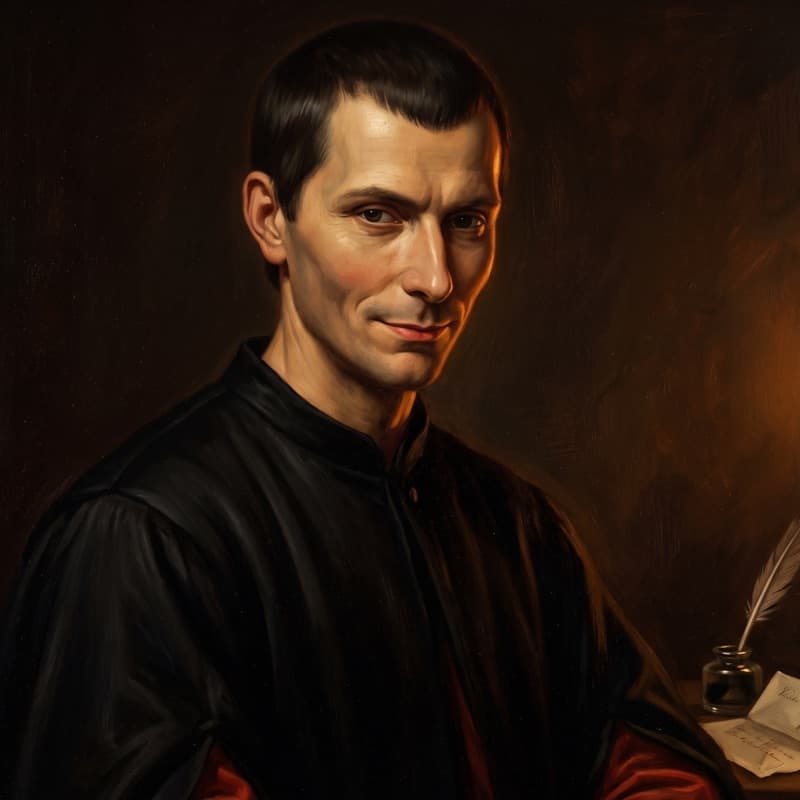
The essential Machiavelli facts: born in Florence on May 3, 1469; spent fourteen years as a diplomat and Second Chancellor of the Florentine Republic before writing the theory he's remembered for; organized Florence's own citizen militia rather than trust mercenaries; imprisoned and tortured in 1513 on a false conspiracy charge; wrote The Prince in exile at the end of 1513 or early 1514, published only in 1532, after his death; died in Florence on June 21, 1527, at 58. All verified. This page also flags the "quotes" that don't survive checking.
The core facts, with why they matter
He was a practitioner before he was a theorist. From 1498 he served as Second Chancellor of the Florentine Republic and Secretary to the Ten of War, running diplomatic missions to France, Rome, and the Holy Roman Empire for fourteen years. The Prince was written by someone who had sat across the table from actual princes, not an armchair philosopher.
He built Florence's own militia instead of hiring mercenaries. Around 1505–1506 he organized a citizen army, reflecting a lifelong argument that a state defended by its own people is sturdier than one rented from condottieri. That militia's defeat when the Medici were restored in 1512 cost him his job.
He was imprisoned and tortured on a false charge. Wrongly implicated in an anti-Medici conspiracy in early 1513, Machiavelli was jailed and subjected to the strappado before release under an amnesty tied to a new pope's election. He wrote The Prince not long after, from a working farm outside Florence, not a position of power.
He defended republics at length, in roughly the same years as The Prince. The Discourses on the First Decade of Titus Livius, composed from around 1514 onward, argues for republican government and liberty — a body of work routinely ignored by anyone who reduces him to "the guy who wrote about tyrants."
He wrote comedy too, not just political theory. His play Mandragola dates to around 1518. The Art of War, published in 1521, was the only major work to appear in print during his lifetime — The Prince and the Discourses were both published after he died.
The Medici who once imprisoned him later paid him to write their history. In 1520, Cardinal Giulio de' Medici commissioned a history of Florence from him; he delivered the Florentine Histories in 1525 — rehabilitation of a sort, given that family's allies had tortured him seven years earlier.
Popular "facts" that need correcting
"Machiavelli said the ends justify the means." He didn't write that sentence anywhere. The closest real passage, in The Prince, Chapter XVIII, argues that a prince is judged by outcomes and appearances in the specific business of holding a state — narrower and more careful than the slogan implies.
"Machiavellian means exactly what Machiavelli believed." The adjective postdates him by centuries and mostly describes a caricature, not a writer who also produced a republican treatise and a stage comedy.
"He was purely a cynic who admired cruelty." The Prince, Chapter XVII, says it is safer to be feared than loved when a ruler must choose — but the very next line insists a prince should still avoid being hated. Quoting the first half alone overstates the case.
Five things Machiavelli did (the honest short list)
- Served fourteen years as a Florentine diplomat and Second Chancellor.
- Built Florence's citizen militia instead of relying on mercenaries.
- Survived imprisonment and torture after the 1512 Medici restoration.
- Wrote both The Prince and the Discourses on Livy in the years after his exile.
- Wrote Florence's official history on commission from the family that once jailed him.
The fact pages can't hold him
Facts are the skeleton; the voice is the man. Our Machiavelli — an AI recreation, built from the sourced record and labeled as what it is — can tell you what the farm outside Florence felt like, why the militia mattered more to him than any single line in The Prince, and how fourteen years of diplomatic dispatches became the era's most argued-over book on power. Ask him about virtù and fortuna directly. He's ready when you are.