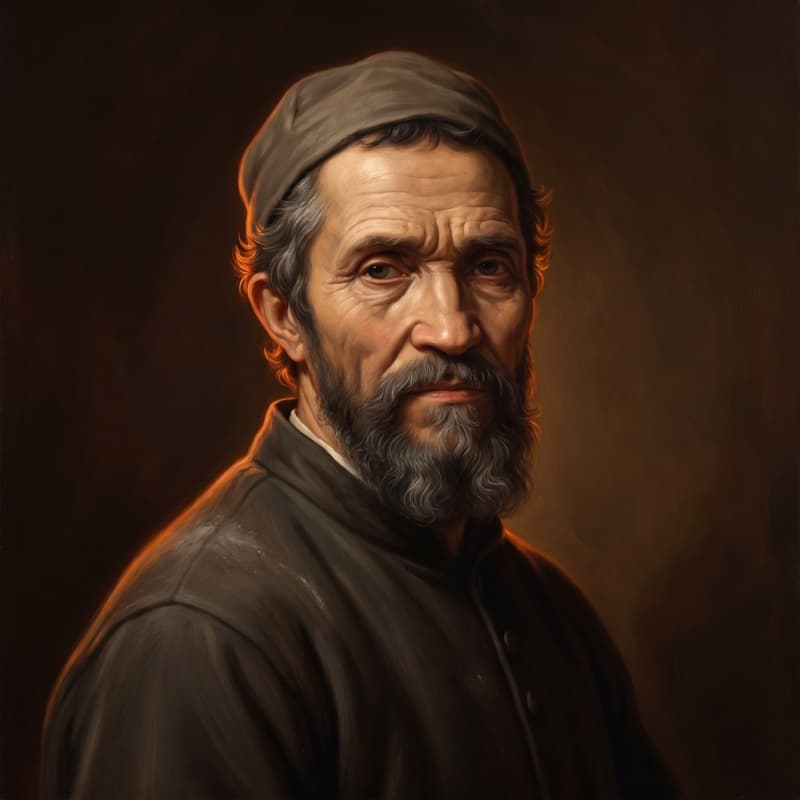
Michelangelo Buonarroti (1475–1564) was a Renaissance sculptor, painter, architect, and poet, best known for the David, the Pietà, the Sistine Chapel ceiling, The Creation of Adam, The Last Judgment, and his late work on St. Peter's. He is famous for mastery across four arts while insisting on sculpture as his true one — a claim he made in his own letters and verse, which this page cites directly. Every quotation below is drawn from verified editions of his poems and correspondence, or from institutional sources; popular quotes that could not be verified are noted as such.
Early life and training
Michelangelo was born at Caprese on March 6, 1475, according to the modern reckoning noted in Holroyd's edition of Condivi (Michael Angelo Buonarroti). At thirteen he was apprenticed to the painter Domenico Ghirlandaio under a 1488 agreement; his father bound him to Domenico and Davit Ghirlandaio for a three-year term. The decisive step came when Ghirlandaio selected him to study in Lorenzo de' Medici's sculpture garden at San Marco, where antique models and Bertoldo's instruction shaped him between roughly 1489 and 1492. The garden, not the painter's workshop, became his formative school.
The Pietà and the David
Between 1498 and 1499 Michelangelo carved the Roman Pietà for Cardinal Jean de Bilhères. Holroyd recounts that after hearing the work attributed to another sculptor, Michelangelo carved his name on the belt of the Madonna's robe — and states that he never signed any other work (Holroyd).
He began work on the colossal David in Florence in September 1501, and the finished statue was installed at the Palazzo Vecchio in 1504, after a placement debate whose committee included Leonardo da Vinci. The two artists' relationship is best described as documented proximity and professional rivalry: beyond the placement committee, Holroyd notes that Leonardo and Michelangelo were assigned competing battle cartoons for the Palazzo Vecchio.
His own account of sculpture survives in verse: "The best of artists hath no thought to show which the rough stone in its superfluous shell doth not include," he wrote in a sonnet, adding, "To break the marble spell is all the hand that serves the brain can do" (The Sonnets of Michael Angelo Buonarroti, trans. John Addington Symonds). The familiar modern versions of this idea — "I saw the angel in the marble and carved until I set him free" and "Every block of stone has a statue inside it and it is the task of the sculptor to discover it" — are not found in his letters or the verified editions of his poems; the sonnet above is the sourceable original.
The Sistine Chapel
In 1505 Julius II called Michelangelo to Rome for a tomb project that became a decades-long struggle: an original ambition of more than forty statues, later reduced, leaving the Moses as the survivor of the larger scheme (Holroyd).
On May 8, 1508, Michelangelo signed the contract to repaint the Sistine Chapel ceiling, and the Vatican Museums state the work must have been complete by October 31, 1512 (Vatican Museums, Ceiling). The program expanded from its original apostle scheme into the Genesis cycle, whose most famous scene, The Creation of Adam, centers on the near-contact of God's and Adam's fingers — the point through which, in the Vatican Museums' description, the breath of life is transmitted (Vatican Museums, Creation of Adam).
Michelangelo's own testimony about the ceiling is a comic sonnet on its physical cost: "My beard turns up to heaven; my nape falls in," he wrote, "Crosswise I strain me like a Syrian bow," closing with "Since foul I fare and painting is my shame" (Symonds translation) — a complaint about the labor of fresco, not an assessment of the finished work. Decades later he returned to the same chapel: between 1536 and 1541 he painted The Last Judgment on the altar wall (Vatican Museums, The Last Judgement), a work that drew both praise and controversy, and later coverings.
Sculptor by conviction
Michelangelo's insistence on sculpture was a considered position, not a pose. Writing to Benedetto Varchi, he said that "la scultura fussi la lanterna della pittura" — sculpture had seemed to him the lantern of painting (Le lettere di Michelangelo Buonarroti; the phrase is given in Italian to avoid overclaiming a modern translation). His sonnets make the same case for the art's permanence: "With Sculpture, know this well; her wonders live in spite of time and death" (Symonds).
What is his most famous work?
The question has two defensible answers, depending on what it means. If it means a sculpture, David is usually the clearest single answer: it established his public fame in Florence and became the emblem of his heroic marble style. If it means his most famous image overall, the Sistine ceiling — and The Creation of Adam in particular — is the main rival. The Pietà holds a distinction of its own as the only work he is known to have signed. Note that The Creation of Adam is not a separate portable painting: it is a fresco scene within the ceiling's Genesis program (Vatican Museums).
Late work and death
After Antonio da Sangallo died in 1546, Michelangelo succeeded him as architect-in-general for the Pope, with St. Peter's as the principal work (Holroyd). His late poetry turned increasingly devotional; in one sonnet he confessed, "Painting nor sculpture now can lull to rest my soul" (Symonds). He died in Rome on February 18, 1564, a few weeks before his eighty-ninth birthday.
Continue the conversation
The sources cited on this page also power something stranger: Calls From The Past hosts an AI Michelangelo persona — clearly framed as an AI persona, not the man — that you can question directly. Ask him why sculpture was the lantern of painting in the Varchi letter, what he saw in the David block, or why a man who was rich lived and worked like he was still covered in quarry dust.