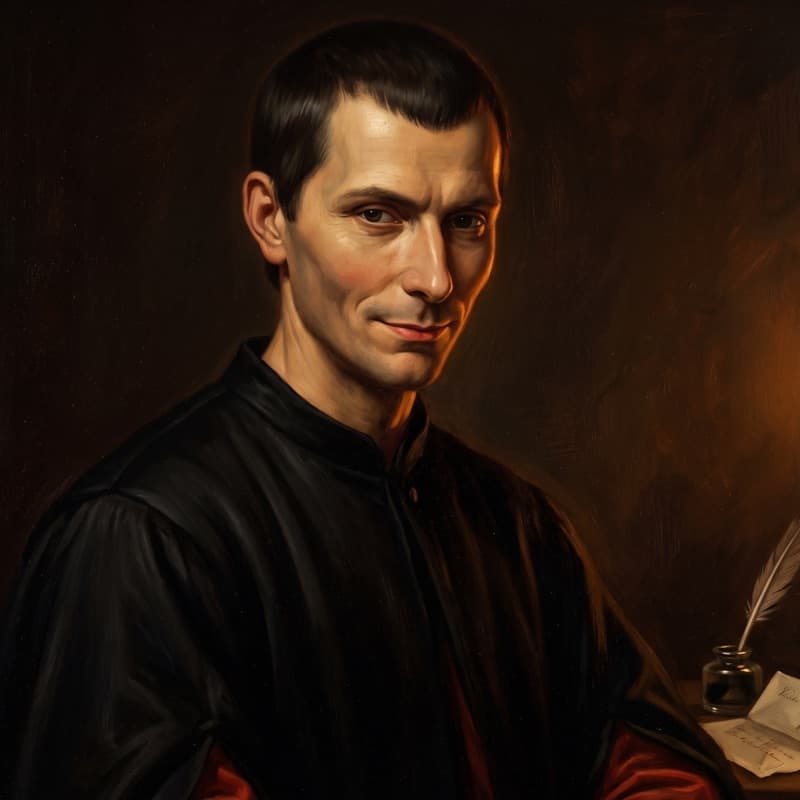
Niccolò Machiavelli died in Florence on 21 June 1527, at age 58. The cause was ordinary illness: a stomach ailment he had reportedly been suffering from since 1525, not any act of violence or political retaliation. He was buried in the Basilica of Santa Croce, the Florentine church that later became a resting place for a cluster of major Italian tombs.
That answers the immediate question. The timing of his death, though, is the part worth sitting with.
The republic came back too late for him
A few weeks before Machiavelli died, Florence's political ground shifted again. The Medici, who had restored themselves to power in 1512 and then employed Machiavelli on and off in his final years, were expelled from the city once more after the Sack of Rome, and citizens set up a new republican government. Machiavelli — who had spent the previous decade trying to work his way back into public life, first as an exile writing in isolation and later doing commissioned work for the Medici, including Florence's official history — was reportedly considered for a role in the restored republic. The idea was turned aside precisely because of his recent association with the Medici he had once served against his own republican instincts.
He died weeks later, still on the outside of the government he had spent his working life trying to serve. It is the kind of ending that resists a tidy moral, and the sources don't try to supply one — it's simply how the clock ran out.
Not the death you'd expect from his reputation
A writer remembered for cold analyses of cruelty, conspiracy, and the mechanics of power invites an assumption: that his own end was dramatic, maybe violent, maybe political. It wasn't. The dramatic threat to Machiavelli's life came fourteen years earlier, in 1513, when he was wrongly implicated in a conspiracy against the newly restored Medici, imprisoned, and tortured with the strappado before being released under an amnesty. He survived that. The illness that actually killed him in 1527 was unremarkable by comparison — the kind of death that happens to any Florentine in his late fifties, regardless of what he had written or who he had angered.
From a conversation with our Machiavelli
An excerpt from a conversation with our AI Machiavelli persona — a stylized recreation, honestly labeled, not a historical quotation. Our Machiavelli's knowledge ends before that final illness.
Caller: Doesn't it bother you that the ending isn't dramatic — no plot, no enemy, just a bad stomach?
Machiavelli: You have been reading too much of what I wrote about princes and not enough of what I wrote about Fortune. She is a river in flood, friend — she does not spare a man because he once amused himself designing how rivers ought to be dammed. Most men do not die at the climax of their own story. They die in whatever chapter they happen to be standing in when the water rises. I would rather be remembered for what I built on the good days than for how the last one arrived.
What outlived him
Machiavelli's fame as "Machiavelli" the theorist is largely a posthumous invention. Neither of his two major political works reached print in his lifetime: the Discourses on Livy was published in 1531, four years after his death, and The Prince followed in 1532. The man who spent fourteen years as a working diplomat, then years more trying to talk his way back into Florentine politics, never lived to see the books that made his name outlast the office he lost.
More in this cluster: Machiavelli's verified quotes · his biography · fact file · back to the Machiavelli hub.