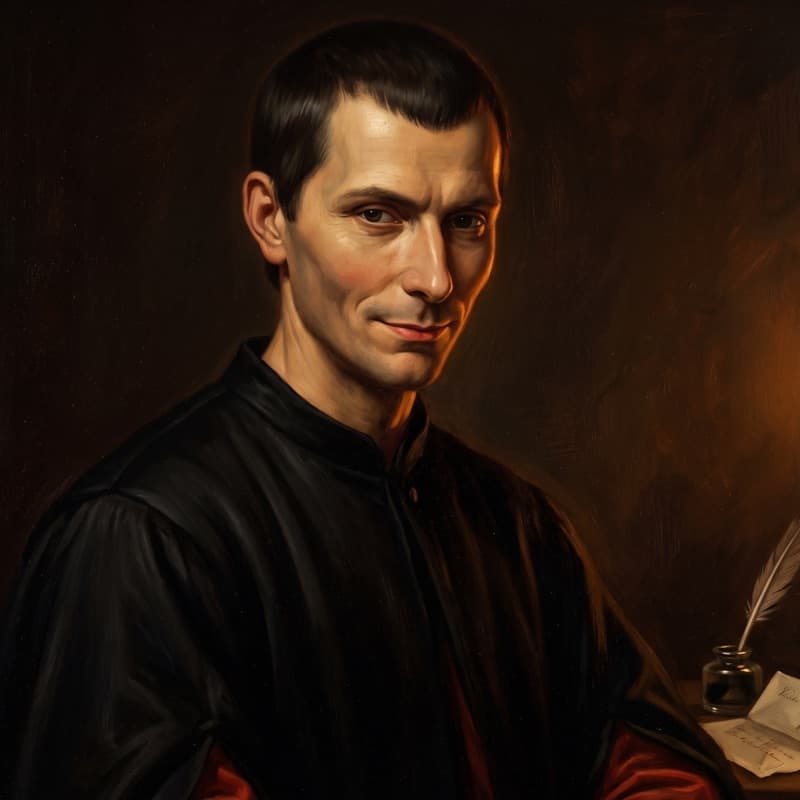
Niccolò Machiavelli was born on May 3, 1469, in Florence, the son of an attorney, and died in the same city on June 21, 1527, having spent his final years trying to work his way back into the government that had once imprisoned him. Between those dates sits a life most people get backward: he was a working diplomat for fourteen years before he wrote a word of the political theory he is now known for, and his most famous book was published only after he was dead.
The temptation is to read his life as building toward The Prince, as though the whole career were research for one manuscript. Taking the record in order tells a truer story — a career civil servant losing his job in a regime change, and turning what was left of his life into something else entirely.
A Republic's service
Machiavelli grew up with a strong legal and literary bent — his father was an attorney — and received a classical humanist education from childhood, reading Livy, Cicero, Aristotle, and Thucydides. In 1498 he was appointed Second Chancellor of the Florentine Republic and Secretary to the Ten of War, beginning fourteen years of public service that was no desk job: he ran diplomatic missions across Italy, to the French court, and to the Holy Roman Empire, producing the dispatches now known as the Legations. In 1502 he observed Cesare Borgia's campaign in the Romagna firsthand — direct experience that later fed The Prince's discussion of Borgia as a model "new prince." He married Marietta Corsini in 1501, and around 1505–1506 organized a Florentine citizen militia, reflecting a lifelong distrust of mercenaries; that militia helped recover Pisa for Florence in 1509.
The 1512 rupture
In August 1512, Spanish and papal forces restored the Medici to power in Florence, defeating the republic's government and its militia. Machiavelli's tenure in office ended that November. In early 1513 he was wrongly implicated in a conspiracy against the restored Medici, imprisoned for roughly three weeks, and tortured with the strappado before being released under an amnesty tied to the election of Giovanni de' Medici as Pope Leo X.
Exile at Sant'Andrea in Percussina
After his release, Machiavelli retired to his family farm outside Florence. In a December 1513 letter to his friend Francesco Vettori, he described the ritual that structured his exile: ordinary days among farmhands and tradesmen, evenings given over to reading. "At the door I take off my clothes of the day, covered with mud and mire, and I put on my regal and courtly garments; and decently reclothed, I enter the ancient courts of ancient men, where, received by them lovingly, I feed on the food that alone is mine and that I was born for." Out of those evenings came The Prince, written at the end of 1513 or early 1514, and, beginning around 1514–1515, the much longer Discourses on the First Decade of Titus Livius — an extended argument for republican government often set against The Prince, even though both were largely written in the same years of exile. Neither book was published in his lifetime; the Discourses appeared in 1531 and The Prince in 1532, four and five years after his death.
A partial return, and a last irony
The Medici never fully restored him to office, but they did not ignore him. He likely wrote his comedy Mandragola around 1518, published The Art of War in 1521 — the only major work printed in his lifetime — and in 1520 was commissioned by Cardinal Giulio de' Medici to write a history of Florence, completed as the Florentine Histories in 1525.
Machiavelli died in Florence on June 21, 1527, and was buried in the Basilica of Santa Croce. The timing carries its own irony: he died within weeks of the Medici being expelled from Florence a second time and the republic briefly restored, just as the political ground he had spent years trying to stand on again shifted beneath him.
Continue the conversation
You have just read the recorded life — a career official who lost everything in a single year, and turned the years that followed into two books people still argue about. Ask our Machiavelli about the diplomatic missions, the night he was tortured, or why he wrote a defense of republics in the same years he wrote a manual for princes.
More in this cluster: Machiavelli hub · his death · verified quotes · facts.