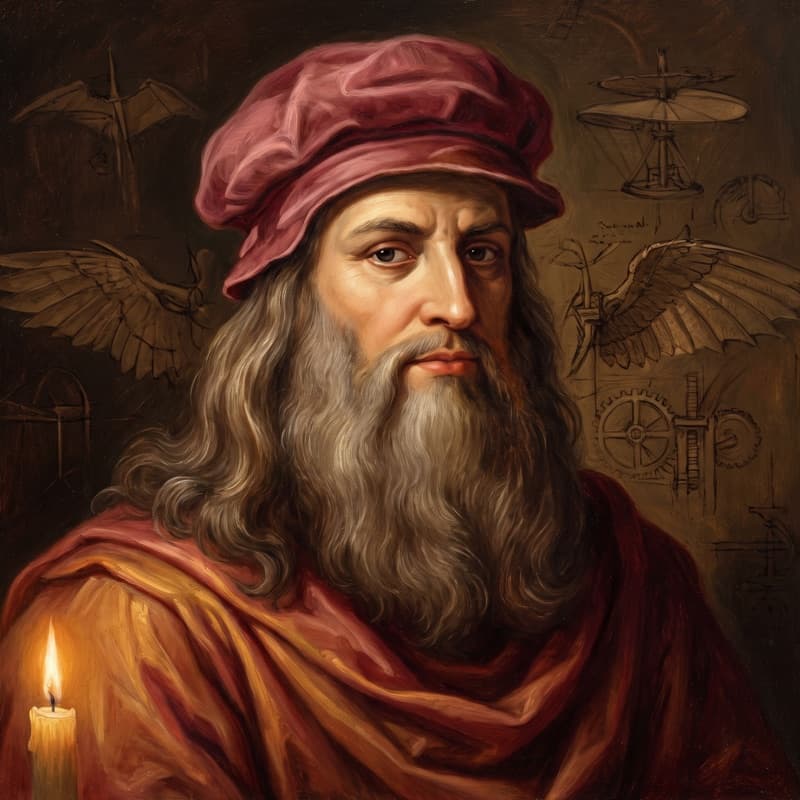
Leonardo da Vinci was born on April 15, 1452, in or near the Tuscan hill town of Vinci, the illegitimate son of a Florentine notary, and died on May 2, 1519, at the manor of Clos Lucé in Amboise, France, aged 67, an honored guest of King Francis I. In between he painted the Mona Lisa and The Last Supper, dissected more than ten human bodies by his own count, designed flying machines nobody built, and filled thousands of notebook pages — written right to left, in mirror script — with questions.
That is the summary. The notebooks are where the summary falls apart.
The apprentice who trusted his eyes
Leonardo's birth shut doors. As a notary's illegitimate son he was denied Latin schooling and a path into his father's profession, so he was apprenticed instead to the sculptor and painter Andrea del Verrocchio in Florence, and by 1472, at age 20, he qualified as a master in the Guild of Saint Luke, the city's guild of painters and physicians. The learned men of his day quoted Aristotle at him. His answer, written into his notebooks, became the closest thing he had to a creed:
"Though I may not, like them, be able to quote other authors, I shall rely on that which is much greater and more worthy:--on experience, the mistress of their Masters." — The Notebooks of Leonardo da Vinci, tr. Jean Paul Richter
He kept sharpening the point all his life. "Science is the captain, and practice the soldiers," he wrote in Chapter XIX of the notebooks. Look first. Test everything. Trust no authority you have not checked against nature.
Milan, and a masterpiece that started dying immediately
Around 1482 Leonardo moved to Milan and entered the service of Duke Ludovico Sforza — pitching himself, characteristically, as a military engineer who also happened to paint. The painting came anyway. Between roughly 1495 and 1498 he covered the refectory wall of Santa Maria delle Grazie with The Last Supper, and because true fresco dries too fast for a man who cannot stop revising, he gambled on an experimental technique — tempera over gesso, pitch, and mastic on a dry wall.
The gamble bought him time to perfect the picture and cost the picture its life. It began deteriorating almost immediately; rescuing what survives took a restoration that ran from 1978 to 1999. It is the most Leonardo story there is: the greatest narrative painting of the Renaissance, flaking, because its maker refused to work at any speed but his own.
The notebooks: a mind caught on paper
The paintings made him famous. The notebooks make him knowable. Five of them, bound into the three Forster Codices at the Victoria and Albert Museum since John Forster's bequest of 1876, jump from proportion to hydraulics to mechanics — all in that famous right-to-left mirror writing. The Vitruvian Man, drawn around 1490 and kept at the Gallerie dell'Accademia in Venice since 1822, compresses the whole project into one image: a man in two poses, inscribed in a circle and a square. And the anatomy pages record fieldwork almost nobody else alive was doing:
"I have dissected more than ten human bodies, destroying all the other members, and removing the very minutest particles of the flesh by which these veins are surrounded, without causing them to bleed." — The Notebooks, Chapter XIV
Candlelight, a strong stomach, and patience measured in corpses — that was the price of drawing a heart accurately in 1500. One caution while quoting him: many lines that circulate under his name, from "Simplicity is the ultimate sophistication" to "Once you have tasted flight," have no source in his writings. The real lines are better anyway.
From a conversation with our Leonardo
What follows is an excerpt from a conversation with our AI Leonardo persona — a stylized recreation for readers, not a historical quotation.
Caller: Be honest — was the backwards writing a secret code?
Leonardo: Ha! Everyone hopes for a cipher, and I hate to disappoint a hopeful mind. I am left-handed, my friend. Dragging a pen from left to right smears the ink across my hand; going right to left, the page stays clean and so do I. Hold my notes to a mirror and every secret surrenders at once — though watching a visitor tilt his head and whisper sorcery has been worth a little something all these years.
Who is the Mona Lisa — and why does France own her?
Two of the most-searched questions about Leonardo have plain answers. The sitter is Lisa Gherardini, wife of the Florentine silk merchant Francesco del Giocondo — hence "La Gioconda." And she is in Paris because Leonardo carried the portrait to France, where King Francis I bought it from him in 1518. Since 2005 she has hung in the Louvre's Salle des États behind protective glass, a poplar panel slowly warping for five centuries.
The end at Amboise
In 1516 Leonardo accepted Francis I's invitation to France and settled at Clos Lucé, near the royal château at Amboise — still arranging his notebooks, his right hand weakening. He died there on May 2, 1519, possibly of a stroke, and was interred that August in the château's church of Saint-Florentin. The church was later demolished, which is why the identification of his remains is disputed to this day. The famous image of him dying in the king's arms is a Romantic-era legend — moving, and undocumented.
He left behind the Sforza horse never cast, the Battle of Anghiari lost, panels abandoned mid-thought — and pages that out-ask every finished thing he made.
Caller: Doesn't it haunt you, everything you left unfinished?
Leonardo: Gently, yes — the way an old debt haunts a rich man. But consider: a finished painting answers one question forever. A notebook asks a thousand and leaves them open for whoever comes next. I began more than I ended because the world kept interrupting me with new things to notice. Tell me truthfully — is that a flaw in me, or a flaw in the size of a single life?
Excerpt from our AI Leonardo persona — stylized, and labeled as such.
Keep reading — or ask him yourself
The pages below go deeper: his full biography, his death at Amboise and the mystery of his grave, his verified quotes — and the viral ones he never said, and the facts, sourced.
Or skip the reading. Our Leonardo takes calls. Ask him why The Last Supper started peeling in his own lifetime, what he found dissecting by candlelight, or why he could never quite call the little portrait of Lisa finished. He is an AI recreation, honestly labeled — but he answers the way the notebooks read: one good question at a time, and he has time for yours.