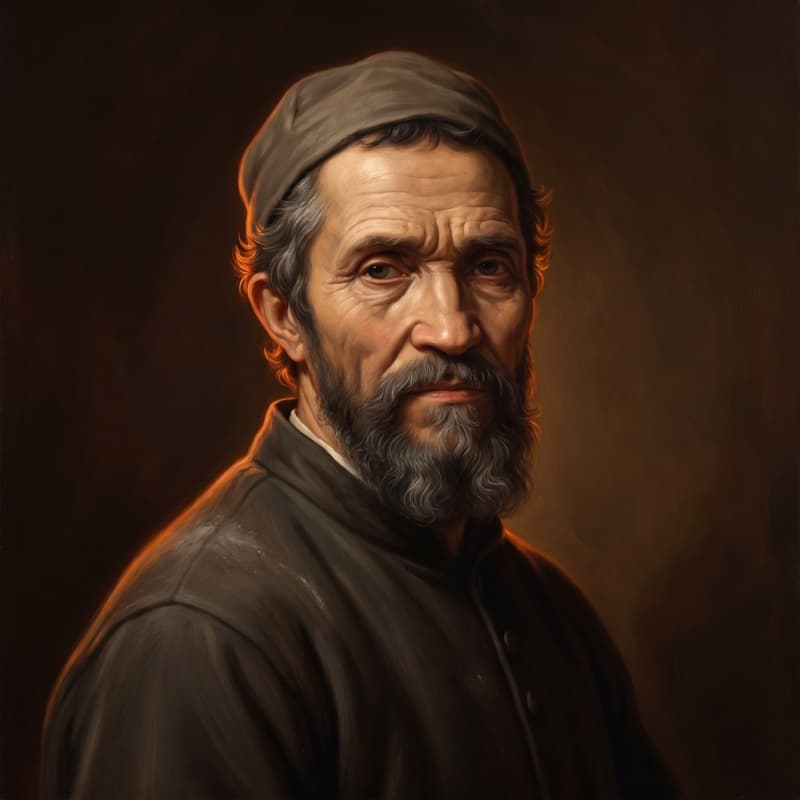
Ten verified facts about Michelangelo: born at Caprese in 1475; apprenticed to Ghirlandaio in 1488; trained in Lorenzo de' Medici's sculpture garden; carved the Pietà — his only signed work — and the David; signed the Sistine ceiling contract in 1508 and finished by 1512; recorded that labor in a sonnet; painted The Last Judgment in 1536–1541; became architect of St. Peter's in 1546; wrote a substantial body of verse; and died in Rome in 1564. Each fact below carries its citation, and the section at the end lists popular "facts" and quotes that failed verification.
Early training
1. Birth at Caprese, March 6, 1475. The modern reckoning is noted in Holroyd's edition of Condivi (Michael Angelo Buonarroti). The common assumption of a Florentine birth is wrong, though the family returned to Florentine life.
2. Apprenticeship at thirteen. A 1488 agreement bound him to Domenico Ghirlandaio for three years (Holroyd).
3. The Medici garden as formative school. Ghirlandaio selected him to study in Lorenzo de' Medici's San Marco sculpture garden, where antique models and Bertoldo's instruction shaped him, c. 1489–1492 (Holroyd).
Signature works
4. The Pietà is his only signed work. Carved 1498–1499 for Cardinal Jean de Bilhères; after hearing it attributed to another sculptor, he carved his name on the belt of the Madonna's robe. Holroyd states he never signed any other work (Holroyd).
5. The David is precisely datable. Begun September 1501; installed at the Palazzo Vecchio in 1504, following a placement debate whose committee included Leonardo da Vinci (Holroyd).
6. The Sistine ceiling ran on a contract. Signed May 8, 1508; the Vatican Museums state the work must have been complete by October 31, 1512, and that the program expanded from its original apostle scheme (Vatican Museums, Ceiling).
7. The famous fingers are the composition's focal point. The Vatican Museums describe the near-contact of God's and Adam's fingers in The Creation of Adam as the channel through which the breath of life is transmitted (Vatican Museums, Creation of Adam) — not a decorative detail.
Patrons and pressure
8. He documented the ceiling's cost in verse. His comic sonnet on the fresco records the strain: "My beard turns up to heaven; my nape falls in," and "Crosswise I strain me like a Syrian bow," closing "Since foul I fare and painting is my shame" (The Sonnets of Michael Angelo Buonarroti, trans. Symonds). The line is a complaint about labor, not a judgment of the finished ceiling.
9. The late fresco is securely dated. The Last Judgment was painted on the Sistine Chapel altar wall between 1536 and 1541 (Vatican Museums, The Last Judgement).
Late work
10. His principal architectural responsibility came late. After Antonio da Sangallo died in 1546, Michelangelo succeeded him as architect-in-general for the Pope, with St. Peter's as the principal work; he died in Rome on February 18, 1564, a few weeks before his eighty-ninth birthday (Holroyd).
What failed verification
Several staples of Michelangelo trivia were checked against the primary editions used for this page and could not be verified: "I saw the angel in the marble and carved until I set him free," "Every block of stone has a statue inside it and it is the task of the sculptor to discover it," "Trifles make perfection, and perfection is no trifle," and the motto "Ancora imparo." None was found in his letters or the verified editions of his poems. The verified counterpart of the marble aphorisms is his own sonnet: "The best of artists hath no thought to show which the rough stone in its superfluous shell doth not include" (Symonds).
Continue the conversation
The sources behind these facts also power Calls From The Past's AI Michelangelo persona — identified plainly as an AI persona, not the man. If a fact here sharpened your curiosity, take it further: ask why signing the Pietà once was already one signature too many, or how it felt to inherit St. Peter's when he was already old.