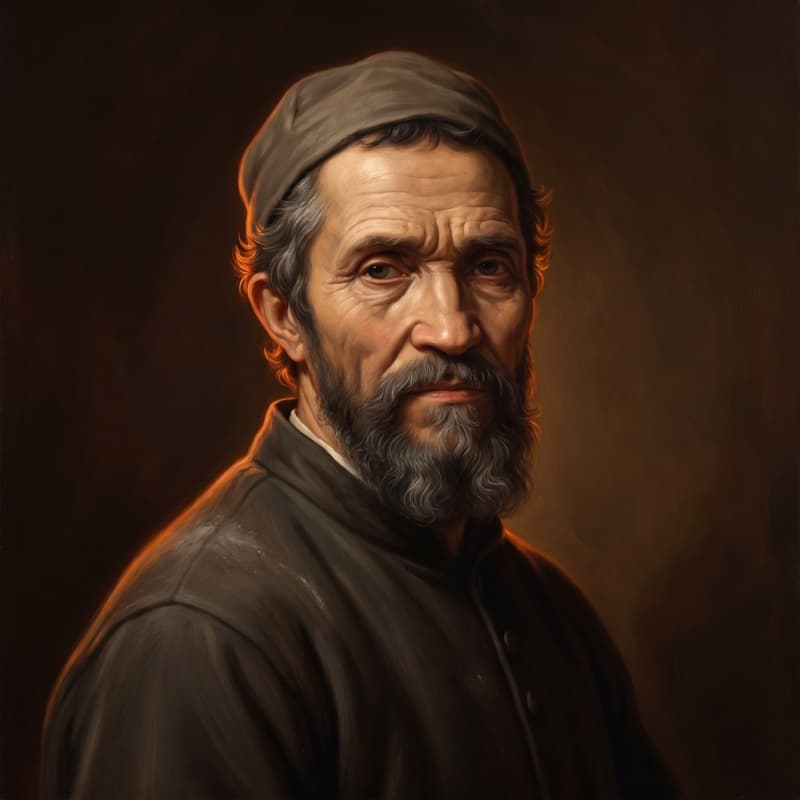
Michelangelo Buonarroti was born at Caprese on March 6, 1475 — the modern reckoning noted in Holroyd's edition of Condivi — and died in Rome on February 18, 1564, a few weeks before his eighty-ninth birthday (Michael Angelo Buonarroti). His nearly nine decades span the arc of the High Renaissance, and his working life covers four arts: sculpture, fresco painting, architecture, and poetry. This biography follows the documented record — Holroyd's Condivi/Vasari material, the Vatican Museums' chronology of the Sistine frescoes, and Michelangelo's own sonnets and letters — with citations throughout.
Birth and training, 1475–1492
A common error places his birth in Florence; Holroyd's edition gives Caprese as the birthplace, while also describing the family's return to Florentine life. In 1488, at thirteen, his father bound him to Domenico and Davit Ghirlandaio for a three-year apprenticeship (Holroyd). The apprenticeship, however, was not his formative school. Ghirlandaio selected him to study in Lorenzo de' Medici's sculpture garden at San Marco, where between about 1489 and 1492 antique models and Bertoldo's instruction shaped him as a sculptor. His later assurance in marble was trained, not miraculous: contract, workshop, garden — the record is specific.
Early masterworks, 1498–1504
Between 1498 and 1499 Michelangelo carved the Roman Pietà for Cardinal Jean de Bilhères. Holroyd recounts that after hearing the work attributed to another sculptor, he carved his name on the belt of the Madonna's robe — and never signed any other work (Holroyd).
In September 1501 he began the colossal David in Florence; the finished statue was installed at the Palazzo Vecchio in 1504. Leonardo da Vinci appears in the documented record at precisely this point: Holroyd places him on the committee debating the placement of the David, and notes that the two artists were assigned competing battle cartoons for the Palazzo Vecchio. Their relationship is best characterized as professional rivalry and documented proximity, not the invented scenes of popular retellings.
Julius II and the Sistine ceiling, 1505–1512
In 1505 Julius II called Michelangelo to Rome for an ambitious tomb project that became a decades-long struggle: originally conceived with more than forty statues, it was later reduced, leaving the Moses as the survivor of the larger scheme (Holroyd).
The pope then redirected him to fresco. Michelangelo signed the contract to repaint the Sistine Chapel ceiling on May 8, 1508, and the Vatican Museums state that the work must have been completed by October 31, 1512, before the papal Mass of November 1 (Vatican Museums, Ceiling). The commission was not the natural work of a trained fresco specialist, and Michelangelo's own sonnet on the ceiling records the physical toll: "My beard turns up to heaven; my nape falls in," he wrote, and "Crosswise I strain me like a Syrian bow" (The Sonnets of Michael Angelo Buonarroti, trans. Symonds).
The long late career, 1536–1564
The claim that his career peaked young with the David does not survive the chronology. Between 1536 and 1541 he painted The Last Judgment on the Sistine Chapel's altar wall (Vatican Museums, The Last Judgement). After Antonio da Sangallo died in 1546, Michelangelo succeeded him as architect-in-general for the Pope, with St. Peter's as the principal work (Holroyd).
Of his private life the record supports restraint. He never married. Condivi and Holroyd discuss his affection for Vittoria Colonna; his circle included Tommaso de' Cavalieri; and his sonnets repeatedly transform beauty and desire into spiritual struggle (Holroyd; Symonds). The poems are the interior biography: labor, beauty, old age, and a late religious unease that art could no longer answer — "Painting nor sculpture now can lull to rest my soul," he wrote in a late devotional sonnet (Symonds).
He died in Rome on February 18, 1564, a few weeks before his eighty-ninth birthday (Holroyd).
Continue the conversation
The same record behind this biography powers Calls From The Past's AI Michelangelo persona — presented plainly as an AI persona, not the man. If the chronology raises questions the documents leave open, put them to him: why Lorenzo's garden mattered more than any schoolroom, why Julius II became both tormentor and necessary force, or what he still wanted from St. Peter's when death was already near.