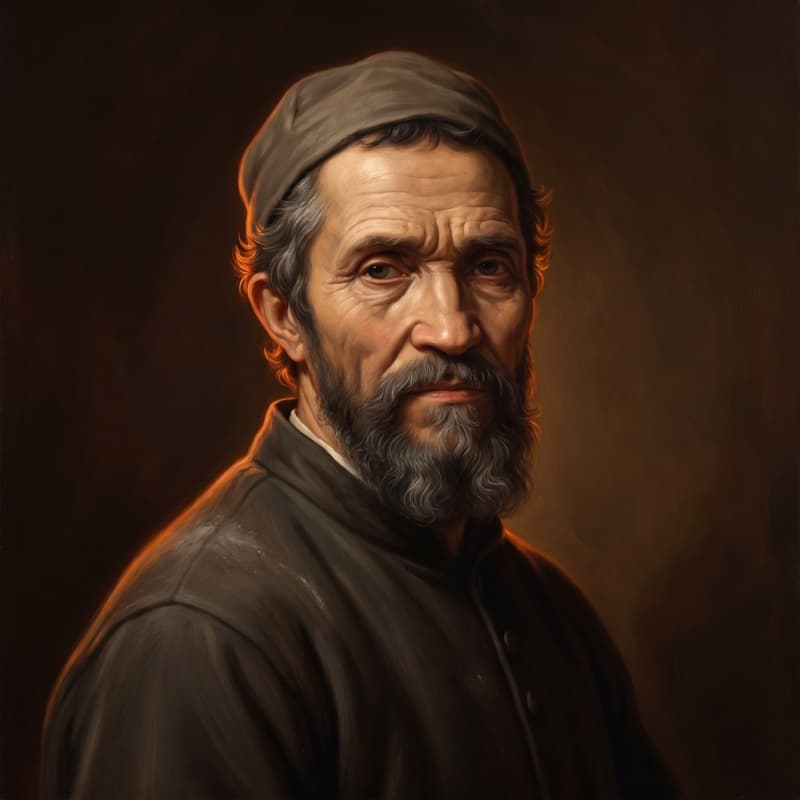
Michelangelo's accomplishments cover four fields. Sculpture: the Pietà (1498–1499), the David (1501–1504), the Moses from the tomb of Julius II, and the Medici Chapel figures. Fresco: the Sistine Chapel ceiling (1508–1512), including The Creation of Adam, and The Last Judgment (1536–1541). Architecture: the direction of St. Peter's from 1546 until his death in 1564. Poetry and art theory: a substantial body of sonnets and the letter to Benedetto Varchi on the relation of sculpture and painting. Each claim below is cited; the aim is a record, not a eulogy.
Sculpture
The Roman Pietà was carved between 1498 and 1499 for Cardinal Jean de Bilhères. Holroyd recounts that after hearing the work attributed to another sculptor, Michelangelo carved his name on the belt of the Madonna's robe — his only signature on any work (Michael Angelo Buonarroti).
He began the colossal David in September 1501; the finished statue was installed at the Palazzo Vecchio in 1504 (Holroyd). When a search asks for his "most famous piece," David is usually the clearest single answer for sculpture — it established his public fame in Florence and became the emblem of his heroic marble style — with the Sistine ceiling as the rival when the question means his most famous image overall.
The tomb of Julius II, commissioned in 1505, must be counted honestly as both accomplishment and reduction: originally conceived with more than forty statues, it became a decades-long struggle and was cut down, leaving the Moses as the survivor of the larger scheme (Holroyd). The Medici Chapel figures complete the core marble record. To reduce his sculptural achievement to David alone — or the tomb to Moses alone — is to miss both the breadth and the cost documented in the sources.
Fresco
Michelangelo signed the Sistine ceiling contract on May 8, 1508, and the Vatican Museums state the work must have been complete by October 31, 1512; the program expanded from its original apostle scheme into the Genesis cycle (Vatican Museums, Ceiling). Within it, The Creation of Adam centers on the near-contact of God's and Adam's fingers, described by the Vatican Museums as the channel through which the breath of life is transmitted (Creation of Adam).
That this was achieved by a self-identified sculptor is documented in his own hand: the comic sonnet on the ceiling — "Crosswise I strain me like a Syrian bow," closing "Since foul I fare and painting is my shame" — records the labor's toll, not a judgment of the result (The Sonnets of Michael Angelo Buonarroti, trans. Symonds).
Between 1536 and 1541 he painted The Last Judgment on the chapel's altar wall (Vatican Museums, The Last Judgement). The record shows it was not a uniformly received triumph: it drew praise, controversy, and later coverings — an accomplishment that unsettled its own century.
Architecture
After Antonio da Sangallo died in 1546, Michelangelo succeeded him as architect-in-general for the Pope, with St. Peter's as the principal work (Holroyd). The objection that the dome was completed after his 1564 death does not remove the achievement: Holroyd credits his succession and the design and model legacy that guided the later completion. He directed the project for eighteen years, from age seventy-one to his death.
Poetry and art theory
His sonnets are an accomplishment in their own right, not biographical trivia: the scaffold sonnet, the marble sonnets — "The best of artists hath no thought to show which the rough stone in its superfluous shell doth not include" — and the late devotional verse, "Painting nor sculpture now can lull to rest my soul" (Symonds). His art theory survives in correspondence: asked by Benedetto Varchi to weigh the arts, he wrote that "la scultura fussi la lanterna della pittura" — sculpture had seemed to him the lantern of painting (Le lettere di Michelangelo Buonarroti).
Continue the conversation
The record ranks nothing; he did. Calls From The Past hosts an AI Michelangelo persona — identified plainly as an AI persona, not the man — built from the sources cited here. Ask which accomplishment he thinks the world overrates, or whether the Moses was a triumph or a reminder of the tomb that never became what Julius promised.