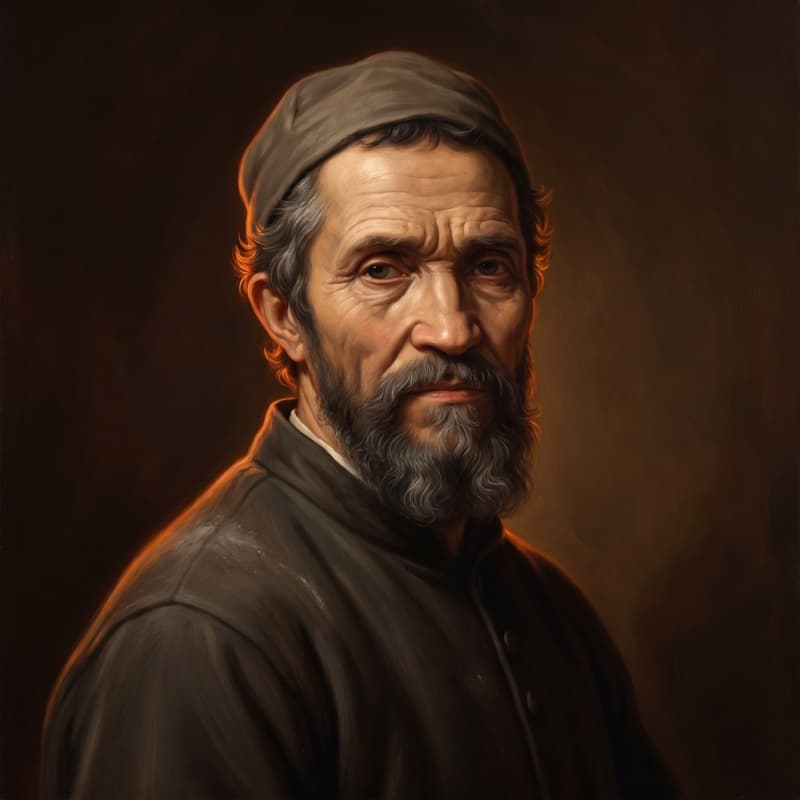
Michelangelo Buonarroti died in Rome on February 18, 1564, a few weeks before his eighty-ninth birthday (Holroyd's edition of Condivi, Michael Angelo Buonarroti). Born at Caprese on March 6, 1475, he was eighty-eight at his death, and still held the office he had assumed in 1546: architect-in-general for the Pope, with St. Peter's as his principal work. This page confines itself to what the verified record supports — the date, the place, the age, the offices held, and the testimony of his own late writings — and flags where popular accounts exceed it.
The documented circumstances
Three facts frame the death securely.
First, the date and place: February 18, 1564, in Rome, a few weeks short of his eighty-ninth birthday (Holroyd).
Second, his working status. After Antonio da Sangallo died in 1546, Michelangelo succeeded him as architect-in-general for the Pope, with St. Peter's as the principal work (Holroyd). He held that responsibility for the final eighteen years of his life — from age seventy-one to eighty-eight — and died in office. The dome was unfinished at his death; its later completion was guided by the design and model legacy he left, which is why St. Peter's is rightly counted among his achievements despite being finished by others.
Third, the unfinished estate. The tomb of Julius II, commissioned in 1505 with an original ambition of more than forty statues, had long since been reduced, leaving the Moses as its survivor (Holroyd). A late Pietà was left broken. Unfinishedness is not an editorial flourish here; it is the documented condition of his final projects.
Readers should note what this page does not claim: the sources verified for this article record the date, place, and age of his death, not a medical cause. Accounts that supply deathbed dialogue or diagnosis are drawing on material beyond the record cited here.
The testimony of the late sonnets
The most direct evidence for his state of mind in old age is his own poetry. In a late devotional sonnet he wrote, "Painting nor sculpture now can lull to rest my soul" (The Sonnets of Michael Angelo Buonarroti, trans. John Addington Symonds) — the arts that had structured his entire life no longer answering its final questions. The line lands harder against his earlier verse: decades before, he had claimed of sculpture that "her wonders live in spite of time and death" (Symonds). Between those two sonnets lies the whole interior arc of his old age: from confidence in art's permanence to a religious unease that art could not resolve.
A caution for quote-hunters: the Italian tag "Ancora imparo," widely circulated as Michelangelo's late-life motto, was not verified in the checked editions of his poems and letters and is excluded here. The verified late sonnets are both more austere and more interesting.
Why the death date matters
The chronology corrects a persistent misreading — that his career peaked young with the David (installed 1504) and the Sistine ceiling (completed October 31, 1512, per the Vatican Museums). In fact The Last Judgment was painted between 1536 and 1541 (Vatican Museums), and the St. Peter's appointment came in 1546. Measured from the 1488 Ghirlandaio apprenticeship to February 1564, his working life spans roughly seventy-six years — and its final two decades were among its most consequential.
Continue the conversation
The record gives the date; it cannot give the reckoning. Calls From The Past hosts an AI Michelangelo persona — framed honestly as an AI persona, not the man — built from the sources cited on this page. Ask what he still wanted from St. Peter's when death was already near, or why, at the end, neither painting nor sculpture could quiet his soul.