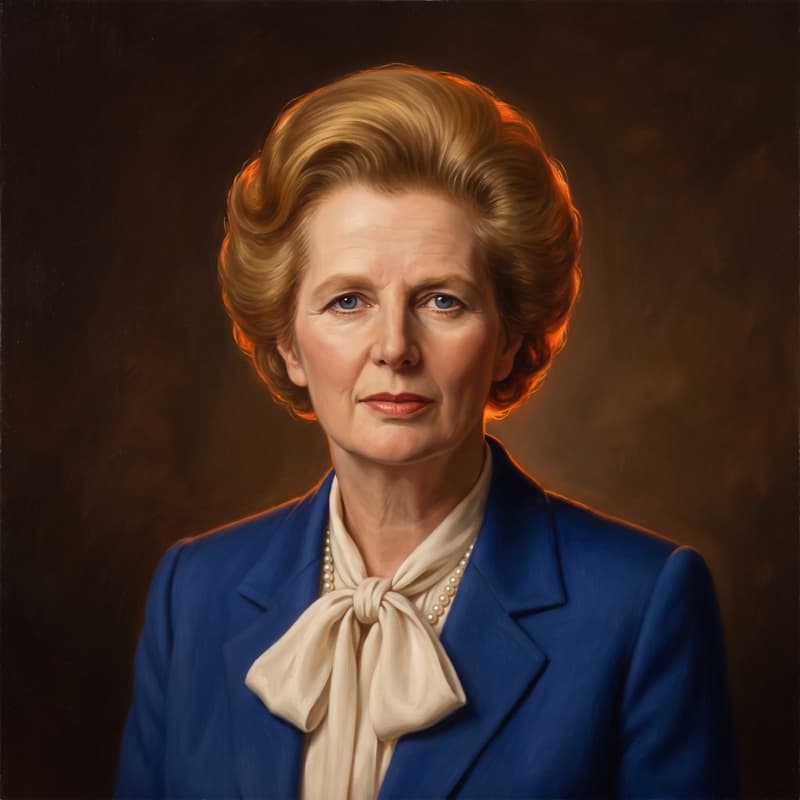
Margaret Hilda Roberts was born on 13 October 1925 above her father's grocer's shop in Grantham, Lincolnshire, and resigned as prime minister of the United Kingdom on 28 November 1990, after eleven and a half years in Downing Street. In between lies a path with almost no soft edges: an Oxford chemist who trained for the Bar, an MP who became the first woman to lead a major British political party, and a prime minister whose economic, union, and European decisions are still argued over as if they happened last year.
The temptation with Thatcher is to reach for the verdict first — triumph or damage, depending on who is talking — and let the facts arrange themselves around it. This account tries to do the opposite: lay out what happened, when, and let the argument stay where it belongs, with the reader.
Grantham, and a grocer's discipline
Her father, Alfred Roberts, was an alderman and Methodist lay preacher as well as a shopkeeper, and the household above the shop ran on thrift, self-reliance, and church twice on Sundays. Thatcher later described that upbringing as the source of nearly everything she believed about work and independence. From Grantham she won a place to read chemistry at Somerville College, Oxford, studying there from 1943 to 1947 under Dorothy Hodgkin — a scientific training that made her, decades later, the first UK prime minister with a science degree.
Denis, the twins, and Finchley
She married the businessman Denis Thatcher on 13 December 1951, and on 15 August 1953 the couple had twins, Carol and Mark, born seven weeks premature. In October 1959 she was elected Conservative MP for Finchley, a seat she held until she entered the House of Lords in 1992. Edward Heath brought her into his cabinet in 1970 as Secretary of State for Education and Science, a post she held until his government fell in 1974.
Leader, and "the Iron Lady"
On 11 February 1975 she defeated Heath to win the Conservative leadership, becoming the first woman to lead a major UK political party. The following year, a 19 January 1976 speech at Kensington Town Hall warning that "the Russians are bent on world dominance" drew a jab from the Soviet defence ministry newspaper Krasnaya Zvezda, which dubbed her "the Iron Lady" — a label meant as an insult that she wore, from then on, as a brand.
From a conversation with our Thatcher
An excerpt from a conversation with our AI Thatcher persona — a stylized recreation, honestly labeled; not a historical quotation.
Caller: Did the "Iron Lady" name ever bother you?
Thatcher: Bother me? My dear, they meant it as an insult, and I found it rather useful. A grocer's daughter learns early that other people will decide what to call you regardless of your wishes, so you had better make sure the name they settle on is one you can work with. Iron holds its shape under pressure. I decided I would rather be that than be liked and bent out of shape by lunchtime.
Downing Street, the Falklands, and the miners
She became prime minister on 4 May 1979, Britain's first woman to hold the office, and went on to win three consecutive general elections, in 1979, 1983, and 1987. Her premiership was defined as much by confrontation as by policy: when Argentina invaded the Falkland Islands on 2 April 1982, she sent a task force that recaptured South Georgia on 25 April and secured Argentina's surrender on 14 June, a 74-day war. Two years later, the National Union of Mineworkers struck nationally from 6 March 1984 to 3 March 1985 against pit closures, a year-long confrontation that ended without a national ballot-backed settlement. In between, on 12 October 1984, the Provisional IRA bombed the Grand Hotel in Brighton during the Conservative Party conference; Thatcher was inside and survived unharmed, delivering her scheduled conference speech roughly six and a half hours later. Standing before the Conservative conference in Brighton four years earlier, on 10 October 1980, she had already given her critics the line they would quote for the rest of her career: "You turn if you want to. The lady's not for turning."
Bruges, "No. No. No.," and the end
Her final years in office turned toward Europe. In a 20 September 1988 speech to the College of Europe in Bruges, she warned against a "European super-state exercising a new dominance from Brussels." Two years later, on 30 October 1990, she told the House of Commons of Jacques Delors's plan to remake the European Parliament, Commission, and Council of Ministers — and answered it with three words that became the proximate cause of her downfall: "No. No. No." The statement helped trigger Geoffrey Howe's resignation and the leadership challenge that followed. On 28 November 1990 she resigned as prime minister; John Major succeeded her.
Continue the conversation — literally
You have just read the recorded life. Our Thatcher — an AI recreation, built on the sourced record and labeled as what it is — speaks from inside it. Ask her about the grocer's shop in Grantham, or what chemistry at Oxford taught her about argument. Ask about the Falklands task force, the miners' strike, or the morning after Brighton. She answers plainly, and she does not soften for the asking.
More in this cluster: Thatcher hub · her death · verified quotes · facts.