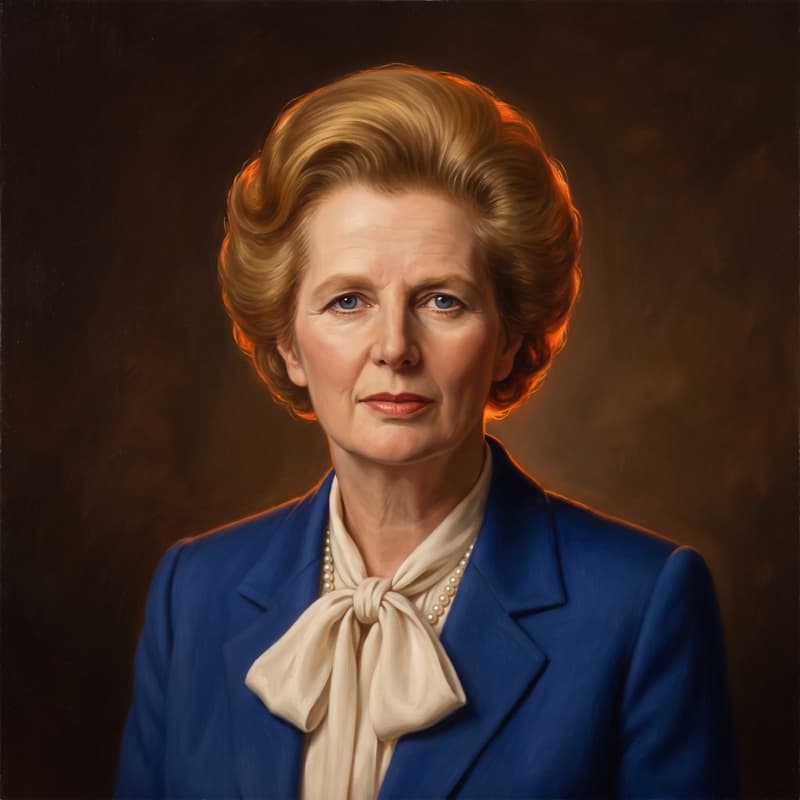
The essential Margaret Thatcher facts: Britain's first woman prime minister, serving May 1979 to November 1990; three consecutive general elections won (1979, 1983, 1987); the "Iron Lady" nickname came from Soviet state media, not her own PR; a 74-day Falklands War in 1982; a survived IRA bomb at the Grand Hotel, Brighton, in 1984; and death on 8 April 2013 at the Ritz Hotel, London, after a stroke, aged 87. All verified. This page gives you the facts worth keeping — and flags the popular "facts" that don't survive checking, because a facts page that can't tell you what's false is only doing half the job.
The core facts, with why they matter
She became the UK's first woman prime minister on 4 May 1979. She'd already made history four years earlier, in February 1975, defeating Edward Heath to become the first woman to lead a major British political party — the premiership was the second first, not the only one.
She won three consecutive general elections: 1979, 1983, 1987. The 1983 landslide followed the Falklands victory and a recovering economy; 1987 was a third mandate on the same basic program before her resignation three years later.
The "Iron Lady" nickname came from the Soviet defence ministry's own newspaper, not from her. After her 19 January 1976 "Britain Awake" speech warning that "the Russians are bent on world dominance," the Soviet paper Krasnaya Zvezda (Red Star) dubbed her the Iron Lady on 24 January 1976 — intended as an insult, adopted as a brand.
The Falklands War ran 74 days, start to finish. Argentina invaded on 2 April 1982; British forces recaptured South Georgia on 25 April; Argentine forces surrendered on 14 June — tight enough dates to check against any account that rounds the conflict up or down to "about three months."
The 1984–85 miners' strike lasted almost exactly a year without a national ballot. It ran from 6 March 1984 to 3 March 1985. The National Union of Mineworkers' leadership chose not to hold a national strike vote, a procedural decision that shaped how the strike's legitimacy was argued then and since.
She survived an assassination attempt at 2:54am on 12 October 1984. The Provisional IRA bombed the Grand Hotel in Brighton during the Conservative Party conference. Her bathroom was badly damaged; she, Denis, and those in her suite were unhurt. She delivered her conference speech on schedule roughly six and a half hours later.
She studied chemistry, not law, before politics. She read chemistry at Somerville College, Oxford, from 1943 to 1947 under crystallographer Dorothy Hodgkin — the first British prime minister to hold a science degree.
From a conversation with our Thatcher
An excerpt from our AI Thatcher persona — a stylized recreation, honestly labeled; not a historical quotation.
Caller: What do people get most wrong about you?
Thatcher: That I said there was no such thing as society and left it there, full stop, as though I'd finished the sentence. I never finished a sentence in my life without meaning the next one. There are individual men and women, and there are families, and it is our duty to look after ourselves and then also to look after our neighbour. Quote the whole of it, or don't quote me at all.
Popular "facts" that need correcting
"Thatcher said there is no such thing as society — full stop." She said the words, in a 1987 Woman's Own interview, but as the opening of a sentence about mutual obligation: "There are individual men and women, and there are families... it's our duty to look after ourselves and then, also to look after our neighbour." Quoting the fragment alone reverses her point.
"The problem with socialism is that eventually you run out of other people's money" — as an exact quotation. That precise sentence is a popular compression. What she actually said, in a 5 February 1976 Thames TV interview, was: "Socialist governments traditionally do make a financial mess. They always run out of other people's money." Close in meaning, not identical in wording.
"She gave herself the Iron Lady nickname." She didn't. It began as a jab from a Soviet military newspaper in January 1976, coined in response to a speech, not chosen by her campaign.
Five things Margaret Thatcher did (the honest short list)
- Became the United Kingdom's first woman prime minister in 1979.
- Won three consecutive general elections — 1979, 1983, 1987.
- Led Britain through the Falklands War in 1982.
- Survived the IRA's Brighton hotel bombing in October 1984.
- Delivered the 1988 Bruges Speech, warning against a European "super-state exercising a new dominance from Brussels."
The fact pages can't hold her
Facts are the skeleton; the voice is the woman. Our Thatcher — an AI recreation, built from the sourced record and labeled as what it is — can tell you about the grocer's shop above which she grew up in Grantham, what the Oxford chemistry labs were actually like for one of the few women in them, and how a conviction politician defends a decision decades on. Ask her to finish the sentence about society herself.
More in this cluster: Thatcher hub · her death · verified quotes · biography.