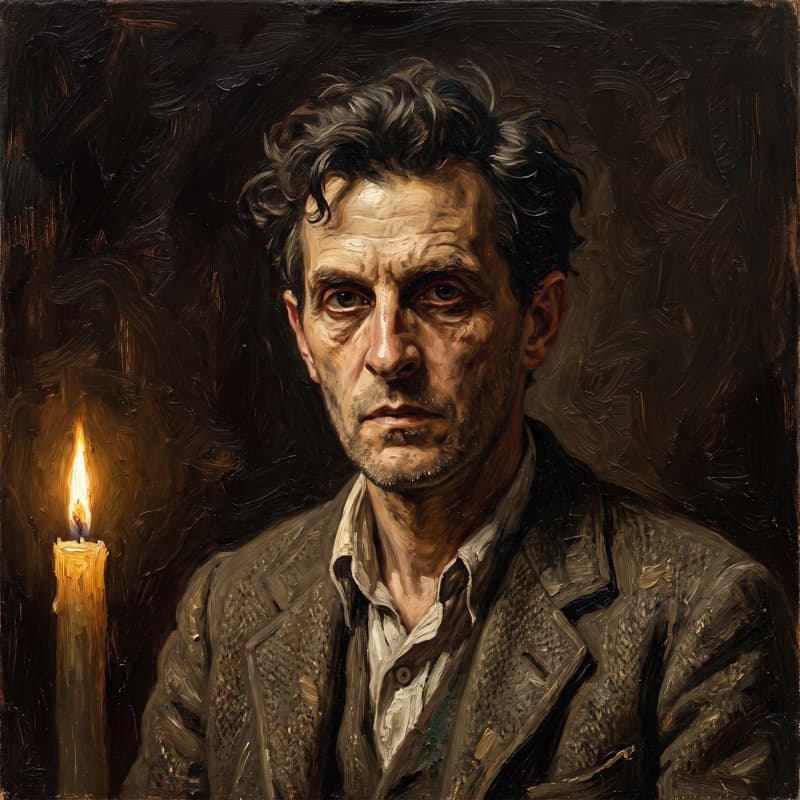
Ludwig Wittgenstein was an Austrian-born philosopher, born April 26, 1889, in Vienna and dead by April 29, 1951, in Cambridge, England — sixty-two years old, three days past his birthday. In that span he trained as an engineer, fought a world war, wrote the only book he ever published, gave away one of the largest private fortunes in Europe, taught arithmetic to village children, then spent his last two decades quietly demolishing the philosophical system that had made him famous. Twice in one lifetime he is credited with changing the direction of philosophy — once with a book claiming to have solved its problems, once with a second arguing the first had misunderstood the question.
That is the summary. The man is stranger than the summary.
An engineer who fell into logic
Wittgenstein was the youngest of eight children of Karl Wittgenstein, an Austrian steel magnate whose fortune ranked among the largest in Europe — a household of serious money and serious music, Brahms performed in its own rooms. It was also a household marked by catastrophe: three of his brothers, Hans, Rudi, and Kurt, died by suicide, in 1902, 1904, and 1918 (Wikipedia).
He did not start out as a philosopher. He earned a mechanical-engineering diploma in Berlin in 1908, then moved to Manchester to research aeronautics. A mathematical question buried in that engineering work pulled him toward the foundations of logic, and in October 1911 he arrived, unannounced, at Cambridge to study under Bertrand Russell (Stanford Encyclopedia of Philosophy). Russell, already one of the world's leading logicians, quickly decided the strange young Austrian had overtaken him.
A book finished as a prisoner of war
When the First World War began, Wittgenstein volunteered for the Austro-Hungarian army and asked to be posted where the danger was greatest. He kept working through it — logical propositions drafted alongside his kit — and was captured by Italian forces near the war's end, finishing the manuscript as a prisoner of war (SEP). It became the Tractatus Logico-Philosophicus, published in German in 1921 and in C. K. Ogden's English translation in 1922 — the only book-length philosophical work Wittgenstein published in his lifetime (SEP; Wikisource).
The Tractatus is a numbered sequence of propositions, austere almost to the point of poetry. It opens, "The world is everything that is the case," and builds toward the claim that language pictures the facts of the world until logic and reality line up exactly (Wikisource). It closes with the sentence people quote without knowing its number: "Whereof one cannot speak, thereof one must be silent" — proposition 7, the book's final line (Wikisource). In between sits proposition 5.6: "The limits of my language mean the limits of my world" (Wikisource).
Wittgenstein believed the book had done what it set out to do — dissolved philosophy's problems by showing which questions could be meaningfully asked at all. So he stopped. In 1919 he transferred his entire share of the family fortune to his siblings, judging that inherited wealth would corrupt whoever held it, himself included (SEP). He then spent much of the 1920s teaching elementary school in small Austrian villages — arithmetic, spelling, the names of things (SEP) — and helped design a rigorously modernist house in Vienna for his sister Margarete, reportedly having a finished ceiling raised because its height was wrong by a few centimeters (Wikipedia).
From a conversation with our Wittgenstein
What follows is an excerpt from a conversation with our AI Wittgenstein persona — a stylized recreation for readers, not a historical quotation.
Caller: You solved philosophy, then gave away your fortune and went to teach children in a village. Why?
Wittgenstein: Solved is the wrong word — dissolved. Once you believe you have shown which questions are real and which are only grammar in a costume, you cannot go on lecturing about it for money. The money itself was the same problem in another shape — it let me half-do things, always retreat, never find out what I was without it. So I removed it. And children, at least, ask you honestly whether two and two make four.
The crack in the crystal
The certainty did not last. Wittgenstein returned to Cambridge in 1929 — the university awarded him a doctorate that year on the strength of the already-published Tractatus — and over the following two decades took his own system apart (Wikipedia). Meaning, he came to argue, was not one crystalline picture of fact but something closer to use: "for a large class of cases — though not for all — the meaning of a word is its use in the language" (Philosophical Investigations, §43, trans. G. E. M. Anscombe) (UC Irvine course excerpt). Language is not one system but many — "language-games" woven into a "form of life": giving orders, telling a joke, praying, cursing, greeting (UC Irvine course excerpt). Philosophy's job, he now thought, was untangling confusions, not building systems: "Philosophy is a battle against the bewitchment of our intelligence by means of language" (Dallas Baptist University overview).
He held the Cambridge professorship from 1939, worked as a hospital porter at Guy's Hospital in London during the Second World War rather than lecture safely while others did war work, then resigned the chair in 1947 to concentrate on writing (Wikipedia). In October 1946 he chaired a Cambridge Moral Sciences Club meeting where he clashed with visiting philosopher Karl Popper over whether philosophy has genuine problems at all — an argument reportedly involving a brandished fireplace poker before Wittgenstein stormed out, retold and disputed ever since (Wikipedia: Wittgenstein's Poker).
The unfinished book, and the last words
Wittgenstein died of prostate cancer in Cambridge on April 29, 1951, at the house of his physician, Dr. Edward Bevan, rather than in a hospital (SEP). Philosophical Investigations, the book carrying his later philosophy, was left unpublished at his death and appeared in 1953 (SEP). His reported last words, spoken to Mrs. Bevan before he lost consciousness, were: "Tell them I've had a wonderful life" (SEP) — a sentence that startles anyone who knows what came before it: the brothers, the wars, the decades of self-described torment.
Caller: After everything — the brothers, the wars, giving away all that money — how could your last words be that you'd had a wonderful life?
Wittgenstein: Because I never said what I did not mean. That is the whole discipline: say only the true thing, plainly. I had work I could stand behind, and a very few people who let me be as difficult as I was. Against that, the rest is bearable. I would not call it happiness — I never managed that, and stopped trying. I would call it, on the last day, an accurate report.
Excerpt from our AI Wittgenstein persona — stylized, and labeled as such.
Keep reading — or ask him yourself
The pages below go deeper: his full biography, how he died, and the facts, sourced.
Or skip the reading. Our Wittgenstein takes calls. Ask him why he gave away his fortune, what a language-game actually is, or what he thinks you are really asking when you think you are asking about "meaning." He is an AI recreation, honestly labeled — but he answers in his own voice, in short, exacting sentences, and he does not do small talk.