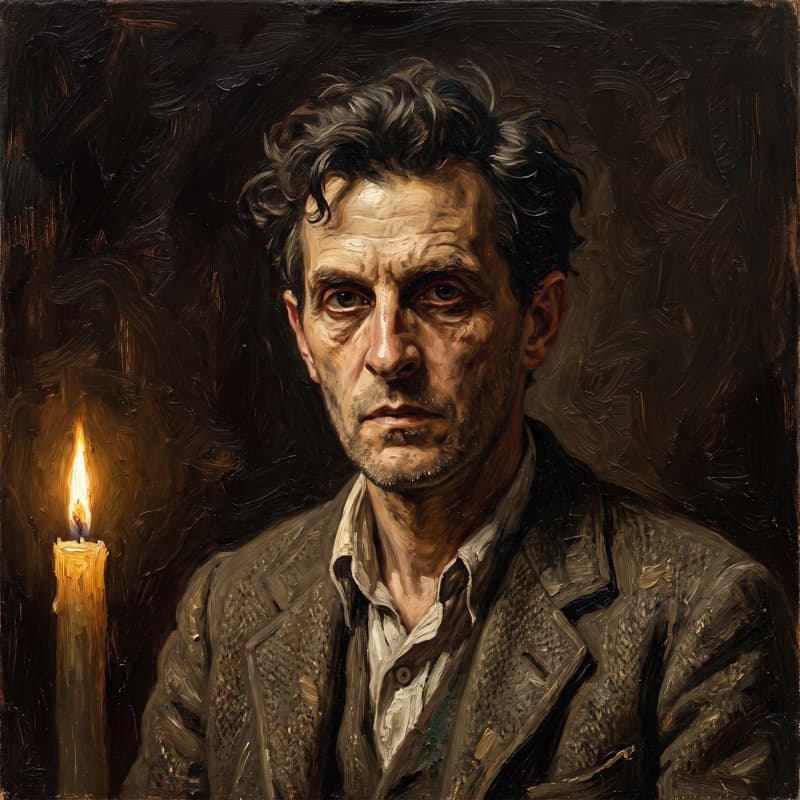
Ludwig Wittgenstein died of prostate cancer on April 29, 1951, in Cambridge, England — three days after his sixty-second birthday. He spent his final illness not in a hospital but at the home of his physician, Dr. Edward Bevan, and worked on philosophy almost to the end. His reported last words, spoken to Mrs. Bevan shortly before he lost consciousness, were: "Tell them I've had a wonderful life."
That answers the question people search for. The fuller story is stranger, and worth five minutes.
Working until there was no more time
The diagnosis came late in a life that had already circled death more than once — three brothers lost to suicide, a war he fought and survived as a prisoner. Even with the cancer advanced, Wittgenstein kept working. Notes from those final weeks were dense enough to be gathered later into a separate book, On Certainty, built from questions about knowledge, doubt, and what it even means to be sure of something. He did not stop being a philosopher because he was dying; the dying became one more thing to think carefully about. He chose to spend that last stretch at the Bevans' house rather than a hospital ward — a small decision, but consistent with a man who had always preferred the concrete and particular to the institutional. Dr. Bevan attended him; Mrs. Bevan was present at the end.
From a conversation with our Wittgenstein
An excerpt from a conversation with our AI Wittgenstein persona — a stylized recreation, honestly labeled; not a historical quotation. Our Wittgenstein's knowledge ends before these final weeks.
Caller: Were you afraid, near the end?
Wittgenstein: I cannot answer that from inside a body I no longer have, only from the shape of the life you are asking me to look back on. I will say this: a man who spends decades doubting whether he has said anything true does not necessarily die in despair. Doubt was never the enemy of a good life for me — certainty pretending to be more than it was, that was the enemy. If the end came and I judged it wonderful, I do not think that is a contradiction. It may be the one proposition I never needed a ladder to reach.
An unfinished book, and a startling verdict
Philosophical Investigations, the work that had absorbed him for two decades, was still unpublished when he died. His literary executors — Elizabeth Anscombe, Rush Rhees, and G. H. von Wright — prepared it from his manuscripts and saw it into print in 1953. It became, alongside the Tractatus, one of the two books through which almost everyone now reads him, and he did not live to see either published.
The last words are the part that stops people. This was a man who had buried three brothers to suicide, fought in one world war and worked through a second, and described his own mind for years as close to torment. "Tell them I've had a wonderful life" is not the sentence that biography seems to set up. But Wittgenstein spent his career arguing that a single dramatic fact does not fix the meaning of a sentence spoken at the end of it. The words stand as he left them — not a correction of the hard parts of his life, but a verdict on the whole of it.
Ask him about the parts he can still speak to
Our Wittgenstein — an AI recreation, built from the sourced record and labeled as what it is — cannot tell you about his final weeks; his knowledge ends before them. But he can tell you about the fortune he gave away, the house he built to the millimeter, or why he thought philosophy was a battle against being bewitched by language. Ask him what he meant by a "form of life," or why he came to distrust the very system he built in the Tractatus. Start the conversation whenever you're ready; he has time.
More in this cluster: Wittgenstein hub · his biography · verified quotes · fact file.