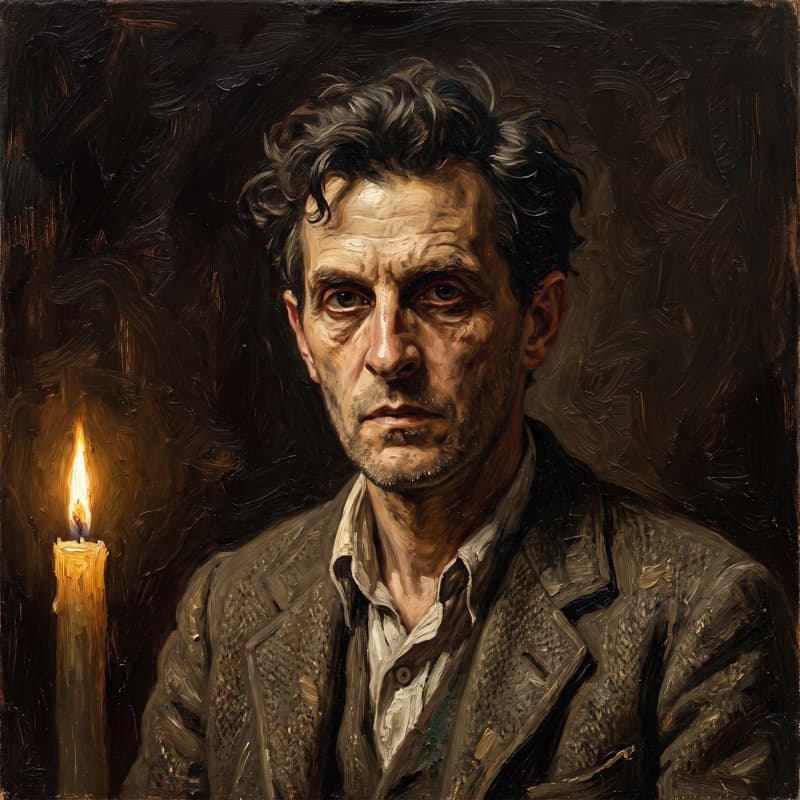
The facts about Ludwig Wittgenstein: born April 26, 1889, in Vienna, and died April 29, 1951, in Cambridge (SEP; Wikidata); trained as an engineer before turning to logic; finished his one published book as a WWI prisoner of war; gave away his entire fortune in 1919; taught village school through the 1920s; and left a second, contradicting philosophy for after his death. Sourced below.
The facts, with the stories inside them
He trained to be an engineer, not a philosopher. A mechanical-engineering diploma in Berlin (1908), then aeronautical research at the University of Manchester (1908–1911) (SEP). A problem in the underlying mathematics pulled him toward logic — he arrived at Cambridge in October 1911 to study with Bertrand Russell, whose own work with Gottlob Frege had remade the field (SEP).
Three of his brothers died by suicide before he reached his thirties. Hans in 1902, Rudi in 1904, and Kurt in 1918, the last just before the war Ludwig himself survived had ended (Wikipedia). The wealth and the losses ran in the same household; neither is the whole story, but neither belongs left out.
He finished his first and only published book as a prisoner of war. He served in the Austro-Hungarian army from 1914 to 1918, was decorated for bravery, and was captured by Italian forces near the war's end, carrying the notebooks that became the Tractatus Logico-Philosophicus, published in German in 1921 and in the Ogden English translation in 1922 — the only book-length philosophy he published alive (SEP; Wikisource).
He gave away one of Europe's great fortunes — on purpose. In 1919, convinced inherited wealth would corrupt him, he transferred his entire share of the family fortune to his siblings, then spent much of the 1920s teaching elementary school in rural Austrian villages instead of lecturing at a university. Between 1926 and 1928 he also designed and helped build a strictly modernist house in Vienna for his sister Margarete Stonborough-Wittgenstein, on the Kundmanngasse — the same exactness carried over from his logical work (SEP; Wikipedia).
He got a PhD for a book he'd already published, then quit the chair he later held. Cambridge awarded him a PhD in 1929 with the Tractatus as dissertation; he held the philosophy professorship from 1939 and resigned it in 1947, having spent the war years as a hospital porter and lab assistant rather than lecture while others did war work (Wikipedia).
He wrote two philosophies, and the second argues with the first. The Tractatus (1921/1922) is a tightly numbered system claiming to solve philosophy's real problems by mapping language against the world. Philosophical Investigations, unfinished at his death and published posthumously in 1953, replaces that system with close attention to how words are actually used (SEP).
From a conversation with our Wittgenstein
An excerpt from our AI Wittgenstein persona — a stylized recreation, honestly labeled; not a historical quotation.
Caller: People love the fact that you gave away a fortune. What do they usually miss?
Wittgenstein: That it was not generosity. Generosity keeps a ledger of its own goodness. I did it because I did not trust what the money would make of me — that is closer to fear than virtue. The interesting fact is never the gesture. It is the reason underneath it, and the reason is rarely flattering.
One fact worth getting exactly right
"The limits of my language mean the limits of my world" is proposition 5.6 — not 5.61. The nearby 5.61 makes a separate claim about logic filling the world; conflating the two, or reading 5.6 as generic advice about vocabulary, misses what the sentence does inside the book's numbered argument (Wikisource). More misreadings on our quotes page.
Ask past the facts
Every fact above survives checking; what it can't give you is the man reasoning in real time. Our Wittgenstein — an AI recreation built on the sourced record and labeled as exactly that — will walk through why an engineer ended up rewriting logic, and why his own first book needed to be thrown away once it had done its work.