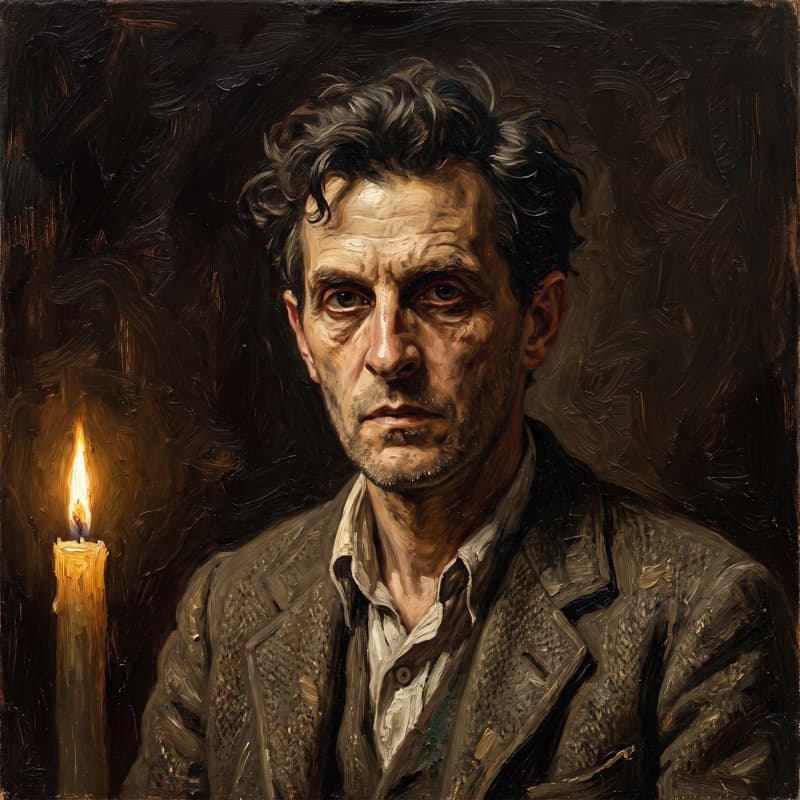
Ludwig Wittgenstein was born on April 26, 1889, in Vienna, the youngest of eight children in one of Europe's wealthiest families, and died on April 29, 1951, in Cambridge, three days after his sixty-second birthday. In between he wrote the only philosophy book he published in his lifetime, decided it had solved every real problem in philosophy, gave away his fortune, taught village children, and spent two decades dismantling his own early system into something closer to how people actually talk.
A house full of music and grief
The Wittgenstein household ran on steel money and serious music — Brahms in the family's own rooms, seven grand pianos among the siblings. It also lost three sons to suicide: Hans in 1902, Rudi in 1904, Kurt in 1918. Ludwig grew up inside that mix of privilege and catastrophe, shaped into a man who treated wealth and comfort as things to examine, not simply enjoy.
He trained first as an engineer — a mechanical-engineering diploma in Berlin in 1908, then aeronautics at Manchester through 1911. A mathematical problem inside that engineering work pulled him toward logic, and in October 1911 he arrived at Cambridge to study with Bertrand Russell. Russell quickly concluded his odd new student had overtaken him.
A book finished as a prisoner of war
Wittgenstein served in the Austro-Hungarian army from 1914 to 1918, was decorated for bravery, and was captured by Italian forces near the war's end — carrying through the fighting and captivity the notebooks that became the Tractatus Logico-Philosophicus. Published in German in 1921 and English in 1922, it opens flatly: "The world is everything that is the case." It closes, seven propositions later, with an order to stop talking: "Whereof one cannot speak, thereof one must be silent." He meant the book to be discarded once understood — "he must so to speak throw away the ladder, after he has climbed up on it."
He did not treat that as a metaphor. In 1919 he gave his entire share of the family fortune to his siblings, convinced inherited wealth would corrupt him. Through the 1920s he taught elementary school in rural Austrian villages, and between 1926 and 1928 he helped design a starkly modernist house in Vienna for his sister Margarete, reportedly having a finished ceiling raised three centimeters over a proportion he judged wrong — the same exactness now applied to a doorframe.
From a conversation with our Wittgenstein
An excerpt from a conversation with our AI Wittgenstein persona — a stylized recreation, honestly labeled; not a historical quotation.
Caller: You solved philosophy once. Why go back?
Wittgenstein: I did not solve it — I built a clean box and mistook the box for the room. A word is not a name waiting for its object; it is a move in a game, and there are as many games as there are things people do together. I had to put the ladder down and look at how anyone actually talks.
The return, and the unbuilding
He returned to Cambridge in 1929, and the university accepted the already-published Tractatus as his doctoral dissertation. He held the professorship from 1939, resigning in 1947 to write undistracted, and during the Second World War left Cambridge to work as a hospital porter and lab assistant rather than lecture in safety. In 1946 he clashed with visiting Karl Popper at the Cambridge Moral Sciences Club over whether philosophy has genuine problems at all — a confrontation chroniclers still argue about.
His method had moved by then to a carefully hedged claim — "for a large class of cases, though not for all," the meaning of a word is its use in the language — and to watching what people actually did with their sentences: "don't think, but look." Philosophical Investigations, the record of that unbuilding, was still unfinished when he died in 1951; his executors published it in 1953.
Continue the conversation — literally
You have just read the recorded life. Our Wittgenstein — an AI recreation, built on the sourced record and labeled as what it is — speaks from inside it. Ask him why he gave away a fortune, what a language-game is, or about the poker and the ceiling raised three centimeters. He answers the way the record says he thought: exact, restless, unwilling to let a question rest.
More in this cluster: Wittgenstein hub · his death · verified quotes · facts.