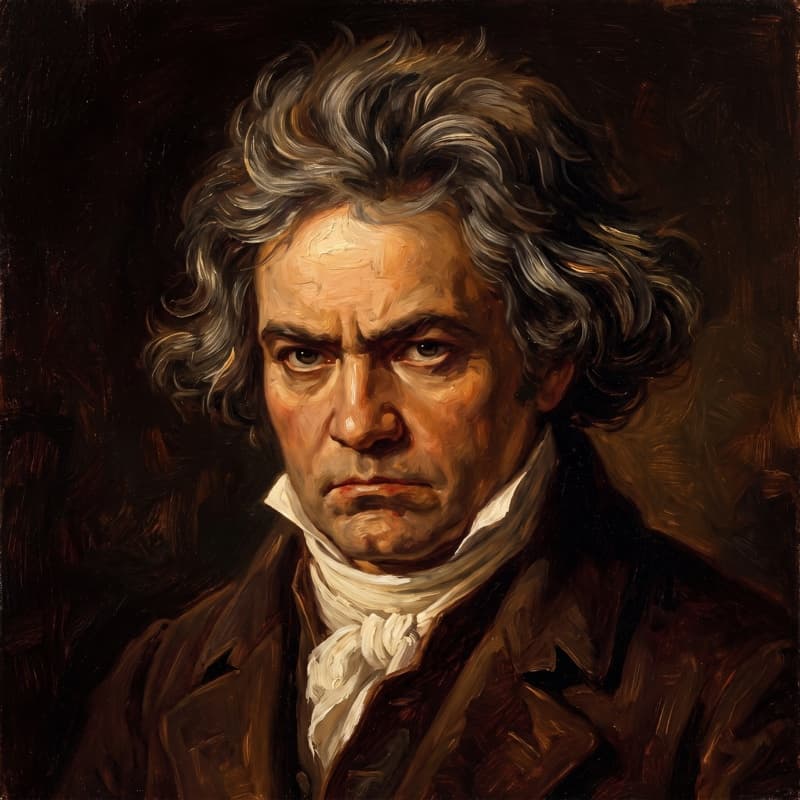
Every Beethoven fact on this page is checked against the Beethoven-Haus Bonn's own chronology, a period account of his students, or a primary letters edition, with each citation shown inline. The short version: baptized in Bonn on 17 December 1770; moved to Vienna in November 1792 to study with Haydn; his hearing began failing before he turned 30; he wrote the Heiligenstadt Testament in 1802 rather than end his life; the Ninth Symphony premiered on 7 May 1824; he died in Vienna's Schwarzspanierhaus on 26 March 1827. Details and sources below, followed by corrections to three claims that circulate as fact but aren't.
Ten verified facts
- Baptized in Bonn on 17 December 1770, one day after the birth date traditionally given for him; no birth record survives (Beethoven-Haus Bonn).
- His first publication appeared in 1782: the Nine Variations on a March by Dressler, WoO 63 (Beethoven-Haus Bonn).
- Appointed deputy court organist in Bonn in 1784, working court posts years before he was known as a composer (Beethoven-Haus Bonn).
- Left Bonn for Vienna in November 1792 to study with Joseph Haydn; the move became permanent (Beethoven-Haus Bonn).
- His hearing began declining before he was 30. In 1802, at Heiligenstadt, he set down an unsent letter to his brothers — the Heiligenstadt Testament — describing the isolation the illness caused; it was found among his papers only after his death (Beethoven-Haus Bonn).
- In 1804, on hearing that Napoleon had crowned himself Emperor, Beethoven tore up the dedication to his Third Symphony. His pupil Ferdinand Ries recorded the outburst — "Is he too, then, nothing more than an ordinary human being?... Now he, too, will trample on the rights of man, and indulge only his ambition!" — after which Beethoven "took hold of the title page by the top, tore it in two, and threw it on the floor." The work, originally titled for Bonaparte, was published in 1806 as the Eroica (The Listeners' Club).
- By 1818, conversation books were necessary, because visitors had to write out what they wanted to say to him (Beethoven-Haus Bonn).
- The Ninth Symphony premiered in Vienna on 7 May 1824, its choral finale setting Schiller's "An die Freude" ("Ode to Joy") (Beethoven-Haus Bonn).
- His last completed work carries his own handwritten question and answer. In the manuscript of the String Quartet Op. 135's finale, headed "Der schwer gefaßte Entschluß" ("The Difficult Decision"), Beethoven wrote "Muß es sein?" ("Must it be?") and answered, in the movement's faster main theme, "Es muß sein!" ("It must be!") (Wikipedia).
- Beethoven died on 26 March 1827 in Vienna's Schwarzspanierhaus (Beethoven-Haus Bonn).
Three circulating claims, corrected
"Beethoven went completely deaf." Close, but not exact. Wikipedia's biography is precise on this point: "Contrary to common belief, Beethoven never became totally deaf; in his final years, he was still able to distinguish low tones and sudden loud sounds" (Wikipedia). His hearing was devastating enough to require conversation books by 1818 — but "silent genius" flattens a more complicated reality.
"Beethoven called it the 'Moonlight Sonata.'" He didn't. He titled the piece Sonata quasi una fantasia, Op. 27 No. 2. The nickname came later, from the poet Ludwig Rellstab, who compared the first movement to moonlight on water (Beethoven-Haus Bonn).
"I shall seize fate by the throat; it shall certainly never wholly overcome me." This is the version that circulates on quote sites. Beethoven-Haus Bonn's own English rendering of the actual 16 November 1801 letter to Wegeler reads: "I want to grasp fate by the throat, it should certainly not completely bend me — it is so good to live life a thousand times" (Beethoven-Haus Bonn, digital archive) — close in spirit, different in wording, and worth using the archive's own phrasing over the popular paraphrase.
Frequently asked, quickly answered
Was Beethoven completely deaf? No — he retained some perception of low tones and sudden loud sounds even in his final years, though ordinary conversation required written notes by 1818 (Wikipedia).
Why did Beethoven tear up the dedication to Napoleon? He'd written the Third Symphony for Napoleon as a liberator; news that Napoleon had crowned himself Emperor, in 1804, convinced Beethoven he was just another ambitious ruler (The Listeners' Club).
What was Beethoven's last completed work? The String Quartet Op. 135, finished in October 1826, whose finale carries his own "Muß es sein? Es muß sein!" epigraph (Wikipedia).
Related pages
Beethoven hub · his death · verified quotes · biography.
For questions a fact list can't settle — what the Heiligenstadt Testament actually cost him to write, how the custody fight over his nephew Karl weighed against the music, what it means to conduct a premiere you cannot hear — this site hosts a conversational AI recreation of Beethoven, grounded in the sources cited above and labeled plainly as an AI persona. The facts are here; the voice is a conversation away.