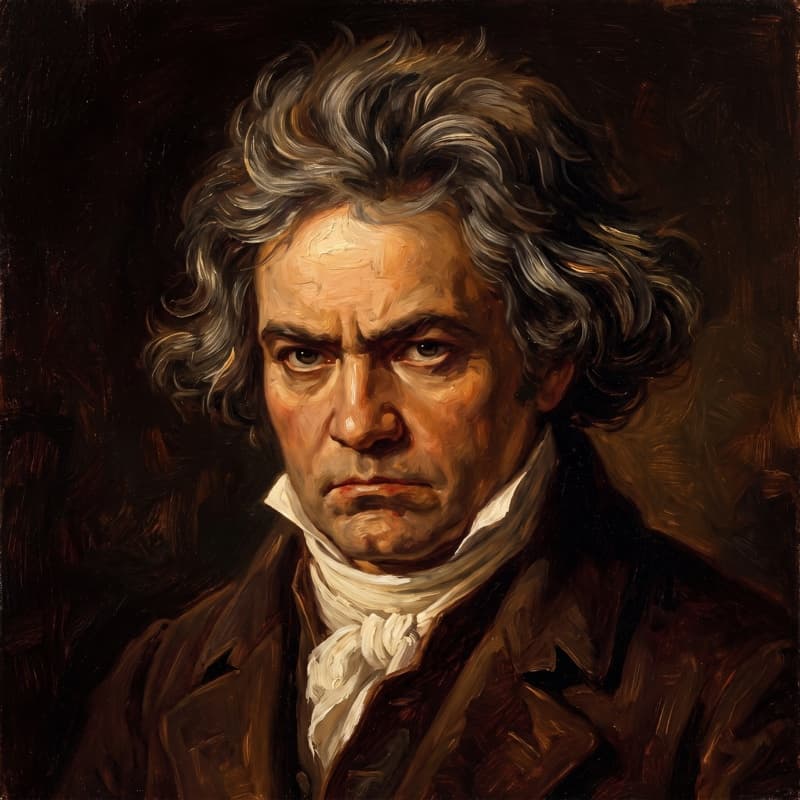
Ludwig van Beethoven was baptized in Bonn on December 17, 1770, at the Catholic Parish of St. Remigius; his birth is traditionally placed one day earlier, though no birth record survives (Beethoven-Haus Bonn). He died on March 26, 1827, in Vienna's Schwarzspanierhaus, at age 56 (Beethoven-Haus Bonn). Between those dates the documented record shows a working court musician who became a composer, a man who confronted advancing deafness in a document he never sent, and a household name who could not hear his own most famous premiere. This biography states only what the sourced chronology supports.
A working musician's apprenticeship in Bonn
Beethoven's father, Johann van Beethoven, held a post as a tenor in the Bonn court choir from 1764 (Beethoven-Haus Bonn). The son's own path into music was similarly institutional rather than prodigious in the popular sense: his first publication, the Nine Variations on a March by Dressler (WoO 63), appeared in 1782; he was appointed deputy court organist in 1784; and by 1789 he had become a member of the Bonn court chapel as a violist (Beethoven-Haus Bonn). He was a salaried court employee for years before he was a famous composer.
Vienna, Haydn, and a public debut
In November 1792, Beethoven left Bonn for Vienna to study with Joseph Haydn; the move became permanent once the French occupation dissolved the Electorate of Cologne in 1794 (Beethoven-Haus Bonn). His first public Vienna appearance came on March 29, 1795, performing a piano concerto at the Hofburg Theatre in an "academy" organized by Haydn (Beethoven-Haus Bonn).
The Eroica and the emperor
Beethoven's Third Symphony was originally dedicated to Napoleon Bonaparte. According to his pupil Ferdinand Ries, when news reached Vienna in 1804 that Napoleon had crowned himself Emperor, Beethoven "flew into a rage and cried out: 'Is he too, then, nothing more than an ordinary human being? Now he, too, will trample on the rights of man, and indulge only his ambition!'" and tore the dedication page from the manuscript (The Listeners' Club, quoting Ries; Wikipedia). The symphony was published in 1806 as the Eroica.
Heiligenstadt, 1802: deafness confronted in private
On October 6, 1802, Beethoven wrote the Heiligenstadt Testament, an unsent document addressed to his brothers Carl and Johann describing his worsening hearing loss and his choice to go on: "Art! art alone, deterred me" from ending his life (Beethoven's Letters, trans. Lady Wallace, Project Gutenberg). It was found among his papers only after his death.
A private life that stayed unresolved
In July 1812, while at Teplitz, Beethoven wrote a ten-page love letter to an unnamed "Immortal Beloved," which he never sent and whose recipient has never been conclusively identified (Wikipedia). From 1816 through 1820 he fought a protracted legal battle over guardianship of his nephew Karl — winning Karl's removal from his mother's custody in January 1816, losing sole guardianship when the case moved to Vienna's civil magistrate in 1818, then regaining custody after further struggle in 1820 (Wikipedia).
The Ninth, heard by everyone but him
The Ninth Symphony premiered in Vienna on May 7, 1824, its choral finale setting Schiller's "An die Freude" (Beethoven-Haus Bonn). Contemporary accounts describe the audience acclaiming him through five standing ovations that Beethoven, unable to hear the applause, could only see once a performer turned him toward the crowd (Beethoven-Haus Bonn exhibition). It is worth correcting a common overstatement here: Beethoven never became totally deaf, and in his final years could still distinguish low tones and sudden loud sounds (Wikipedia).
Related pages
Beethoven hub · his death · verified quotes · fact file.
Where the documents stop, this site also hosts a conversational AI recreation of Beethoven, built on the record cited above and labeled as exactly that — a stylized recreation, not the composer himself.