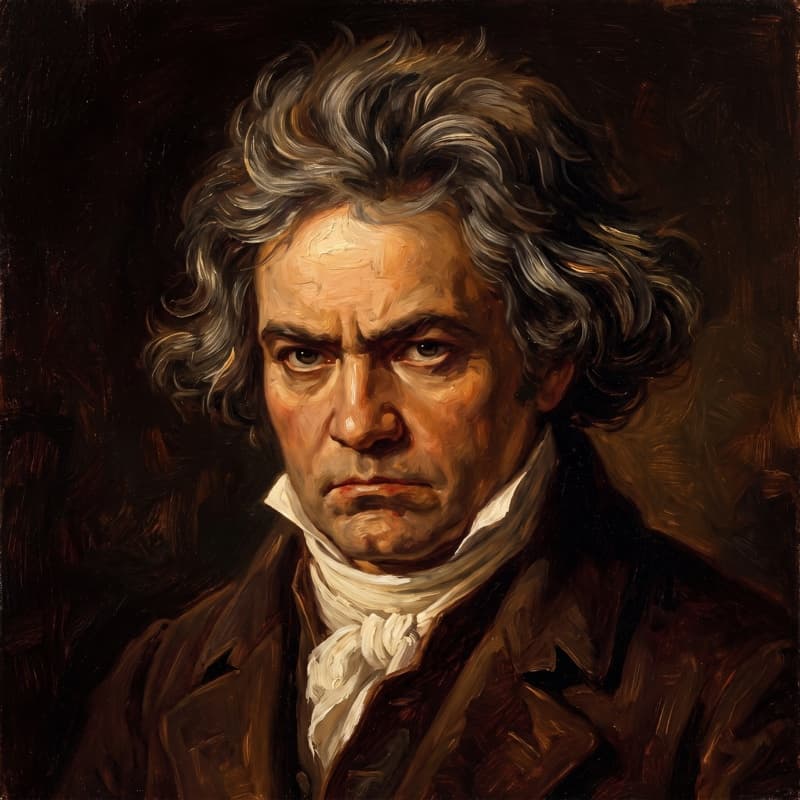
Ludwig van Beethoven died on 26 March 1827 in the Schwarzspanierhaus in Vienna, after several months of bedridden illness. He was 56. Three days later, on 29 March, Vienna gave him a funeral that the Beethoven-Haus archive in Bonn calls one of the most attended the city had ever seen, with a eulogy delivered by the writer Franz Grillparzer.
That answers the search. What's worth five more minutes is what he was doing right up until the illness closed in, and why the tidy version of his deafness — "he went completely deaf" — is slightly wrong even at the very end.
A death, not a diagnosis
The record that survives is a chronology, not a modern medical chart: place, date, months of illness beforehand, a crowded funeral, a named eulogist. It resists handing him one clean cause of death, and that restraint is worth keeping rather than papering over with a confident diagnosis borrowed from a documentary. What's actually documented is enough on its own — a long decline, a death in his own city, and a public response that tells you how the city regarded him.
The first death he wrote about
Twenty-five years earlier, in October 1802, Beethoven had already confronted a kind of death in writing. Alone in the village of Heiligenstadt outside Vienna, worsening deafness pushing him toward isolation, he addressed an unsent letter to his brothers Carl and Johann — what's now called the Heiligenstadt Testament. It reads, in places, like a suicide note that changes its own mind mid-sentence: "Art! art alone, deterred me. Ah! how could I possibly quit the world before bringing forth all that I felt it was my vocation to produce?" He put the letter away; it was found among his papers only after he actually died, a quarter-century later. Reading the two deaths side by side — the one he talked himself out of at Heiligenstadt, the one that came anyway in 1827 — says more about him than either date alone.
Working until the end
He did not stop composing when his health did. The String Quartet Op. 135, finished in October 1826, just months before his death, was his last completed work. On the manuscript of its finale, headed "Der schwer gefaßte Entschluß" — "The Difficult Decision" — he wrote his own two-line epigraph: "Muß es sein?" ("Must it be?"), answered by the movement's faster main theme, "Es muß sein!" ("It must be!"). It's his own handwriting on his own last finished score, not a critic's gloss added afterward.
Not "completely deaf"
The common shorthand says Beethoven died totally, silently deaf. It overstates the record: even in his final years he could still distinguish low tones and sudden loud sounds, and never became totally deaf. It's a small correction, but it matters here — the man who died in March 1827 was gravely ill and profoundly hard of hearing, not sealed inside total silence. The plainer version is truer than the dramatic one.
Ask him about the years that led there
Our Beethoven — an AI recreation built from the letters and the record, labeled honestly as a stylized re-creation and not a historical transcript — speaks from within his own life, not from beyond it.
Caller: Weren't you afraid, writing that letter at Heiligenstadt, that you might actually go through with it?
Beethoven: Afraid, and something worse — ashamed, that a man who could still hear music in his own skull should be so tempted to leave before writing it down. I chose Patience for my guide that year, not because I had much of it, but because the alternative was silence twice over, once in my ears and once forever. Art would not let me go. It rarely does, once it has truly taken hold of a man.
Ask him about the letter he never sent, about choosing patience when he had none, about the work he still meant to finish. More in this cluster: Beethoven's verified quotes · his biography · fact file · back to the Beethoven hub.