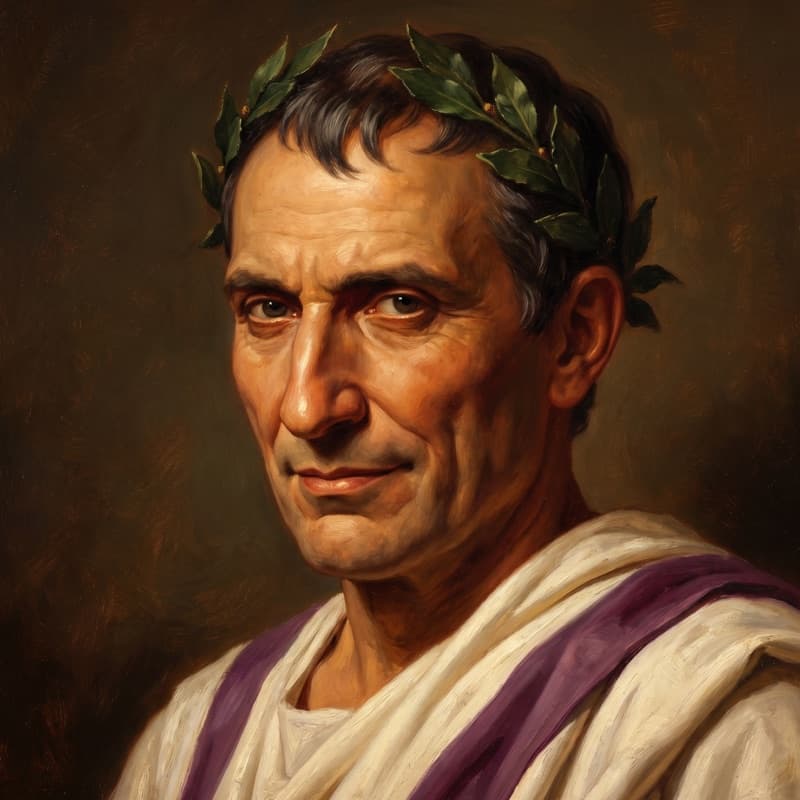
Julius Caesar was born in 100 BCE into a patrician family whose name outran its bank balance — the Julian gens, aligned with the Populares faction — and he was assassinated on the Ides of March, 44 BCE, stabbed twenty-three times by senators that included men he had spared. Between those dates: early honors, eight years of conquest in Gaul, a civil war started by crossing a small river, and a dictatorship that reshaped Rome before it cost him his life.
Ambition before power
Caesar's father held the office of praetor and governed a province in Asia, but the family's real currency was its ancient name, not its wealth. The young Caesar earned a civic crown for battlefield heroism before he held major command. Ambition shows plainest in Spain, where Plutarch reports Caesar wept before a statue of Alexander the Great and asked, "Do you think I have not just cause to weep, when I consider that Alexander at my age had conquered so many nations, and I have all this time done nothing that is memorable?" On the same trip he preferred being first in a squalid village to being second in Rome.
Consul, conqueror, and his own historian
Around 60 BCE, Caesar joined Pompey and Crassus in the alliance historians call the First Triumvirate, which carried him to the consulship in 59 BCE. What followed was the Gallic Wars, roughly 58 to 51 BCE — a campaign that built his legend and, by one modern estimate, killed or enslaved more than a million Gauls. Caesar told the story himself, in the third person, opening his Commentaries with a line every Latin student learns: "All Gaul is divided into three parts." Terse soldier's prose, and effective propaganda for his political base at home.
The Rubicon and civil war
By January 49 BCE, Caesar's standing with the Senate had collapsed, and he led his troops across the Rubicon River into Italy — an act forbidden to any general and understood as a declaration of war. Later tradition gives him a line at the riverbank: Suetonius has him say "the die is now cast," while Plutarch reports he spoke the thought in Greek — two historians' reports, not a transcript. War with Pompey followed, decided at Pharsalus in 48 BCE. Afterward, Suetonius says the placard carried in his Pontic triumph needed only three words: "I came, I saw, I conquered."
"You ask when I decided to cross that river. It was not a single moment — it was every year before it, every man who told me to wait my turn."
— From a conversation with our Julius Caesar persona. This is an AI recreation speaking in character, not a historical quotation.
Dictator in Rome
Caesar returned to Rome in 46 BCE as its unrivaled master: he expanded the Senate, broadened citizenship, and reformed the calendar. He was, by most accounts, sensitive about his baldness and prized the Senate's grant of a laurel crown he could wear constantly. He divorced his second wife, Pompeia, after a scandal touched her name, saying only, "I wished my wife to be not so much as suspected." Reforms and clemency could not manage the larger problem: power without a fixed term turned old allies uneasy, and mercy toward former enemies curdled into fear of a king in a republic with no place for one.
The life in one line
A patrician who wept over another man's conquests at his own age, conquered Gaul to outrun that shame, crossed a river to keep what he had won, and ruled Rome long enough to remake it before the men closest to him decided remaking was the problem. For how the story ends, see the death page; for claims graded by their sources, the facts page; for his genuine words, the quotes page; or the Caesar hub for the overview.
Or ask the man's likeness yourself: our AI persona of Julius Caesar, in the voice his own writing suggests — measured, allergic to modesty — answers the question this biography keeps circling: what does a man owe the people who put him first, once he no longer needs them?